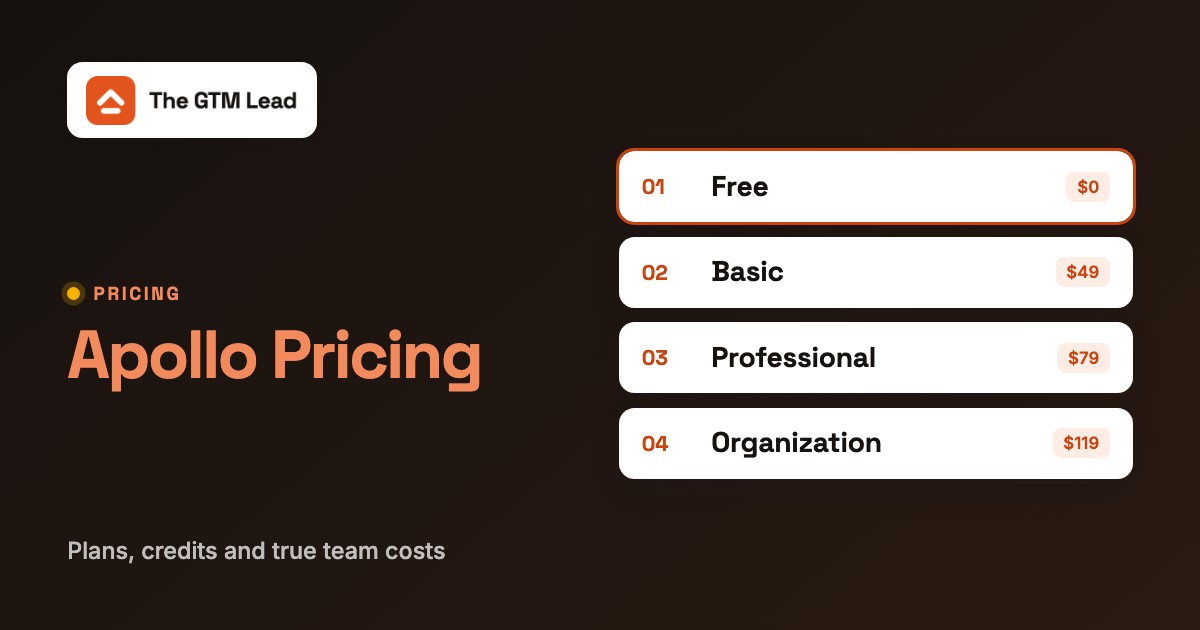
Apollo pricing starts with a Free plan, while paid subscriptions are advertised from $49 per seat per month for Basic, $79 for Professional and $119 for Organization, using annual billing. Organization requires at least three seats. Those are subscriptions, and they're not a promise that every prospecting action, phone call or bulk enrichment job will fit inside the included usage allowance.
For a revenue team, the buying question isn't just which plan a rep wants. It's how many leads can move from discovery into a CRM, through outreach and into an accountable handoff without paying for unused licenses or exhausting credits in the middle of a launch.
How much does Apollo cost per month?
Apollo costs $0 on Free and offers three publicly priced paid editions: Basic, Professional and Organization. Apollo's official US pricing page shows the paid monthly equivalents below when the team commits to annual billing. Switching the same page to monthly billing raises them to $65 for Basic, $99 for Professional and $149 for Organization, so the annual rates carry roughly a 24% discount. One caution: the structured data embedded in the page labels Basic as $49 and Professional as $99 monthly, which mixes the two billing modes. The visible grid is the one to trust. You'll want to confirm your actual cash payment schedule and applicable taxes at checkout or on the order form.
- Free$0 per month
- 900 credits per seat per year, granted monthly
- 2 sequences
- Basic prospecting filters
- CRM enrichment capped at 100 per month
- Basic$49 per seat per month, billed annually
- 30,000 credits per seat per year, granted upfront
- Unlimited sequences
- Advanced prospecting filters
- CRM integrations and automated CRM enrichment
- 14-day trial offered
- Professional$79 per seat per month, billed annually
- 48,000 credits per seat per year, granted upfront
- Unlimited lead scoring and AI research
- 4,000 minutes of call recording and AI insights
- Unlimited sequences with A/Z testing
- Organization$119 per seat per month, billed annually; minimum 3 seats
- 72,000 credits per seat per year, granted upfront
- 12 intent topics and intent filters
- Unlimited meeting events and inbound routers
- 8,000 minutes of call recording and AI insights
US advertised annual-billing rates and credits, checked October 18, 2026. Monthly billing on the same page shows $65 (Basic), $99 (Professional) and $149 (Organization, 3 seat minimum). Packaging and terms can change.
Which Apollo plan is the cheapest for a working outbound team?
Apollo Basic is, without question, the lowest listed paid edition, but Free may be useful for a founder testing account selection and outreach. Basic is where the published plan description adds unlimited sequences, advanced filters and CRM connections. The cost difference only makes sense if the team can turn those additions into a working prospecting process, and that's the test.
A common mistake is paying for a larger plan just because the annual credit number looks generous, and it's an expensive one. Credits are a shared budget for specific actions, not a count of guaranteed usable opportunities, and that's where teams get surprised. When the team struggles with contact fit or CRM duplication, more credits won't fix the input quality, and they'll only drain faster.
When is Apollo Professional worth the upgrade?
Apollo Professional is the tier you'll want to investigate when full-time sellers need 4,000 minutes of call recording, unlimited lead scoring and A/Z testing, none of which Basic includes at that level. The meaningful test is a real workflow: select an account, find the right contact, choose a sequence, make a call, sync the result and inspect reporting. A feature matrix isn't a substitute for that demonstration, and it's what vendors lead with.
Ask the seller which permissions and usage allowances apply to your account, since they're not identical across editions. A marketing operations leader may care about who may change a sequence or enrich CRM records, while an SDR manager may care about calling capacity. Those are different requirements, and they shouldn't be collapsed into the same user story.
How does Apollo Organization pricing work?
Apollo Organization is advertised at $119 per seat per month, billed annually, with a minimum of three seats. That means its published seat-price equivalent can't be modeled as a single-license purchase. For teams with several functions in the workflow, clarify whether RevOps admins and managers need paid seats or can use another permission level.
A three-seat purchase at the advertised rate has a monthly equivalent of $357 and a twelve-month base equivalent of $4,284, before any separately priced usage or services. They're arithmetic illustrations, not a vendor quote for taxes, additional credits or negotiated contracts.
How Apollo credits work and when they expire
Apollo credits pay for qualifying contact-data and other usage actions. The current pricing table publishes annual allowances per seat, while its dedicated credits FAQ says credits expire at the end of the billing cycle and don't roll over. Your team needs to know both the capacity it's granted and the actions that draw against it.
| Apollo edition | Advertised credits per seat per year | Distribution | What to check |
|---|---|---|---|
| Free | 900 | Granted monthly | Free plan feature limits |
| Basic | 30,000 | Granted upfront | Actual data and workflow usage |
| Professional | 48,000 | Granted upfront | Calling and research mix |
| Organization | 72,000 | Granted upfront | Seat minimum and administration |
Annual credit allowances look large when converted into an average monthly budget, but that simple division isn't a guarantee of how the product applies consumption. For annual plans Apollo's FAQ explains when the balance becomes available. It also says unused credits won't carry into a new billing cycle.
Does Apollo charge credits when you export contacts?
Apollo's plan grid lists CSV, CRM and API data enrichment as paid features, and its credits page says credits may sometimes be used when exporting company data. Email access costs 1 credit and a phone number costs 8 on the pricing page. The exact charge per export type isn't published there, so a revenue operations team should therefore test its planned CRM handoff, not just the interactive contact search screen.
For instance, the team can build an ICP-filtered list, save records, export the selected contacts to Salesforce or HubSpot and compare the before-and-after usage balance. Repeat for enrichment that runs automatically and for a list imported by marketing. These tasks can move data differently, even if the intended recipients are the same.
Do unused Apollo credits roll over?
Unused Apollo credits don't roll over, period, according to Apollo's official credit FAQ. The FAQ states they expire at the end of the billing cycle, including at renewal. A team shouldn't treat a yearly allocation as a permanently banked asset and should ask about any different terms in its own signed agreement.
A simple safeguard is a recurring review of consumed credits, expected next-quarter campaigns, and who is authorized to export. Waiting until the last week of a contract to discover that capacity will expire rarely leads to better purchasing decisions, and you can't get that balance back.
What increases the total Apollo bill?
Apollo's final cost depends on the user count, billing cadence, included credits and the specific outbound tools a team needs. Published seat rates are a useful baseline, but CRM enrichment volume, calling requirements and overage purchases can change the real purchase.
Seat growth. Count the sellers who work directly in Apollo and any operations users who need premium permissions. Don't assume every person on a go-to-market launch team needs a license. Messaging reviewers and customer success stakeholders may have a different role from prospecting reps.
Credit consumption. Forecast contact discovery, email verification, phone reveals, CRM sync and bulk list cleanup separately. A seller who exports a small batch after careful targeting has a very different consumption profile from a nightly enrichment job, and it's the job that drains credits.
Calling and add-ons. The US dialer uses credits, and the Advanced Dialer add-on (international, parallel and power dialing) is listed at $119 per team per month, billed annually. The Inbound add-on runs $119 (Essentials) or $639 (Max) per team per month. Confirm whether dialer features and call recording capacity match the intended motion. If a plan's included functionality can't support the actual call workflow, a cheaper seat rate won't represent the true stack cost.
Monthly vs annual commitment. A monthly price expressed as an annual-billing equivalent isn't a month-to-month cancellation right. Apollo's pricing FAQ notes that cancellations take effect at the end of the current term, and its downgrade text distinguishes access changes from any refund entitlement.
Data quality and returns. Build an internal sample of contacts your team can actually use, because that's what you're paying for. The relevant cost isn't a subscription divided by every possible database match. It's the cost of a validated record that reaches an owner and can be acted on legally and appropriately.
Apollo pricing calculator for a sales team
An Apollo Basic seat costs $49 per month as an annual-billing equivalent in the published US offer. Multiplying the rate by the number of paid sellers creates a base-plan estimate. This doesn't include overages, optional tools or applicable tax.
This is a seat subscription estimate in USD, not a quote or month-to-month checkout total. Full-year base = displayed monthly equivalent x 12. Additional credits and add-ons excluded.
For a five-seat Basic team, the published monthly equivalent is $245, or $2,940 for twelve months before additions. The same seat count on Professional would have a monthly equivalent of $395, or $4,740 per year at its published annual-billing rate. These examples show the upgrade price, not whether you'll earn more pipeline.
A sales leader should connect each incremental dollar to a bottleneck that's observable today. If the limiting factor is campaign approval or field message readiness, paying for more prospecting capacity won't create shared understanding of the launch message.
What does the Apollo API cost beyond the subscription?
Apollo's API charges some credits based on which endpoint runs and what data it returns. That means a team can't responsibly project usage by counting API requests alone. The current developer documentation says record-creation, record-update and record-listing endpoints generally consume zero credits, while enrichment and certain searches can consume credits when qualifying data is returned.
For people enrichment without waterfall mode, Apollo documents one to nine credits per person: one for qualifying demographic or email data and an additional eight if it returns a mobile phone number. Its developer documentation says unmatched or non-qualifying responses won't incur the same charge. Waterfall configurations can change the total, sometimes considerably, so the ordinary per-person range isn't an upper bound for every enabled integration.
| Apollo API activity | Published credit treatment | What the GTM operator should check |
|---|---|---|
| Create or update records | Generally 0 credits | Whether the actual endpoint is in the free group |
| Standard people enrichment | 1 to 9 credits when qualifying data is found | Email and mobile return rates |
| Organization enrichment | 1 credit per organization | Repeated refreshes and duplicate account records |
| Organization search | 1 credit per page | Pages traversed by automated jobs |
| Waterfall enrichment | Configuration-dependent | Per-vendor data charges and match behavior |
Apollo's endpoint-level credit rules don't mean all exports or contact reveals are free. Apollo's API documentation explicitly directs legacy-plan customers to inspect their own account's billing and credit description because older contracts may behave differently.
A safer way to forecast Apollo enrichment credits
A GTM team should project credit usage with an instrumented trial, and it's the only reliable method. Take a small representative batch, run the exact production endpoints, note the before-and-after balances and record how many records actually qualified for a charge. Extrapolate only from the observed mix, then set monitoring for unexpected spikes and repeated enrichment.
If a nightly CRM job processes the same account repeatedly, review idempotency before you increase the credit package. Separate the engineering question of avoiding redundant calls from the buying question of securing enough data budget. Both affect spend, but only one's fixed by changing a plan tier.
How reliable is Apollo contact data according to users?
Apollo's review discussion often points to the convenience of prospect discovery and sequencing in one interface, while some reviewers describe old contact details and the need to check phone numbers or email accuracy. Treat those comments as buyer-reported concerns, not as a measured error rate for your industry or geography. They're anecdotes, and you'll need your own sample.
Build your own qualification sample by territory, job level and company size. Then measure records that reach an actual seller, not just records returned from a search. A lower seat price doesn't necessarily lower the cost of each useful conversation when the contact or owner is wrong.
Which Apollo plan should you choose?
Apollo Free is appropriate for initial qualification work, Basic for a regular individual or small-team outbound motion, Professional for teams that need expanded seller workflows and Organization for more demanding multi-user requirements. These are scenario recommendations rather than promises that a named plan contains every capability a particular team will need.
- Test prospect search and a limited outbound motionFree, then measure the real usage constraints
- Regular prospecting, sequencing and CRM handoffEvaluate Basic and confirm actions consume credits as expected
- More extensive sales calling and reporting needsCompare Professional against a Basic trial workflow
- Team-wide governance and broader volume with several paid usersRequest an Organization quote and verify the three-seat minimum
- Approve launch messaging and confirm seller readinessTreat this separately from prospecting software; an Apollo subscription does not substitute for release acknowledgement
What should a GTM leader request in the Apollo quote?
A GTM leader should request the seat count, included credits, extra-credit rate, any dialer or other add-ons, billing terms, cancellation date, allowed integrations and data retention terms in a single document. Without them, two seemingly identical seat-price quotes may cover very different workflows.
The acceptance test is specific. Ask a rep to search and qualify one target account, pull a suitable stakeholder, make the intended CRM update, enter a sequence and demonstrate where another owner can find the record and its current state. The buyer can then map each step to the right tool, human decision and budget line.
How Apollo fits a launch-readiness workflow
Apollo's core job is prospecting and sales engagement, while release readiness is the task of getting a consistent approved message to a field team and confirming that people can use it. Apollo can help a rep execute outreach. It doesn't prove outright that the rep read a new product launch caveat or understood what not to promise.
A workable handoff has explicit roles, and it's worth writing them down. Product marketing owns the approved positioning. Sales management decides which sellers need to act on the launch. Revenue operations owns CRM data quality and sequencing. Customer success needs the customer-facing caveats. The sequence becomes actionable only after each team knows which version of the message is authoritative.
Our own product, The GTM Lead, covers that second job only. It sends one release brief to your SDRs, AEs and CSMs, who read it, acknowledge it and answer one quick check. Plans are $29 per month for Starter (50 recipients) and $79 per month for Growth (250 recipients), billed monthly, and signup needs an access code, so there's no self-serve free trial. It isn't a prospecting tool and doesn't replace Apollo.
For this reason, evaluating Apollo credits and measuring release readiness should remain separate purchasing questions. The first measures capacity and platform usage; the second asks for evidence that the people contacting buyers understand the launch. Don't confuse message delivery with readiness to answer a customer's question.
Apollo pricing FAQ
Is Apollo free?
Apollo offers a Free edition at $0 with usage and feature limits, including 900 credits per seat per year and 2 sequences. It isn't the same as an unlimited paid outbound subscription.
How much is Apollo Basic?
Apollo Basic is advertised at $49 per seat per month when billed annually. The full commitment, taxes and any extras should be checked before purchase.
What is the difference between Apollo Basic and Professional?
Professional raises the allowance from 30,000 to 48,000 credits per seat per year and adds unlimited lead scoring, A/Z testing and 4,000 minutes of call recording. A buyer should compare the exact actions and plan gates in their account.
Do Apollo credits expire?
Apollo's credit FAQ says they expire at the end of the billing cycle and don't roll over. Check your contract if your organization has negotiated terms.
Does Apollo Organization require multiple seats?
Apollo's public Organization offer lists a minimum of three seats at its published annual-billing rate. Ask for a written total before calculating the annual budget.
Can Apollo replace release enablement?
Apollo supports prospecting and outreach, but it isn't proof that each seller understood an approved release message. Keep launch acknowledgement and readiness evidence as a distinct workflow.