The best competitive intelligence software is the one that gets a rival's move in front of the person who has to answer it, before the next deal. This guide compares nine tools by that path: what each one collects, who has to curate the feed, where sellers see the result and which package you need.
Only Similarweb, Semrush and Visualping publish a dollar price, and Kompyte publishes plan limits without prices. The other five sell by quote, so we show where each one stands instead of guessing at numbers.
- tools compared
- 9
- kinds of signal source: battlecards, news, traffic, page changes
- 4
- publish a dollar price (Similarweb, Semrush, Visualping)
- 3
- describe a way for Claude or another AI assistant to reach their data
- 6
Best Competitive Intelligence Software: Our Picks by Job
Our picks match each tool to the competitive job it handles best, from battlecards inside the CRM to a cheap alert on a pricing page. The tool cards further down explain each pick and who should skip it. For a product marketing team that runs the program, Klue and Crayon are the closest fit. On a small budget, Visualping's free plan and Similarweb's entry plan are the published starting points.
 Best for battlecards inside Salesforce and SlackKlueA curator reviews an AI-filtered feed, and sellers see the battlecard on the deal or through a Slack command.
 Best for scored changes and rep updatesCrayonCompetitor page changes are scored for importance, and battlecards sit inside open Salesforce opportunities.
 Best for sizing a program by published limitsKompyteEssentials, Professional and Unlimited plans publish the number of companies, users and tracked URLs.
 Best for tagged news and filings feedsContifyMore than a million sources, tagged by company and business event, delivered as feeds, newsletters and widgets.
 Best for competitor profiles with a battlecard workspaceValona IntelligenceEach Competitor Profile is kept current by AI and carries a workspace for building battlecards.
 Best for strategy teams that need cited researchAlphaSenseA library of more than 500 million documents with watchlists, alerts and cited summaries.
 Best for knowing whether a rival's traffic is movingSimilarwebTraffic, channel mix and audience for competitor sites, from $125 per month billed annually.
 Best for content, ads and search movesSemrushTraffic & Market Pro at $289 per month, with weekly email and Slack digests of new blog posts, ads and pages.
 Best for a cheap start on page changesVisualpingA free plan and paid plans from $14 per month send a screenshot and an AI summary when a page changes.
Competitive Intelligence Software Compared
| Tool | Type | How a finding reaches sellers | Price (USD) | Rating |
|---|---|---|---|---|
| Klue | Battlecard platform | Battlecards in Salesforce, Slack and Teams, with win-loss in the same product | Quote only (demo-gated) | 4.7 (441) |
| Crayon | Battlecard platform | Battlecards embedded in open Salesforce opportunities, Slack and Teams | Quote only (demo-gated) | 4.6 (385) |
| Kompyte | Battlecard platform | Battlecards pushed to Salesforce, HubSpot, Highspot, Slack and Teams | Annual plans, no USD prices published (Essentials, Professional, Unlimited) | 4.3 (102) |
| Contify | Market intelligence platform | Newsfeeds, newsletters and dashboard widgets embedded in sales tools | Quote only (7-day free trial offered) | 4.5 (116) |
| Valona Intelligence | Market intelligence platform | Competitor Profiles with a battlecard workspace, alerts and newsletters | Quote only | 4.3 (5) |
| AlphaSense | Market intelligence platform | Cited summaries, watchlist alerts and dashboards for analysts | Quote only | 4.6 (333) |
| Similarweb | Web and traffic intelligence | Weekly email alerts and exports for analysts | From $125 per month billed annually ($199 monthly); business plans by quote | 4.4 (1,175) |
| Semrush | Web and traffic intelligence | Weekly email and Slack digests from Competitor Monitoring | Traffic & Market Pro $289 per month; SEO plans priced separately | 4.4 (4,016) |
| Visualping | Page monitoring | Alert with screenshot and AI summary, to Slack or Teams on Business | Free; Personal from $14 per month ($10 billed annually); Business from $140 per month ($100 billed annually) | No reviews yet |
 The GTM Lead Our product | Release enablement acknowledgements | Shows which SDRs, AEs and CSMs are ready to explain a product change | Access code | No reviews yet |
Prices and plans checked on vendor pages on October 19, 2026. G2 blocks automated access, so ratings are the figures G2 or Gartner Peer Insights showed in search results on the same day. Semrush's rating covers the whole Semrush product, not the Traffic & Market toolkit.
What Competitive Intelligence Software Does
Competitive intelligence software collects public information about competitors, filters it, and turns what matters into something a team can act on: an alert, a battlecard, a report or a dashboard. Gartner now covers it as its own category, Competitive and Market Intelligence Platforms, and published the first Magic Quadrant for that category in April 2026. Crayon and Contify each announced a placement; we didn't read the report itself, which sits behind Gartner's paywall.
How the Four Kinds of Tools Differ
The tools in this guide solve different problems, even though all of them are sold as competitive intelligence.
- Battlecard platforms (Klue, Crayon, Kompyte) track competitors, let a person write the takeaway and push it to sellers inside the CRM and chat tools.
- Market and news intelligence (Contify, AlphaSense, Valona) monitor news, filings and other company sources, and deliver feeds, summaries and reports.
- Web and traffic data (Similarweb, Semrush) estimate how much traffic competitors get, from where, and which of their pages and ads are moving.
- Page monitoring (Visualping) watches the specific pages you pick and tells you when one changes.
Pick by the question you need answered, because that's what separates the groups. "What did they change on their pricing page?" and "Is their traffic growing?" need different tools, and a battlecard platform answers neither on its own unless it also tracks the pages. Questions about the whole market, such as how big a segment is or which accounts are buying, need a different dataset; our guide to market intelligence software compares those tools.
How a Competitor Change Reaches a Seller in Each Tool
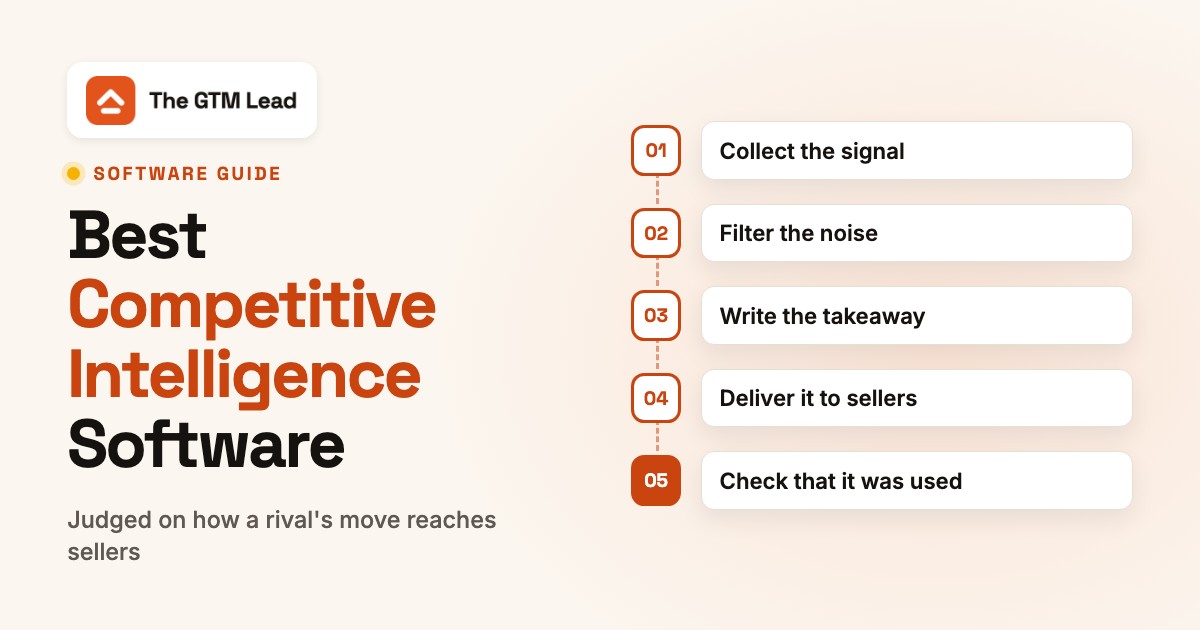
Most comparisons stop at what a tool collects. The harder part is what happens next, and it's easy to miss: someone has to filter the signal, write the takeaway, deliver it where sellers work and find out whether anyone used it. The block below shows which tools document each step. Where a vendor's pages don't describe a step, the tool is left off it.
- Step 1Collect the signal
- Klue
- Crayon
- Kompyte
- Contify
- Visualping
Breaks when a competitor changes a page and nobody is watching it - Step 2Filter the noise
- Klue
- Crayon
- Kompyte
- Contify
- Valona Intelligence
Breaks when alerts pile up and the curator stops reading them - Step 3Write the takeaway
- Klue
- Crayon
- Kompyte
- Valona Intelligence
Breaks when the change is detected but nobody says what sellers should do about it - Step 4Deliver it to sellers
- Klue
- Crayon
- Kompyte
- Contify
- Valona Intelligence
- Semrush
- Visualping
Breaks when the card lives in a tool sellers never open - Step 5Check that it was used
- Crayon
- Kompyte
Breaks when nobody knows whether sellers read the card before the call
Klue, Crayon, Kompyte and Valona cover the writing step with a battlecard builder. Contify, AlphaSense, Similarweb, Semrush and Visualping hand over a feed, a report or an alert, so someone still has to turn it into a message for sellers. Only Crayon and Kompyte describe usage reporting on their own pages: Crayon reports who uses battlecards and how that relates to closed deals, and Kompyte reports win rates with and without battlecards. If your battlecards live inside an enablement platform, our guide to sales enablement software covers the tools that host them.
What Changed in 2025 and 2026: Ownership and Naming
Several tools here changed owners, merged or gained a new competitor in the last year. Older reviews often describe the previous state, so check this table before you rely on a three-year-old comparison.
| Product | What changed | What it means for a buyer |
|---|---|---|
| Kompyte and Semrush | Semrush announced the Kompyte acquisition on February 28, 2022. Adobe completed its acquisition of Semrush Holdings on April 28, 2026. | Semrush's customer FAQ says there will be no immediate changes to services, agreements or points of contact. Kompyte's site still reads "Kompyte by Semrush" with a 2025 footer, so ask for the roadmap in writing. |
| Klue | Klue announced the acquisition of Ignition, an agentic AI platform for product marketers, on September 2, 2025. It bought DoubleCheck Research, a win-loss firm, in 2023. | The win-loss and agent features come partly from acquisitions. Ask which modules are in your package. |
| Valona Intelligence | Valona announced a merger with A-INSIGHTS, a food-industry market intelligence company, on September 4, 2025. The two together serve 400+ enterprise clients. | Competitor profiles and market sizing now sit in one company. Ask what changes in the product roadmap. |
| AlphaSense | AlphaSense completed its acquisition of Tegus, a provider of expert call transcripts and private company data, in 2024. The deal was reported at about $930 million. | Tegus content appears inside AlphaSense as Expert Insights, and expert calls are a priced add-on. |
| The category | Gartner published its first Magic Quadrant for Competitive and Market Intelligence Platforms. Crayon announced a Leader placement on April 29, 2026, and Contify announced a Visionary placement. | Vendor announcements quote the report selectively. AlphaSense and Valona also claim placements that we couldn't confirm. |
| Crayon | We found no acquisition of Crayon. Searches for "Crayon acquired" mostly return Crayon Group, a Norwegian software reseller bought by SoftwareOne, which is a different company. | Don't confuse the two when you read old news, since the results mix them up. |
How to Choose Competitive Intelligence Software
Choose competitive intelligence software by asking who'll review the feed before you ask what it collects. A tool that collects well but has nobody to curate it produces alerts that sellers learn to ignore. Then check seven things in every demo.
- Who curates. Someone has to maintain the battlecards, and the vendors describe that person differently. Klue says every output has human oversight, and Crayon's workflow ends with a CI owner adding takeaways to battlecards. In G2 reviews of Contify, one user says the vendor's team tunes alerts. Kompyte assigns a customer success manager at setup. Decide who'll own the weekly review before you compare prices.
- Where sellers see it. Klue and Crayon open a battlecard from a Salesforce deal. Kompyte pushes cards through Salesforce, HubSpot, Highspot and Showpad. Valona shows competitor news on Salesforce Account pages. Contify embeds widgets in enablement tools. Ask to see the seller's screen, not the curator's, because that's where the card gets used or ignored.
- What it collects. Pages, reviews and ads, news and filings, traffic, or only the pages you list. Klue, Crayon, Kompyte and Visualping describe tracking changes to competitor web pages, Contify's pages describe news, filings and social media, and Similarweb measures traffic.
- Package gates. SSO, API access, Slack and extra users often sit in a higher tier. The package table below shows what each vendor publishes.
- Noise control. Klue says its AI filters out roughly 87% of what it collects, which is Klue's own figure. Crayon sorts changes from high to low importance. Of course, the only test that counts is your own competitors, not a percentage.
- Win-loss. Klue sells a win-loss suite, Crayon ingests win-loss findings and reports on closed deals, and Kompyte reports win rates with and without battlecards. Contify and Valona describe win-loss notes as well. Page monitors and traffic tools don't.
- AI access. Six of the nine describe a way for Claude, ChatGPT or another assistant to reach their data: Klue, Crayon, Contify, Valona, Visualping and Similarweb. Ask which plan includes it.
- Ask who reviews the feed each week and how many hours the vendor assumes
- Ask to see the seller's screen in Salesforce or Slack, not the curator's dashboard
- Give the vendor three of your real competitors and watch what it finds in a live session
- Ask which plan includes SSO, the API, Slack and AI assistant access
- Ask how a user is counted, including people who only receive a digest
- Ask how a battlecard's last update is shown to the seller
- Ask for the quote with your seat count, competitor count and term in writing
Battlecard Platforms: Klue, Crayon and Kompyte
Klue, Crayon and Kompyte combine tracking, a place to write the takeaway and delivery to sellers. They differ in how much the vendor automates, and in how much of the pricing is public.
Klue
Best for battlecards inside Salesforce and Slack
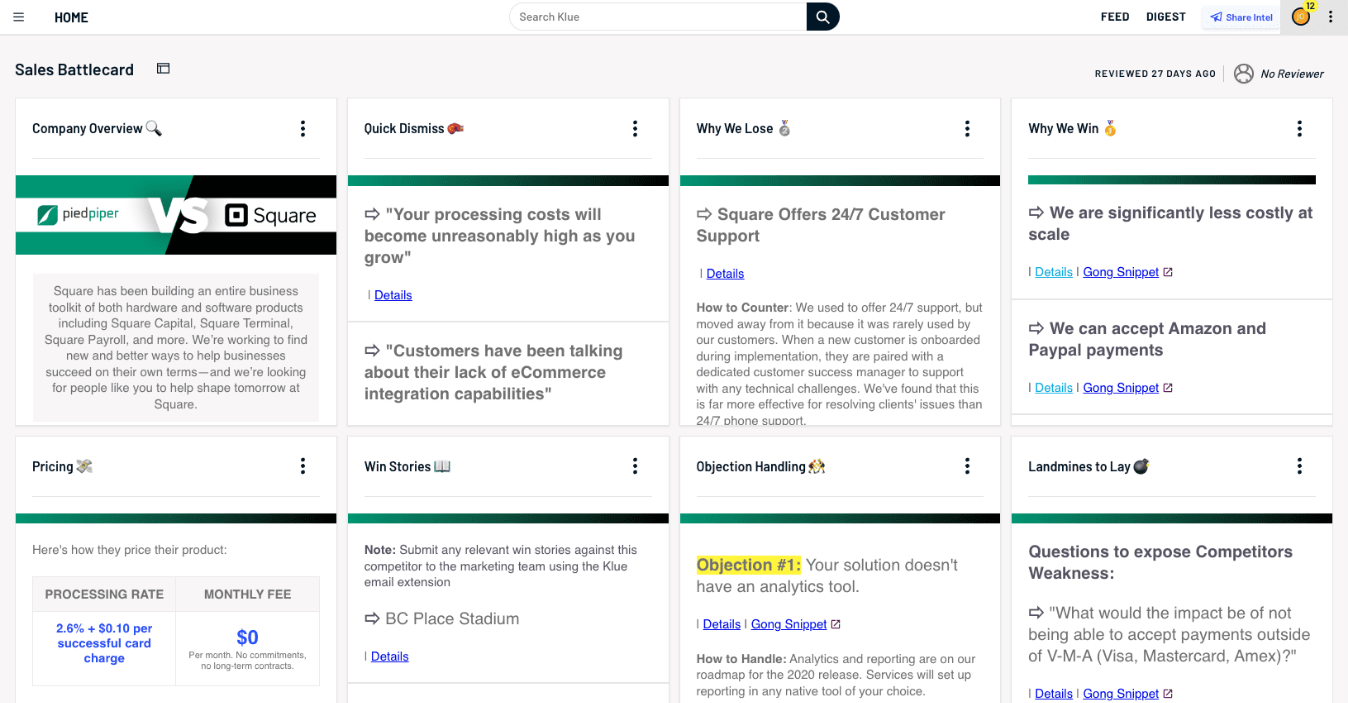
Klue is built for a product marketing team that runs the competitive program and wants battlecards where sellers already work.
Klue collects public-web signals such as website changes, reviews, social posts, press mentions and product launches. On its product page it says its AI filters out roughly 87% of what it collects, which leaves a review feed for the curator. Employees add field intel through Slack, Teams, email forwarding, a Chrome or Edge extension, or call tools such as Gong and Chorus.
The curator updates battlecards and shorter Cards, and Klue shows last-reviewed timestamps and sends update reminders so cards don't go stale. Sellers reach them in Salesforce, where adding a competitor to a deal opens the Klue battlecard panel, through a /klue command in Slack, in Teams, or in digests the team builds itself. Compete Agent, launched on June 10, 2025, builds and updates competitor profiles from the public web, sales calls, win-loss interviews and internal documents, and Klue states that every output has human oversight.
The win-loss suite sits in the same product: expert interviews, an AI Interviewer for short voice conversations, Blindspot Interviews with buyers from evaluations you weren't part of, and a Win & Loss Story Agent that builds stories from CRM data and call recordings.
- a product marketing team owns the competitive program and wants battlecards inside the CRM and chat tools sellers already use
- you want win-loss interviews and competitive intel in one product
- you have no one to review the AI-filtered feed: Klue's own model puts a human curator in the loop
- you only want page-change alerts and don't need battlecards or win-loss
- Users like
- Responsive, knowledgeable support
- Users dislike
- Integrations (Salesforce especially) take some legwork to set up
- Source: G2, 441 reviews
How it works in practice
Klue's rating of 4.7 comes from about 441 G2 reviews, as shown in G2 search results, and one G2 comparison page calls its support outstanding. A search snippet mentions some legwork to get the Salesforce integration running. Klue's pricing page offers only a demo request, so there is no list price. Klue's content can also be queried from Claude, ChatGPT, Perplexity and Glean, and product marketers can update battlecards through Claude. One roundup dates Compete Agent to 2026, but Klue's own news release is dated June 10, 2025.
- Starting price
- Quote only (demo-gated)
- Collects
- Public web, reviews, social, plus field intel from Slack, Teams, email and Gong
- Delivery
- Salesforce panel, Slack, Teams, digests
- Win-loss
- Interviews and AI-written stories
Crayon
Best for scored changes and rep updates
Crayon scores every competitor change for importance, so the curator starts with the biggest ones.
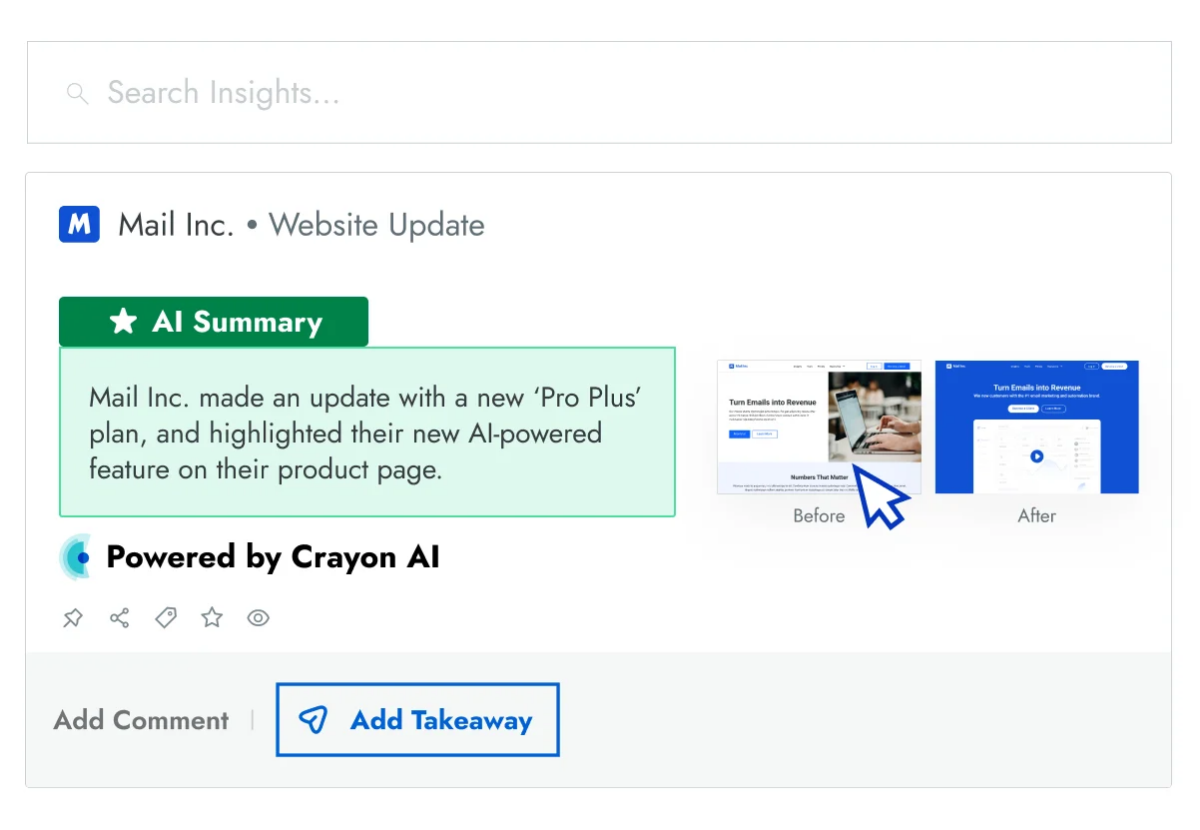
Crayon tracks before-and-after changes to competitor web pages and also captures pricing, news, support docs and customer reviews. Its GTM Insights feature pulls intel from call recordings in Gong, Chorus and Clari and from Slack, and ingests win-loss interview and survey findings. AI importance scoring and news summaries sort changes from high to low importance, and a daily email summarizes the previous day's key insights.
The curator adds takeaways to battlecards. Sparks are scheduled AI research runs, for example on competitor pricing updates, whose findings can be added to a card. Sellers see battlecards embedded in open Salesforce opportunities and in Slack, Teams, Highspot, Seismic, Showpad and SharePoint. Compete Hub gives reps updates by account, territory or competitive landscape, and Crayon Answers is a generative AI assistant for rep questions.
Crayon also measures use: it reports who is and isn't using battlecards and how that affects their performance in competitive deals, using closed-opportunity data from the CRM. In September 2025 it added a Content API, an Answers API and an MCP server so assistants such as ChatGPT, Copilot or Glean can pull battlecards, win-loss stories and profiles that you choose to push in.
- you run a dedicated competitive program and want every change scored and reviewed before it reaches sellers
- you want to see who actually opens battlecards and how that relates to closed deals
- your CRM isn't on its integration list: the one complaint in G2 summaries is CRM compatibility
- you're a small team without a CI owner to review the feed
- Users like
- Centralized competitive intel and battlecards for sales
- Users dislike
- CRM integration and compatibility
- Source: G2, 385 reviews
How it works in practice
Crayon's rating of 4.6 comes from about 385 G2 reviews in G2 search results, and the complaint in G2's summaries is CRM compatibility. Crayon says connecting a CRM takes 10 minutes at most, which is its own claim. Pricing is demo-gated, and G2's pricing page says Crayon hasn't provided pricing. Crayon announced a Leader placement in Gartner's first Magic Quadrant for the category on April 29, 2026.
- Starting price
- Quote only (demo-gated)
- Collects
- Competitor pages, news, reviews, call recordings, Slack
- AI
- Importance scoring, news summaries, Sparks, Answers
- Delivery
- Salesforce, Slack, Teams, Highspot, Seismic, Showpad, MCP and APIs
Kompyte
Best for sizing a program by published limits
Kompyte is the one battlecard platform here that publishes how much each plan covers.
Kompyte tracks competitors across websites, reviews, content, social, ads and job postings. It lists its data sources on the plans page: RSS blogs and press, job hubs such as LinkedIn and Indeed, review sites such as G2, Capterra, TrustRadius and Gartner Peer Insights, social networks, app stores and search marketing. AI filters the changes and produces AI Daily Summaries.
The plan limits are public. Essentials covers 10 companies, 25 user licenses, 50 website URLs per company and 25 search keywords. Professional covers 20 companies, 100 users, 100 URLs per company and 100 keywords. Unlimited has no company or user cap, 150 URLs per company, 200 keywords, SSO and advanced permission management. Every plan allows 20,000 mentions per month and unlimited battlecards, and a user is anyone who logs in or consumes intel by email digest, in the CRM or through an integration.
Battlecards start from templates that pull from any source, win-loss reporting shows competitive revenue and win rates with and without battlecards, and CRM and sales enablement integrations are listed as bi-directional (Salesforce, HubSpot, Highspot and Showpad), alongside Slack and Teams. Kompyte assigns a customer success manager and says insights arrive in 24 to 48 hours with full implementation in one to two weeks. Plans are annual, but no dollar prices are published.
- you want published plan limits (companies, users, URLs per company) so you can size the program before a demo
- a vendor-assisted setup with a customer success manager suits a small CI team
- you need certainty about the product's roadmap: Adobe completed its acquisition of Semrush, Kompyte's owner, on April 28, 2026
- you want a modern agent-style workflow: the vendor pages we read describe monitoring, summaries and templates
- Users like
- Real-time competitor tracking and interface
- Users dislike
- Price
- Source: G2, 102 reviews
How it works in practice
Kompyte's 4.3 comes from about 102 G2 reviews in search results. On Gartner Peer Insights, one December 2025 reviewer rated it 2.0 and called the purchase disappointing, which is a single review, not a trend. The ownership change to Adobe via Semrush is covered in the ownership table above.
- Starting price
- Annual plans, no USD prices published (Essentials, Professional, Unlimited)
- Plans
- Essentials 10 companies, Professional 20, Unlimited
- Sources
- Websites, reviews, ads, jobs, social, app stores
- Setup
- Insights in 24 to 48 hours, full implementation 1 to 2 weeks
Market and News Intelligence: Contify, AlphaSense and Valona
Contify, AlphaSense and Valona lean on external sources such as news, filings and company data. They serve strategy, market intelligence and product marketing teams more than individual sellers.
Contify
Best for tagged news and filings feeds
Contify turns a large source base into tagged feeds that different teams can follow without reading everything.
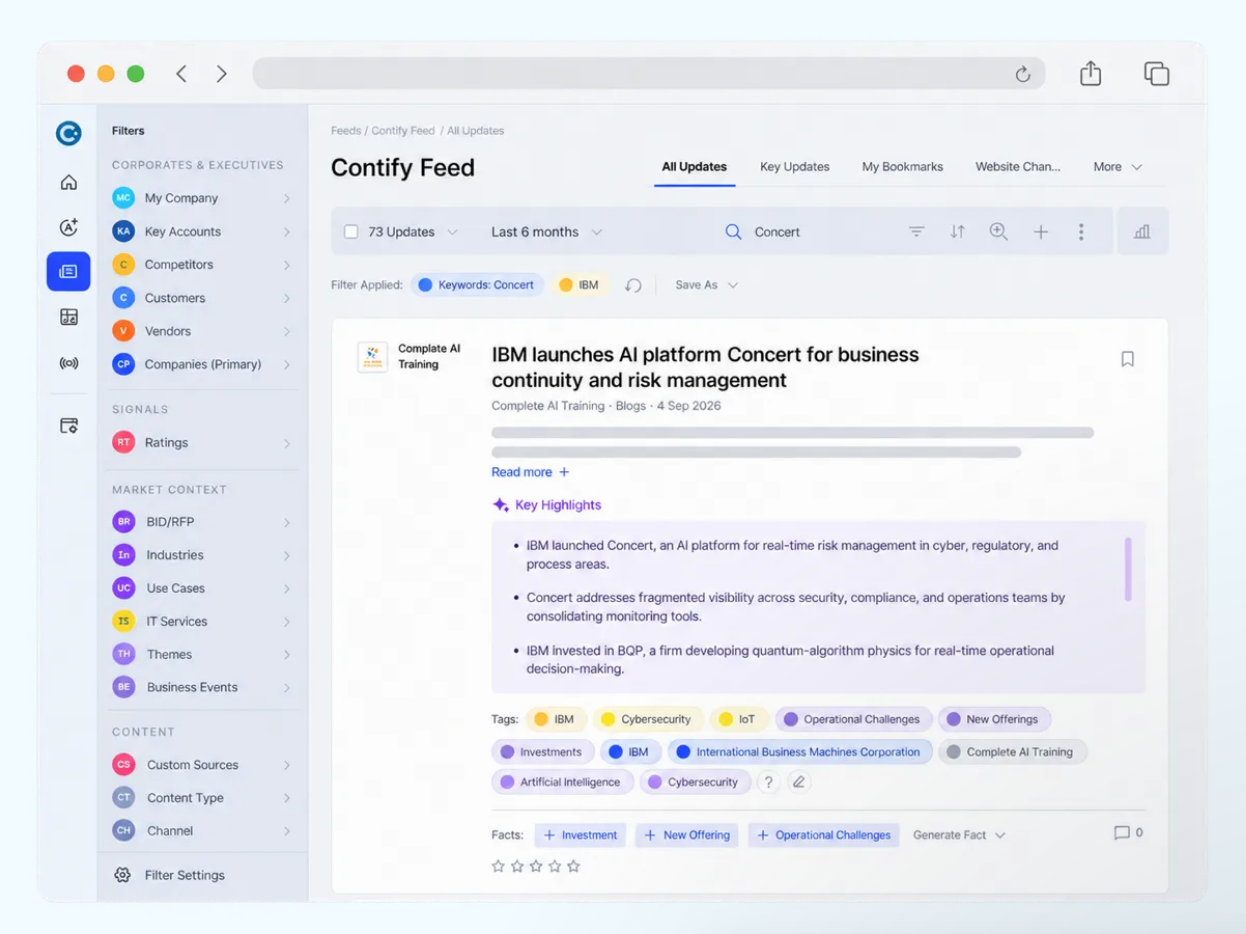
Contify collects from more than a million vetted sources, including news, company websites, SEC filings and social media, in 117+ languages, and customers can add their own sources. It covers 700,000+ companies and 100+ industry segments. Items are tagged by company, business event and location, and followed companies and topics land in a curated feed with AI-written key highlights. A separate global feed is searchable with up to two years of history.
Athena AI extracts 30+ business facts such as product launches, fundings and acquisitions, and offers a question-and-answer assistant grounded in the data you curate. Dashboards have 50+ templates, and battlecard and insight widgets update automatically and can be embedded in other systems. How battlecards are authored isn't explained on the pages we read. Alerts go to inboxes, newsletters are AI-summarized, and updates can be shared by email, Slack or Teams.
For sellers, Contify embeds dashboard widgets and content in Highspot, Seismic, Showpad and HubSpot, offers Salesforce single sign-on, ingests Gong call transcripts and has an MCP server. Contify says setup takes about two weeks with a dedicated account manager, while G2 estimates about two months.
- you track many competitors and markets from news, filings and social, and need tagged feeds for several teams
- you want signals embedded in Highspot, Seismic or Showpad through widgets
- you mainly need competitor website and pricing-page change tracking: the sources described are news, filings and social
- you want a self-serve battlecard builder: battlecards appear as dashboard widgets, and the pages we read don't explain how they are authored
- Users like
- Ease of use and support
- Users dislike
- Alert tuning is done by Contify's team, and search is harder for non-technical users
- Source: G2, 116 reviews
How it works in practice
Contify's 4.5 comes from about 116 G2 reviews in search results. One G2 reviewer says the vendor's team tunes the alerts, which saves time but limits your control, and another finds search harder for non-technical users. Contify announced a Visionary placement in Gartner's first Magic Quadrant for the category. It offers a 7-day free trial and no published prices.
- Starting price
- Quote only (7-day free trial offered)
- Sources
- 1M+ vetted sources, 117+ languages
- AI
- Athena AI extracts 30+ business facts
- Gartner
- Visionary, inaugural 2026 Magic Quadrant (vendor announcement)
AlphaSense
Best for strategy teams that need cited research
AlphaSense is a research library first, which makes it strong for public competitors and thin for sales delivery.
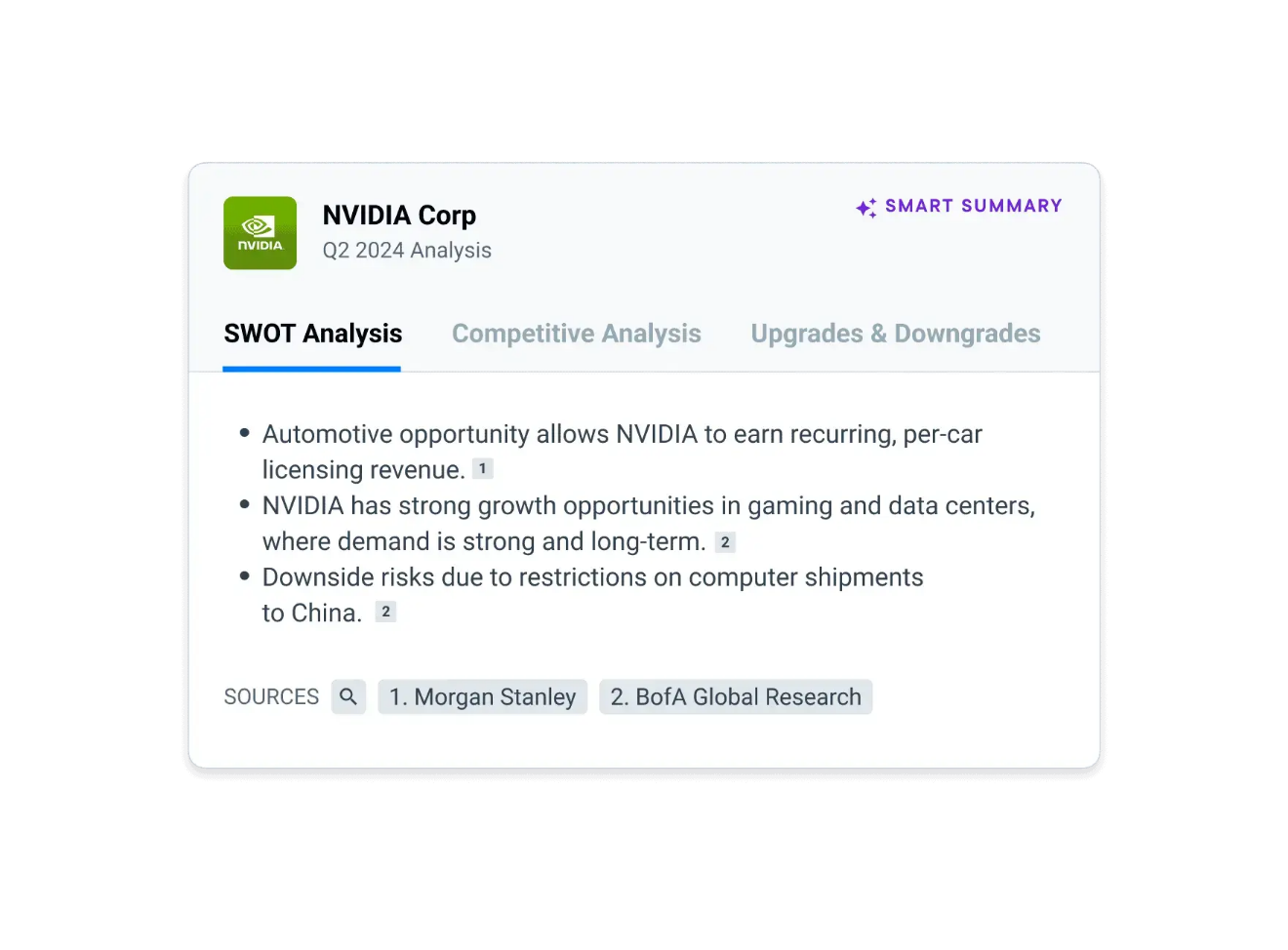
AlphaSense's content library holds more than 500 million premium documents: filings, earnings transcripts, press releases, industry research, news, company and competitor websites, and government and regulatory data. Exclusive content includes broker research and more than 300,000 expert call transcripts. You build watchlists of competitors and get real-time alerts, and Smart Summaries of earnings transcripts, analyst outlooks and expert-sourced SWOT analyses come with citations to the source text.
Generative Search and a Deep Research agent produce briefings, dashboards track competitors and trends, and work products export through PowerPoint and Excel add-ins. Two plans exist: Market Intelligence and Enterprise Intelligence, which adds AI search across your internal content. Expert calls and Canalyst financial models are add-ons.
The competitive intelligence and platform pages we read don't mention battlecards or sales enablement, so delivery to sellers means sharing items from dashboards or notebooks. Connectors cover Slack, Teams, Zoom, Gmail, Outlook, Gong and Salesforce, and HubSpot is marked as coming soon.
- strategy or market intelligence teams need filings, transcripts, broker research and expert calls with citations
- you track public competitors and want earnings-call summaries within minutes of release
- you need native battlecards or a seller-facing delivery layer: the competitive pages we read don't mention them
- you track private competitors' websites and pricing pages and have a mid-market budget
- Users like
- Semantic search that saves time on complex research
- Users dislike
- Cost, and a steep start for new users
- Source: G2, 333 reviews
How it works in practice
AlphaSense's 4.6 comes from about 333 G2 reviews in search results, and cost is the most consistent complaint. Pricing is by quote. AlphaSense says Forrester named it the only Leader in a Q3 2026 Wave for market and competitive intelligence platforms, which is a vendor claim we couldn't verify, though it's a useful sign of how the category is being marketed.
- Starting price
- Quote only
- Library
- 500M+ documents
- Plans
- Market Intelligence and Enterprise Intelligence
- CRM
- Salesforce live, HubSpot coming soon
Valona Intelligence
Best for competitor profiles with a battlecard workspace
Valona keeps one profile per competitor current and lets a team build the battlecard inside that profile.
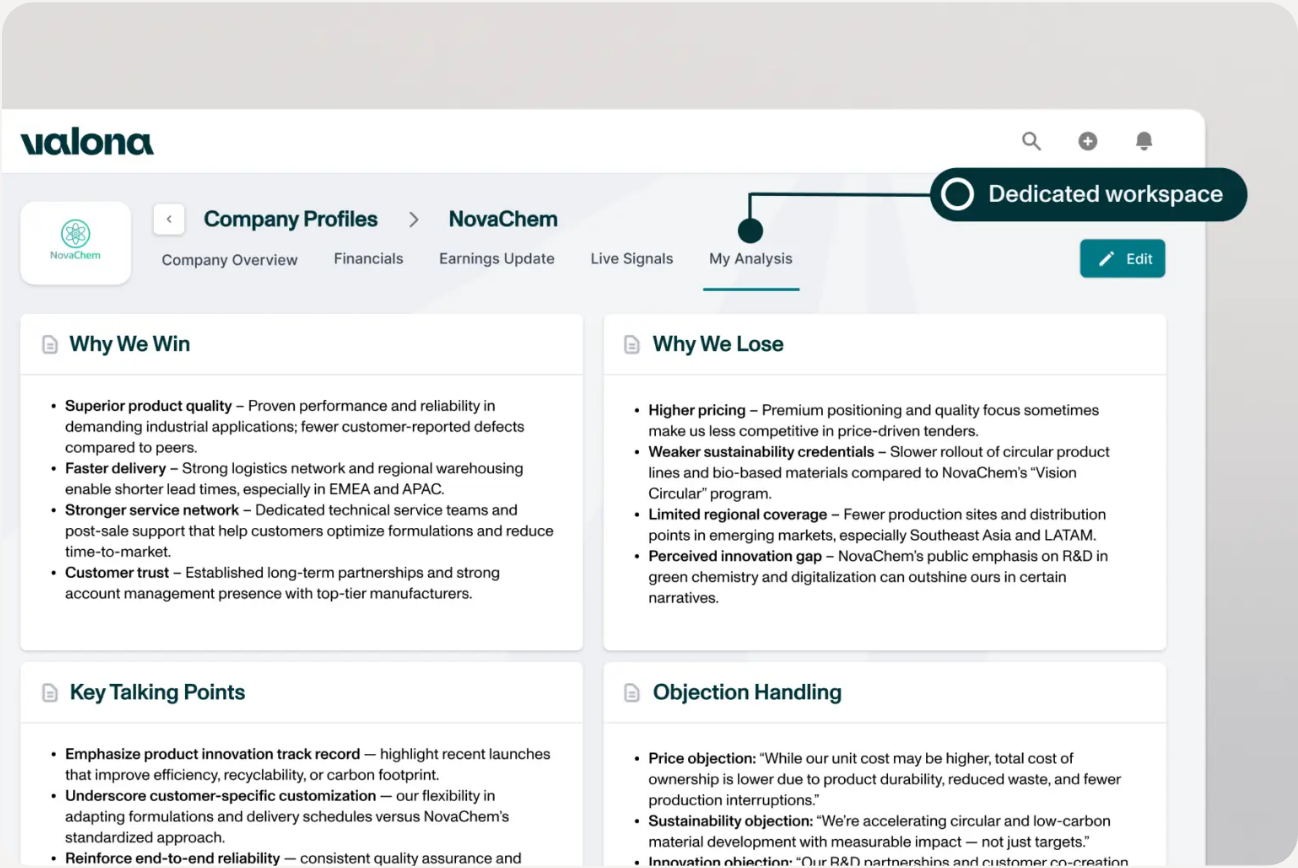
Valona monitors 200,000+ global and local sources in 115 languages, including more than 280 paywalled sources, and can add companies you request or ingest your own reports. Each Competitor Profile is continuously updated by AI, benchmarks public and private companies on one financial model and includes analyst-style AI summaries of quarterly earnings. Each profile also has a built-in workspace for building battlecards with talking points and objection handling.
Alerts from saved searches arrive weekly, daily or in real time, and drag-and-drop newsletters go to defined audiences. AI categorizes, deduplicates and filters for relevance. Valona says competitive and market intelligence teams do most of the setup, and signals can carry comments and mentions.
For sellers, Valona shows competitor news on Salesforce Account pages through an API, an RSS feed or an embedded view, and Win/Loss notes can be sent from Salesforce into Valona. It also lists Microsoft Teams alerts, SharePoint sync, Microsoft Copilot and an MCP server. Its competitive enablement page claims Slack, but the integrations page doesn't list it, so confirm before you rely on it.
- you need to benchmark public and private competitors on financials and also want battlecards inside each profile
- your sellers work in Salesforce or Microsoft Teams
- you want a sales-first product with rep adoption reporting: Valona's own comparison says Klue is oriented to sales enablement and Valona is broader
- you need Slack: the integrations page doesn't list it
- Users like
- User-friendly interface and strong answer quality
- Users dislike
- Occasional lag and freezing
- Source: G2, 5 reviews
How it works in practice
Valona has 12 reviews on Gartner Peer Insights averaging 4.6 and only 5 on G2 at 4.3, so its ratings are weak evidence, however good they look. G2 reviewers mention a friendly interface and occasional lag. Valona's own comparison with Klue says Klue is oriented to sales and go-to-market enablement while Valona is broader market intelligence. Pricing is by quote.
- Starting price
- Quote only
- Sources
- 200,000+ sources, 115 languages
- Merger
- A-INSIGHTS, announced September 4, 2025
- Delivery
- Email, Teams, Salesforce, MCP server
Web and Traffic Intelligence: Similarweb and Semrush
Similarweb and Semrush measure how competitors perform on the web: traffic, channels, audience, pages and ads. They tell you whether a rival's marketing is working, but not what their sales team says in a deal.
Similarweb
Best for knowing whether a rival's traffic is moving
Similarweb shows how many people visit a competitor and where they come from, not what the competitor changed on its pages.
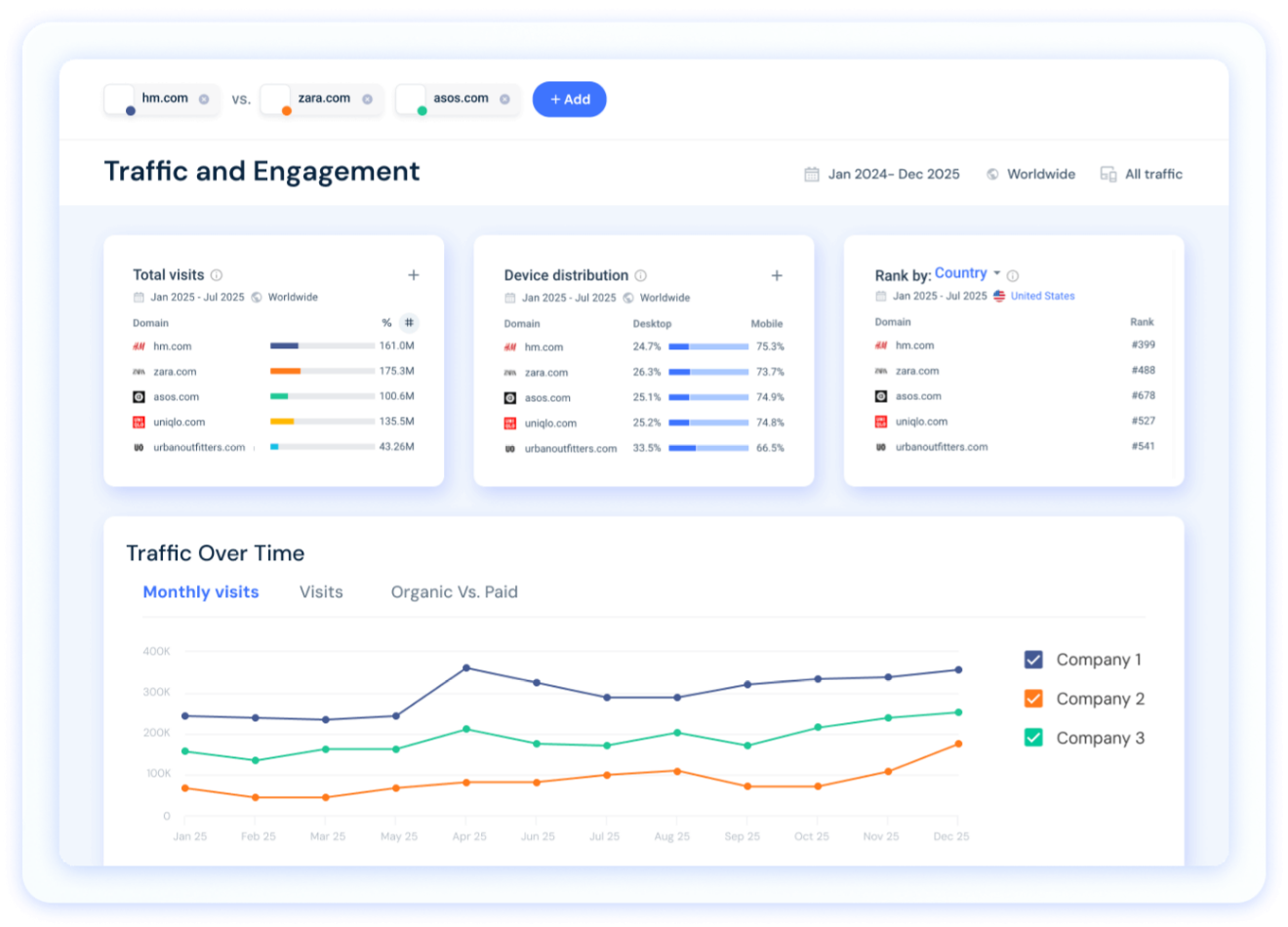
Similarweb's self-service plans cover one user. The first, Competitive Intelligence, costs $125 per month billed annually or $199 per month, with three months of history, website performance, traffic and engagement, demographics, marketing channels and Competitor Alerts. A second plan at $333 per month billed annually ($399 monthly) adds SEO intelligence and tracking for AI search answers, and a third at $542 per month billed annually ($649 monthly) adds ad intelligence, with six months of history on both.
Business and Enterprise plans are by quote. They add up to 37 months of history, coverage of 100+ countries, AI Studio for natural-language questions, AI agents, custom dashboards, competitor conversion tracking, and APIs. The API is available only in custom Business packages or as a separate purchase.
There's no battlecard builder, win-loss feature or Slack delivery in the pages we read, so a product marketer has to turn the numbers into something a seller can use. We couldn't open the help article that describes how Competitor Alerts are sent, so ask how often they arrive.
- you need to know whether a competitor's traffic, channels or audience are shifting, before building a story around it
- you want a published entry price for one user
- you need to know what a competitor changed on their pricing or product pages: it measures traffic, not page content
- you need battlecards, win-loss or Slack delivery: we found none in the sources
- Users like
- Traffic and competitor analysis
- Users dislike
- Price, and data accuracy for smaller sites
- Source: G2, 1,175 reviews
How it works in practice
Similarweb's 4.4 comes from about 1,175 G2 reviews in search results. The most common complaints are price and inaccurate data for smaller sites. That second point matters here: if your competitors are small, check the numbers against something you can verify.
- Starting price
- From $125 per month billed annually ($199 monthly); business plans by quote
- Entry plan
- 1 user, 3 months of history
- Business
- Up to 37 months, 100+ countries, APIs
- CRM
- Salesforce and HubSpot via Integrations Hub
Semrush
Best for content, ads and search moves
Semrush's competitor view is about marketing activity: which pages, ads and channels a rival is investing in.
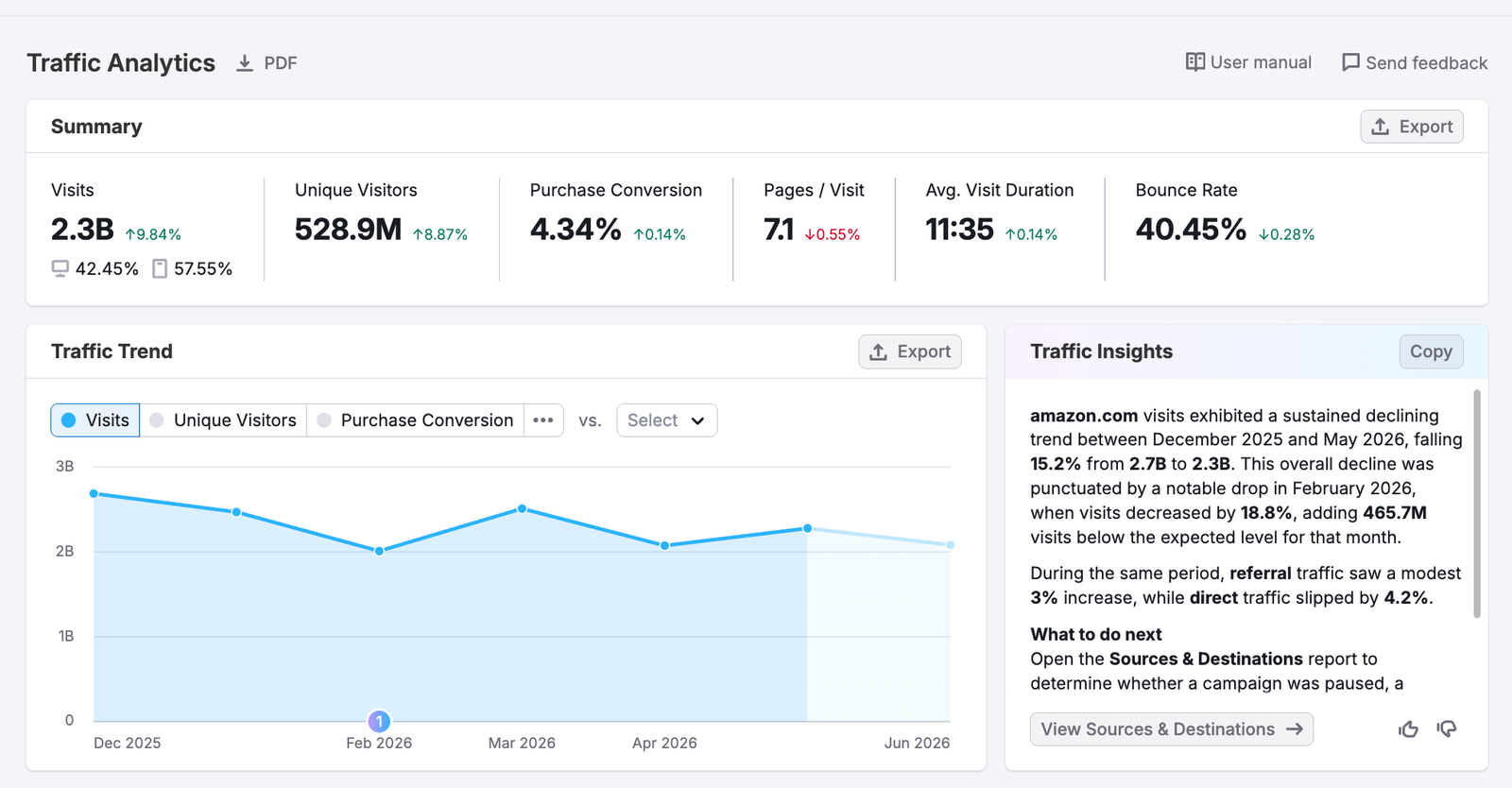
Semrush's Traffic & Market toolkit gives a snapshot of any domain's traffic, engagement and trends, channel dashboards that include AI traffic and paid and organic search, a Top Pages view of a competitor's most visited pages, and a Market Overview of key players and their growth. Traffic & Market Pro costs $289 per month for one seat and up to 3,000 requests per day, with a 7-day free trial, and a free tier shows sample domains only. Team plans with API access are by quote.
Competitor Monitoring, called EyeOn, tracks new blog posts, Google Search Ads, new pages on competitor sites and Facebook and Instagram posts. It sends weekly email notifications and can post to Slack. There's no battlecard builder, CRM sync or win-loss feature in what we read, so sellers see only what a product marketer forwards from the digest, and a weekly cadence limits how fresh it is.
- your competitive questions are about content, search and ads: new pages, new campaigns and traffic by channel
- you already use Semrush for SEO and want the competitor view in the same login
- you need page-level change tracking of pricing and positioning, battlecards or win-loss: not in the sources we read
- you want to buy before the dust settles: Adobe completed its acquisition of Semrush on April 28, 2026
- Users like
- Comprehensive SEO suite
- Users dislike
- Cost for small teams and a learning curve (whole Semrush product)
- Source: G2, 4,016 reviews
How it works in practice
Semrush's 4.4 comes from about 4,016 G2 reviews and covers the whole Semrush product, not this toolkit. Reviewers praise the breadth of the SEO suite and often mention cost and a learning curve for small teams. Adobe completed its acquisition of Semrush on April 28, 2026, which is covered in the ownership table above.
- Starting price
- Traffic & Market Pro $289 per month; SEO plans priced separately
- Pro plan
- 1 seat, 3,000 requests per day
- Monitoring
- Blog posts, ads, new pages, social
- Owner
- Adobe, since April 28, 2026
Page Monitoring: Visualping
Page monitors are the cheapest way to start. They do one thing, tell you when a page you picked has changed, and leave the rest to a person.
Visualping
Best for a cheap start on page changes
Visualping watches the competitor pages you pick, such as pricing, changelog and homepage, and tells you what changed.
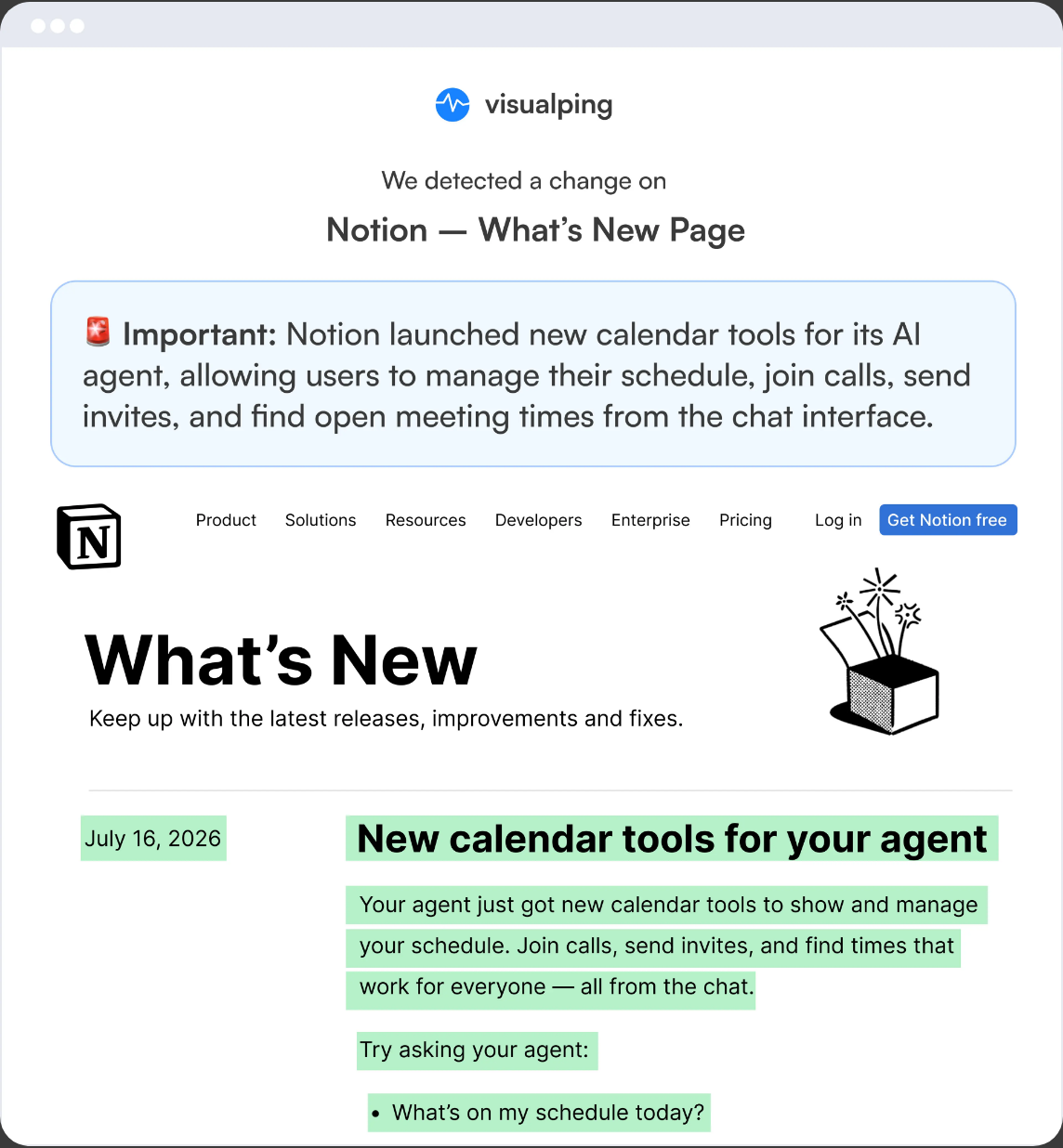
You add a competitor page, select the area to watch to reduce false alarms, and choose how often to check. Each alert carries a timestamp, the source URL, a screenshot and an AI summary that says why a change is flagged Important, judged against instructions you write in plain language. A scheduled report can merge all changes across your competitive set into one email.
The Free plan covers 5 pages and 150 checks per month, checked every 60 minutes. Personal plans run from $14 per month (or $10 per month billed annually) for 1,000 checks on 10 pages, up to $70 per month for 10,000 checks and 40 pages, with checks as often as every 2 minutes. Business plans start at $140 per month ($100 per month billed annually) for 20,000 checks, 200 pages and 5 users, and add Slack, Teams and Google Sheets. A REST API and an MCP server come with every plan, including the free one. Custom AI prompts and SSO are on the quote-only Solutions plan.
There's no battlecard builder or documented CRM sync, so someone has to translate each alert into a message for sellers.
- the questions that matter are 'did their pricing, changelog or homepage change' and you want it at a published price
- you want a free or low-cost start before buying a platform
- you need battlecards, win-loss or CRM sync: Visualping detects and summarizes changes only
- you need broad coverage without choosing pages yourself: you pick the pages and pay by check volume
- Users like
- Automation features (one Gartner Peer Insights reviewer)
- Users dislike
- Support responsiveness, a limiting free tier and a pricey premium plan (one Gartner Peer Insights reviewer)
- Source: Gartner Peer Insights, 2 reviews
How it works in practice
Visualping has no G2 rating we could confirm, because G2 blocked access and search showed none. Capterra shows 5.0 from only 2 reviews, which isn't meaningful. On Gartner Peer Insights one reviewer gave 5.0 for automation and another gave 3.0, citing slow support, a limiting free tier and a pricey premium plan. Some of Visualping's own pages disagree on details, such as the entry price of Business plans, so confirm numbers on the pricing page.
- Starting price
- Free; Personal from $14 per month ($10 billed annually); Business from $140 per month ($100 billed annually)
- Free plan
- 5 pages, 150 checks per month
- Business
- Slack, Teams and Google Sheets; 5 to 11 users
- API and MCP
- On every plan
Which Package Unlocks What, and What Does It Cost?
Only three of the nine competitive intelligence tools publish a dollar price for the product you'd use, and Kompyte publishes plan limits. The table shows where each tool stands, based on the vendor pages we read on October 19, 2026.
| Tool | Where the paid product starts | Price status |
|---|---|---|
| Visualping | Free for 5 pages; Personal from $14 per month; Slack, Teams and Google Sheets need Business | Published, per month or per year |
| Similarweb | $125 per month billed annually for one user; APIs and AI Studio need a custom Business package | Published for self-service, quote for Business |
| Semrush | Traffic & Market Pro at $289 per month for one seat; API access on a custom team plan | Published for Pro, quote for teams |
| Kompyte | Essentials, Professional and Unlimited; SSO only on Unlimited | Plan limits published, no USD prices, annual |
| Klue | Demo request only | Quote only |
| Crayon | Demo request only | Quote only |
| Contify | 7-day free trial; Athena AI plan not stated | Quote only |
| AlphaSense | Market Intelligence or Enterprise Intelligence; expert calls and Canalyst models are add-ons | Quote only |
| Valona | Modules listed (alerts and newsletters, dashboards, integrations, trend radars, earnings analysis); packages not stated | Quote only |
Is There Free Competitive Intelligence Software?
Competitive intelligence software has no free full platform. None of the battlecard or market intelligence platforms lists a permanent free plan. The free options we found are narrower: Visualping's Free plan watches 5 pages, Semrush has a Traffic & Market tier that shows sample domains only, Contify offers a 7-day trial and Semrush's Traffic & Market Pro has a 7-day trial. A free plan's enough to test whether page alerts are useful, but it won't tell you whether sellers would use them. For a small team, start with Visualping's Free plan on a few pricing and changelog pages, and add Similarweb's entry plan only if traffic matters.
How to Trial a Competitive Intelligence Tool
A demo shows the vendor's best case, but a two-week trial of a competitive intelligence tool on your own competitors shows whether the feed is useful and whether sellers read it.
- Pick the questions. Write down three questions sellers asked in recent competitive deals, such as "did they change pricing?" or "do they have this integration now?"
- Fix the competitor set. Give every tool the same five competitors and the same pages, so the alerts are comparable.
- Log every alert. For two weeks, record the time of the alert, the time the competitor actually made the change if you can find it, and whether the alert was useful, noise or a duplicate.
- Deliver three items to sellers. Send them through the tool's real delivery surface, such as the Salesforce panel or a Slack channel, and ask the sellers whether they saw and used them.
- Check the curator's time. Count the hours the weekly review takes. A tool that needs six hours a week is a cost the license price doesn't show.
- Ask for the quote last, since that's when you'll know what you need. With your numbers on alerts, noise and time, ask for a written quote for your competitor count, users and term.
Where The GTM Lead Fits
Competitive intelligence tells sellers what rivals did. It doesn't tell you whether your own revenue team can explain what you changed. After a pricing or packaging change, the step nobody tracks is which SDRs, AEs and CSMs have read the approved messaging. The GTM Lead covers that one step with a release brief, a do-not-say list and a short readiness check. It isn't a battlecard generator or a competitive intelligence tool.
FAQ
What is competitive intelligence software?
Competitive intelligence software collects public information about competitors, such as web page changes, news, reviews and traffic, filters it, and turns it into alerts, battlecards or reports a team can act on. Battlecard platforms such as Klue, Crayon and Kompyte push it to sellers, while Similarweb, Semrush and Visualping focus on traffic, marketing activity and page changes.
What are the best tools for competitor analysis?
The best tool for competitor analysis depends on the question. Klue, Crayon and Kompyte suit teams that want battlecards for sellers. Contify, AlphaSense and Valona suit teams that follow news, filings and company data. Similarweb and Semrush suit marketing questions about traffic, ads and content, and Visualping suits a cheap start on pricing and product page changes.
What is the difference between a SWOT analysis and a competitive analysis?
A SWOT analysis looks at your own strengths and weaknesses and the opportunities and threats around you at one point in time. A competitive analysis compares you with named rivals on products, pricing, positioning and results. Competitive intelligence software feeds the second one continuously, so the comparison stays current between reviews.
Is Klue a legitimate company?
Klue is a Vancouver-based vendor that sells competitive intelligence and win-loss software. It announced its Ignition acquisition on September 2, 2025, and G2 search results show a 4.7 rating from about 441 reviews. As with any vendor, ask for customer references and read the contract terms, because pricing is demo-gated.
How much does Klue cost?
Klue doesn't publish a price. Its pricing page offers only a demo request, so you need a quote. Ask what the quote includes: seats, the number of competitors, the win-loss suite and the AI agent features may be priced differently.
Is there free competitive intelligence software?
Free competitive intelligence software exists only as narrow free tiers, not as a full platform. Visualping's Free plan watches 5 pages, and Semrush's free Traffic & Market tier shows sample domains only. Contify offers a 7-day free trial. The battlecard platforms Klue, Crayon and Kompyte don't list a free plan.
Which competitive intelligence tools work with Salesforce?
Klue and Crayon both put battlecards into Salesforce deal records, and Kompyte lists Salesforce among its bi-directional integrations. Valona shows competitor news on Account pages, Contify offers Salesforce single sign-on, and AlphaSense lists a Salesforce connector. Ask each vendor to show the seller's view in your own org.