Cognism is a B2B sales intelligence platform built around one promise: phone-verified mobile numbers, backed by Do Not Call screening, for teams that sell by phone. That focus makes it a different purchase from an all-in-one outbound tool. You buy it to find the right person and reach them, but you'll run the outreach somewhere else.
This Cognism review covers what the platform does, how its phone verification works, what the vendor's own accuracy study shows, where it falls short and who should buy it. We read Cognism's product, pricing and data-quality pages, its published starting prices and public G2 feedback. We didn't buy a subscription or run a controlled accuracy test, so every performance figure below comes from the vendor or from public reviews.
- Best fit: outbound teams that call prospects and sell into Europe as well as North America.
- Main strength: phone-verified mobiles, with Do Not Call lists cross-checked across 16 territories.
- Main limit: pricing is quote-led and credit-based, and G2 reviewers flag outdated records and limited contacts.
- Buying advice: run a blind pilot on your own accounts before you sign an annual contract.
What is Cognism?
Cognism is a B2B sales intelligence provider that sells contact and company data, account buying signals and CRM enrichment to revenue teams. The vendor says more than 4,000 revenue teams use it, and its customer logos include Asana, Notion, Deel, Xero and IBM. Its sales prospecting product has two tiers, Standard and Pro, and a separate CRM Enrichment product.
In practice you work in three places. The web app is where you build target lists and personas by territory and priority accounts. A browser extension shows buying signals and contact data over LinkedIn and company websites, and lets a rep push a contact into the CRM. Exports and integrations then move the records into your CRM and sales engagement tools. Cognism also offers API and MCP access, so data can reach custom workflows and AI assistants.
The comparison people usually make is with ZoomInfo, Apollo, UpLead and Lusha. Cognism's difference is the emphasis on verified mobiles and European coverage rather than breadth of sales engagement features. If you want a head-to-head view against the enterprise incumbent, read our ZoomInfo vs Cognism comparison.
What does Cognism actually include?
Cognism's sales product comes in two tiers. Both list five included seats, and they both consume credits when a rep reveals a contact.
| Tier | Core inclusions | Added at this tier |
|---|---|---|
| Standard | Contact and company data, firmographic, technographic and signal filters, AI account research, CSV enrichment, MCP and API access | Not applicable |
| Pro | Everything in Standard | Premium mobile data, on-demand mobile verification, Bombora-powered intent data, enhanced dashboards |
Three details matter when you read that table. First, intent data is a Pro-only feature. It uses Bombora Company Surge data, and admins pick up to 12 topics from a library of more than 11,000. Second, signals such as hiring trends, funding events and job changes are part of the filter set, so you can prioritize accounts by what's changing in them, which isn't possible with a static list. You're prioritizing by change, not by size. Third, one credit reveals one contact, and looking again at a contact you've already revealed doesn't cost another credit.
The browser extension and AI search
Cognism's extension is the piece reps touch most. It surfaces the same data while a rep reads a LinkedIn profile or a company site, so a prospect found in the wild can become a CRM record without switching tabs. AI Search and the AI research tool help build lists and prepare calls. These are vendor descriptions, and the results are only as good as your targeting criteria. A vague ICP produces vague lists, whatever the tool.
CRM Enrichment
CRM Enrichment is sold separately or as an add-on. It maintains records that already sit in your CRM, and Cognism says ongoing maintenance is included and a credit is used again only when key details change, such as a job move. If your main problem is decayed CRM data rather than finding new people, price this product on its own, since you won't want prospecting seats you don't use. Our Cognism pricing breakdown covers the published starting figures.
How does Cognism's phone verification work?
Phone verification is the reason many buyers shortlist Cognism, so it's definitely worth a closer look. Cognism describes phone-verified data as a routine process that calls numbers and confirms the right person picks up. Separately, its Diamond Data page lays out five stages behind its records.
- Scoring and matching. Each data point gets a confidence score, built from press releases, websites, news, filings, registries and third-party sources.
- Data verification. Machine-learning models and testing frameworks check email addresses and mobile numbers.
- Compliance checks. Records are screened against Do Not Call lists.
- Human validation. Data scientists review outputs and correct or delete inaccurate records.
- Customer feedback loop. A popularity score based on customer usage decides which profiles get freshness and accuracy checks first.
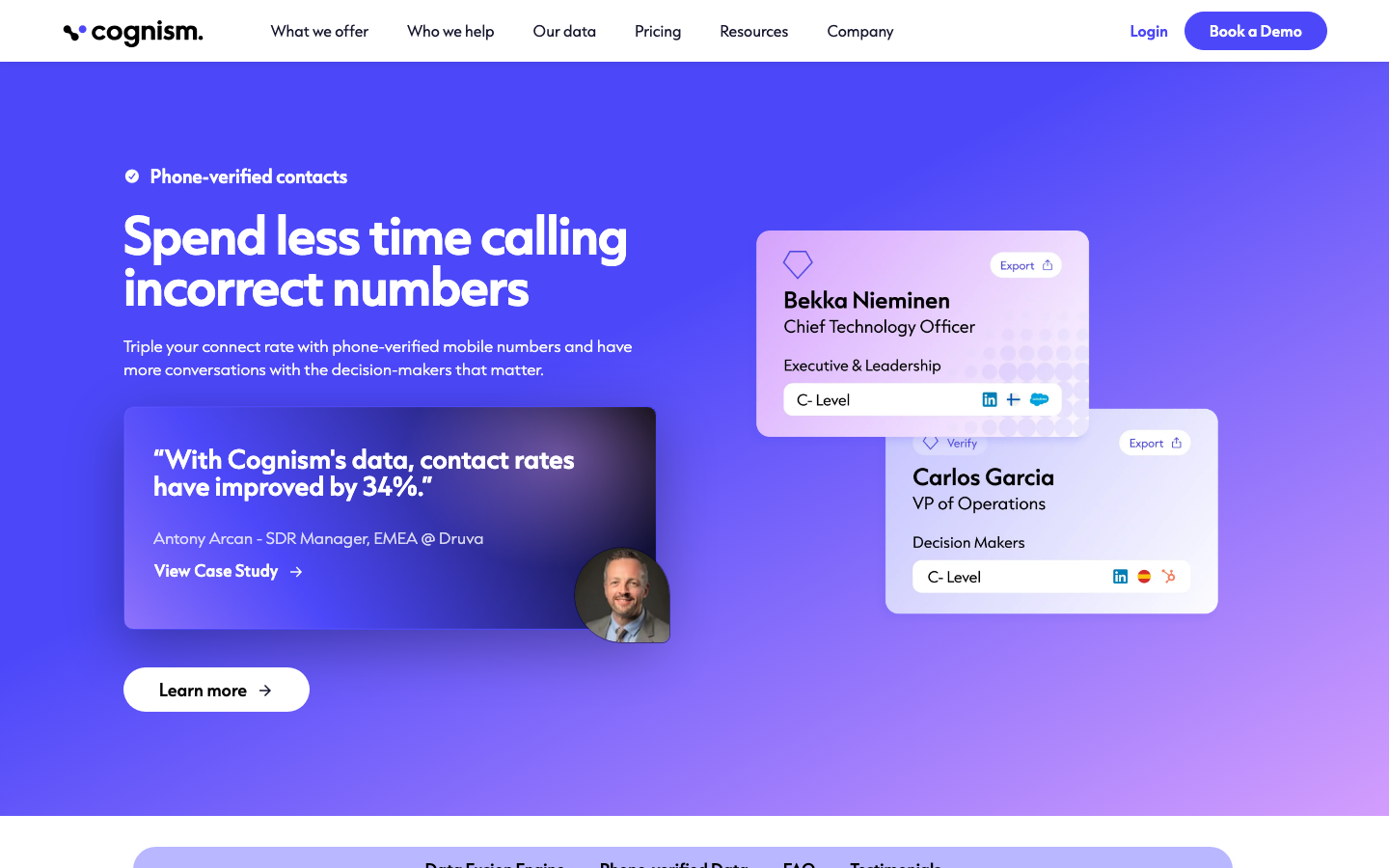
Cognism reports more than 10 million phone-verified contacts and says 95% of director-level and above contacts are refreshed every 30 days. Customers can also ask for verification of a specific mobile number on request, which the page says takes less than 48 hours; that's a vendor claim we haven't timed, and it's worth testing. On-demand verification is a Pro feature.
Keep the vendor's own framing in mind: not every contact in the database is phone-verified. A number that's simply present in the database is a different asset from one that has been called and confirmed. In the product, check how each record is labeled and when it was last verified.
What the vendor's accuracy study shows
Cognism publishes a study of 1,000 contacts' mobile numbers, which it says an independent organization ran by calling the numbers. It compares standard mobiles with Cognism's phone-verified numbers.
| Call outcome | Standard mobiles (%) | Cognism phone-verified (%) |
|---|---|---|
| Correct person picked up | 18 | 45 |
| Correct voicemail | 13 | 41 |
| Wrong number | 27 | 10 |
| Inconclusive | 48 | 14 |
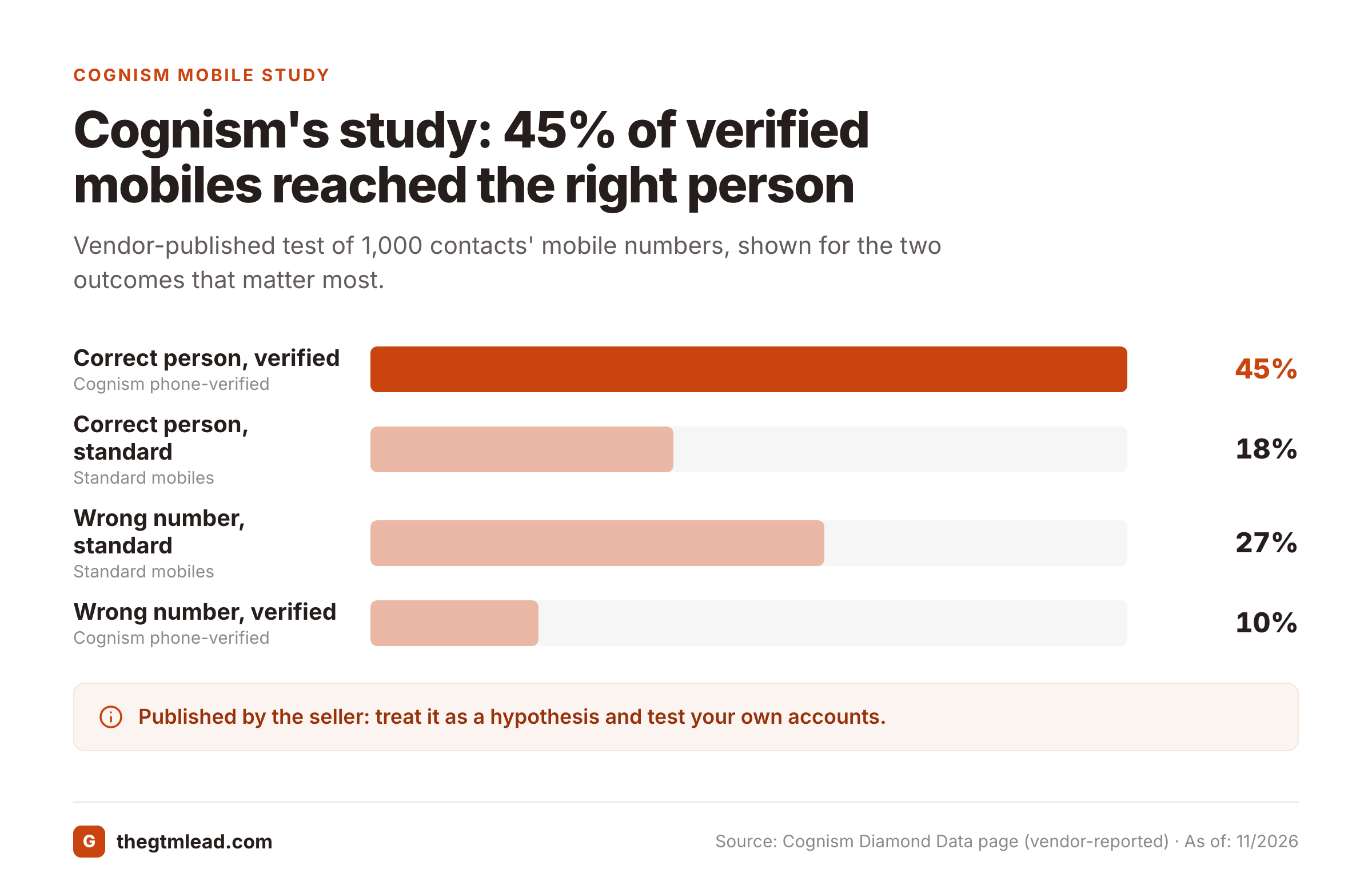
The figures are as the vendor printed them, and each column adds up to slightly more than 100%. The vendor turns the study into a headline that phone-verified numbers are three times more likely to connect, although the correct-person rows (45% against 18%) work out to about 2.5 times. Treat the claim as a hypothesis to test, not a guarantee, because it's the seller's number, and don't plan headcount around it. The study is published by the seller and the sample is a single set of contacts, so it doesn't tell you how your own regions and job titles perform. The useful reading is directional, though: verification appears to reduce wrong numbers and inconclusive calls, which are the outcomes that waste a rep's day.
How does Cognism handle compliance?
Cognism positions itself around compliance-first prospecting. Its Diamond Data page says Do Not Call lists are cross-referenced across 16 territories, naming the US, Australia, the UK (TPS and CTPS), France, Germany and other European countries, with the full list available on request. The vendor also describes its contact lists as built to be GDPR and CCPA compliant.
For a sales team that calls into Germany or the UK, DNC screening is a practical feature, not a slogan, but it's still only one control. It lowers the risk of dialing a number that's registered as off limits. It doesn't remove your own obligations, and it isn't a legal opinion. You still need a lawful basis for outreach, honest notices, a way to handle opt-outs and deletion requests, and counsel who has read your specific campaign plan. Ask Cognism for its current data processing agreement, and check that suppression lists sync to your CRM and sequencing tools.
How does Cognism perform in the field?
Cognism quotes an average pipeline increase of 20 to 40% for its customers, and publishes customer results such as a 15% conversion lift at ComplyAdvantage, a 33% pipeline gain in three months at User Evidence and a 300% jump in weekly dials at SingleStore. Those are vendor-selected stories. They show what the best outcomes look like rather than what a median buyer should expect.
Public reviews are broadly positive, with consistent complaints. On G2, Cognism holds a 4.5 out of 5 rating from 1,329 reviews, and the vendor's pricing page cites 4.7 out of 5 on Capterra. Reviewers praise verified contact data, integrations and support, though the recurring complaints are incorrect or outdated information and a limited number of contacts. Both themes match what any contact database struggles with. Records go stale, and coverage varies by region and seniority.
What are Cognism's strengths?
Phone-first workflows are the headline strength of Cognism. If most of your pipeline depends on reaching a named decision maker by phone, the combination of verified mobiles, on-demand verification and DNC screening is the clearest reason to buy.
European and global coverage. Cognism describes itself as European B2B data for global enterprise growth, with DNC coverage across 16 territories. Teams selling into Europe often shortlist it for that reason.
Signals for prioritization. Hiring trends, funding events, job changes and Bombora intent on Pro give managers a way to rank accounts before reps start dialing.
Workflow reach. The extension, CSV enrichment, API and MCP access let the same data feed research, CRM updates and AI assistants. Credits work across prospecting, Enrich and the API, according to the pricing page.
Governance for RevOps. Team-wide workflows, assigned target companies and personas and admin dashboards help a manager standardize how territories are worked.
Where does Cognism fall short?
Cognism's pricing isn't public on the main page. The pricing page lists Standard and Pro but shows no prices. Cognism has published starting figures in its own editorial material, which we cover in the pricing guide, but those are references, not quotes. A buyer can't self-serve and compare in an afternoon the way Apollo or UpLead allow, which slows evaluation.
Credits cap your usage. One credit per revealed contact means a team that works fresh territories every week can burn through an allowance. The public page doesn't state a universal price per credit, rollover or expiration rule. Ask for those in writing, since they're what turns a starting figure into a real cost.
Data freshness isn't guaranteed. G2 reviewers flag outdated information, and no vendor can promise every record's current. The 30-day refresh claim applies to director-level and above contacts, not the whole database.
It isn't an engagement platform. Cognism finds and verifies people, but it doesn't send anything. Sequencing, email deliverability and call logging happen in tools you already own or will buy. If you'd rather have one product for the whole outbound motion, compare it with an all-in-one tool such as Apollo, covered in our Apollo review.
Phone verification is a subset. The wider database includes records that haven't been phone-verified. Don't budget as if every reveal's a confirmed mobile.
How much does Cognism cost?
Cognism doesn't publish a price on its main pricing page. Standard and Pro are sold by quote. In a Cognism article updated October 5, 2026, the vendor lists Standard from $12,750 per year and Pro from $17,000 per year, and its CRM Enrichment product page says from $12,000 per year. Use these as reference points, not offers.
- StandardFrom $12,750 per year, vendor reference
- Five seats included
- Contact and company data
- Signal, firmographic and technographic filters
- AI research, CSV enrichment, MCP and API access
- ProFrom $17,000 per year, vendor reference
- Five seats included
- Everything in Standard
- Premium mobiles and on-demand verification
- Bombora-powered intent data
- CRM EnrichmentFrom $12,000 per year, product-page starting price
- Standalone or add-on
- Usage-based pricing
- Ongoing record maintenance
- Extra credits available
Starting figures are vendor-published references, not quotes. Final scope, billing and taxes require a written quote.
At those starting figures, Standard works out to about $1,062 a month and Pro about $1,417 a month across a year, but that's accounting arithmetic, not a monthly plan. Compare that with Apollo at $49 per user per month, UpLead Essentials at $74 a month or Lusha Starter at $37.45 a month, all on annual billing, and the gap is clear: Cognism is a sales-led, annual-commitment purchase, not a card-and-go tool. For the full breakdown, including credits, enrichment and what grows a quote, read our Cognism pricing guide.
How should you test Cognism before buying?
A pilot clearly shows whether the data works on your accounts, which vendor stats can't. Run it like an experiment, and don't skip the baseline, because it's what you'll compare against.
Write a baseline
Record how many correct-person conversations your reps get per week with the current data source, over a normal period.
Build a blind account list
Choose accounts across industries, employee sizes, regions and seniority levels. Don't let the vendor pick the sample; they'd choose accounts they know well.
Define a correct record
Right person, right organization, right current role. Separate missing records from wrong ones, because they cost different things.
Let normal reps work
Have representatives do their usual tasks, including reveals, calls and CRM pushes, and log every outcome the same way.
Inspect the CRM and suppression behavior
Check duplicates, field overwrites, ownership rules and what happens after an opt-out or deletion request.
Decide against thresholds
Compare correct-person conversations and cost per usable contact with your baseline, using the real written quote.
- Search my hardest target market and show matched and missing contacts.
- How does the interface label phone-verified numbers and when was each verified?
- Which verification requests are included in my order and what is the limit?
- Show the handoff into my exact CRM, including a duplicate and an outdated job title.
- What are annual credits, pooling rules, top-up price, expiration and rollover?
- Provide the entitlement matrix, support commitments and renewal language in writing.
- Provide your current data processing agreement and DNC coverage list.
Cognism versus ZoomInfo, Apollo, UpLead and Lusha
The right comparison depends on what you're buying.
| Tool | Where it leads | Where Cognism differs |
|---|---|---|
| ZoomInfo | Enterprise breadth and sales-led platform depth | Cognism puts verified mobiles and European coverage first |
| Apollo | Integrated prospecting and sequencing at self-serve prices | Cognism doesn't run sequences, but leans harder on phone verification |
| UpLead | Straightforward self-serve contact credits | Cognism is quote-led with annual contracts |
| Lusha | Lightweight lookups with annual credits | Cognism adds on-demand verification and intent data on Pro |
For a closer look, our ZoomInfo review and Apollo review cover those two platforms. Use the same account sample for every vendor so it's a comparison of coverage and correctness, not database size on a marketing page.
What should product marketing own when sales uses Cognism?
Better data gets the right person on the phone, yet it doesn't tell the rep what to say. Before a campaign goes live, product marketing should hand sales a brief with the target buyer, the customer problem, approved proof and language reps mustn't use. Without it, a verified mobile just delivers an unprepared call faster.
A product launch readiness checklist formalizes that handoff across SDRs, account executives and customer success. Treat data quality and message quality as two separate jobs.
Who should buy Cognism, and who should skip it?
Consider Cognism if you run phone-led outbound, sell into Europe or across several regions, have a defined ICP and can assign someone to own CRM rules and data governance. Pro makes sense when on-demand verification and intent signals would change which accounts your team works first.
Be cautious if you only need occasional lookups, want a public price you can buy with a card, or expect one product to cover sequencing and deliverability as well. A self-serve alternative can show your real usage pattern before you commit to an annual contract.
Skip it for now if your team hasn't yet settled on a target audience. Fix targeting before buying another data source, because no database can rescue a fuzzy ICP.
Final verdict: is Cognism worth it?
Cognism deserves a place on the shortlist when reaching named decision makers by phone is a recurring problem. Its phone-verification routine, five-stage data process, DNC screening across 16 territories and signal filters give buyers specific capabilities to test, and a G2 rating of 4.5 from more than 1,300 reviews suggests most users are satisfied. The limits are just as concrete and they're easy to check: quote-led annual pricing, credit consumption and the usual freshness complaints.
Our editorial verdict is a conditional fit for phone-led outbound teams, not a universal recommendation. Buy after a pilot that proves the right contacts are reachable on your accounts and the written quote fits your volume. If the pilot misses the agreed thresholds, compare an alternative on the same evidence instead of upgrading on feature promises.
What is Cognism used for?
Cognism is used for B2B prospecting. Sales teams build target lists, reveal contact details such as phone-verified mobiles, prioritize accounts with signals and push records into a CRM.
Is Cognism data accurate?
Cognism publishes a study of 1,000 mobiles in which 45% of its phone-verified numbers reached the correct person, against 18% for standard mobiles. That's a vendor-published result, and G2 reviewers also mention outdated records, so test a sample from your own market.
How much does Cognism cost?
Cognism's pricing page shows no prices. A vendor article updated October 5, 2026 lists Standard from $12,750 and Pro from $17,000 per year, and CRM Enrichment starts from $12,000 per year. Get a written quote.
What is the difference between Cognism Standard and Pro?
Cognism Standard and Pro both include five seats and core contact data. Pro adds premium mobile data, on-demand mobile verification and Bombora-powered intent data.
Does Cognism comply with Do Not Call rules?
Cognism says it cross-references Do Not Call lists across 16 territories. You remain responsible for lawful outreach, so have counsel review your campaigns.
Does Cognism send emails or run sequences?
No. Cognism supplies data and exports it to your CRM and sales engagement tools. Sequencing happens elsewhere.