What is a sales readiness checklist?
A sales readiness checklist is a gate that verifies whether a sales team can sell a specific offer accurately, confidently and within approved operating rules. It brings together positioning, audience selection, product knowledge, discovery, demonstration, objections, commercial approvals, systems and manager coaching. Each line needs observable evidence, such as a role-play, a reviewed call, an approved proposal or a correctly completed CRM record.
Readiness isn't the same as attendance at training. A representative can finish a course but still not know how to explain the product to a real buyer. You'll use the checklist before a launch, a territory expansion, a new hire ramp, a major messaging change or a sales process redesign. The aim's to expose gaps while they're still cheap to fix.
This guide is a working framework, not a benchmark study, and it doesn't pretend otherwise. Counts in the tracker, such as three objections per rep, are starting points you'll want to adjust to your own deal cycle and risk profile.
- Give every gate one accountable owner and one piece of observable evidence. Group approval means nobody's able to unblock anything.
- Test skills with role-plays, call reviews, sample proposals and CRM test records, not course completions.
- Separate critical gates (accurate claims, quote approvals, handoff) from improvements that can wait until after launch.
- Never turn the scorecard into one percentage. One unresolved compliance gap outweighs ten finished minor tasks.
- Record a Go, Conditional go or No go decision with an approver, the checklist version and a next review date.
Who owns the readiness decision?
Assign a single accountable owner for the whole checklist, usually the revenue enablement lead or the sales manager, and give subject matter experts authority over their own requirements. The launch approver, who may be the same person or a senior sponsor, makes the final call. Avoid a vague group approval. When everyone owns a gate, nobody's sure who can unblock it.
| Function | What it signs off | Typical evidence |
|---|---|---|
| Product marketing | Positioning, claim register, competitive statements | Approved messaging sheet, dated source links |
| Solutions lead | Technical explanations and demonstration paths | Demo script, environment check |
| Revenue operations | CRM stages, routing, reporting, price source | Test record, dashboard reconciliation |
| Finance | Discount limits and approval path | Approval matrix |
| Legal or security | Contract boundaries, security routing, shared documents | Routing map, link check |
| Enablement lead | Discovery guide and objection library | Question guide, library |
| Implementation lead | Handoff fields | Handoff template, accepted example |
| Sales managers | Rep-level capability | Scorecard with date and evaluator |
| Launch approver | The final go or no go call | Decision record |
Record the name, evidence link, due date and decision for each requirement, so there's a trail when someone asks why a gate passed. A clear escalation route also keeps last-minute launch pressure from quietly overriding critical controls.
Which gates belong on a sales readiness checklist?
Nine areas need a written standard: audience, messaging, discovery, demo, objections, commercial rules, operations, security and procurement, and post-sale handoff. The tracker later in this guide turns them into 24 rows and adds two more, a manager-observed scenario and the launch decision record, for 26 in total. The sections below explain what passing looks like in each of the nine areas.
Start with the buyer and the problem
Before reviewing sales assets, define the customer problem and the buyer most likely to experience it. Write an ideal customer profile from firmographic, operational and trigger criteria rather than a broad industry label. Separate the economic buyer, the daily user, the technical evaluator and the procurement stakeholder.
Explain the pain in the customer's language, what happens when it's ignored and what measurable improvement the offer is meant to support. Then ask each rep to pick a good-fit account and a poor-fit account from short scenarios. If they can't explain why a prospect is unsuitable, either the qualification rules are too weak or the training missed the point. Fix whichever it is. Check that outbound sequences, discovery questions and account lists all use the same audience definition.
Confirm positioning and approved claims
Give every representative a concise positioning statement that names the audience, the problem, the differentiated approach and the intended outcome. Keep a claim register that separates approved facts, customer-specific examples, assumptions and statements that need verification. Include a source and an owner for product capabilities, security claims, integration promises and commercial terms.
Train reps to say that a feature needs confirmation instead of inventing an answer. It's a small habit that prevents big problems. Test positioning with a short recorded explanation. The rep should describe the offer without jargon, unsupported superlatives or a feature dump. Then review website copy, pitch decks, emails and demo narration for contradictions.
Prepare discovery and qualification
Readiness means you're able to run a conversation, not only deliver a presentation. Provide discovery prompts covering the current workflow, business impact, urgency, stakeholders, the buying process and success criteria. Define what evidence an opportunity needs to advance, and what should trigger disqualification.
Ask reps to practice follow-up questions when a prospect gives an ambiguous answer, since that's where discovery usually breaks. Before proposing a solution, a rep should summarize the problem and confirm it with the buyer. Check that qualification notes land in the right CRM fields, not in private documents where nobody else can find them. Judge the quality of the reasoning, not the number of questions asked. A good discovery call's responsive and structured without sounding like a survey.
Validate the demo or product explanation
Create a demonstration path aligned to a buyer use case. Specify the starting state, the workflow shown, the expected outcome and any limits of the environment. Make sure sample data is permitted and doesn't expose real customer information. That's a quick check that's easy to skip.
Reps should be able to explain what they're showing, why it matters and what they'd do if the environment fails. That's the part scripted demos never test. For technical products, define when a specialist must join and which questions need follow-up. A simulated buyer who interrupts, changes priorities or asks about an unsupported capability makes a good test. Score clarity, accuracy, relevance and how gracefully the rep recovers. A polished scripted demo isn't enough evidence of real-world competence, and it's easy to fake.
Build objection and competitor guidance
Collect objections from actual conversations and sort them by urgency, budget, switching effort, implementation risk, security and organizational fit. For each one, provide a clarifying question, an approved response and a next step. Competitive battlecards should stick to verifiable differences and buyer tradeoffs. They shouldn't disparage anyone.
If competitor pricing or capabilities haven't been checked against current primary sources, label them unverified and keep them out of customer-facing material. Role-play difficult objections with managers who vary the scenario, so reps can't lean on a script. The rep should listen actively and not treat every objection as a cue for a rehearsed rebuttal. An unresolved concern can be a legitimate reason to slow a deal down, and it's better to hear it now than after signature.
Check pricing, proposals and approvals
Reps need to know how to get an accurate quote, not memorize numbers that may change. Document the current source of truth for price lists, packaging, minimum commitments, billing frequency and commercial exceptions. Show which discounts need approval and how that approval's recorded.
Ask for a sample proposal with the correct scope, assumptions, implementation responsibilities, validity period and handoff details. Watch the wording on price: an annual-billed monthly equivalent isn't a month-to-month price, and promotional offers need separating from renewal pricing. Where commercial details are confidential or unavailable, point the rep to the authorized quoting workflow. A passed gate here means the rep can move through the process safely and explain uncertainty clearly.
Test the CRM and operating workflow
Walk a sample lead from creation through qualification, opportunity progression, proposal, closed outcome and post-sale handoff. Confirm lead ownership, required fields, stage exit criteria, activity logging and next-step discipline. If a stage's exit criteria are fuzzy, the reports won't be trusted either. Make sure duplicate records, missing contacts and wrong account associations have an escalation path, so nobody's guessing who fixes them.
Revenue operations should test dashboards against known sample records and verify that required integrations work in the target environment. Reps should run the workflow themselves instead of watching a screen share, because that's where the gaps show. Keep a screenshot or a test-record link as evidence where that's permitted. The point's to avoid a team that has a ready pitch but can't reliably route, track or transfer the deal.
Prepare security and procurement responses
Buyers may ask for security documents, privacy information, accessibility details, insurance certificates or procurement forms. Sales reps should know where approved materials live and who's answering specialized questions. They shouldn't make independent compliance guarantees.
Build a routing map for security review, legal redlines, vendor onboarding, data processing terms and unusual customer requests. Test whether a rep recognizes a question that needs an expert, instead of improvising. Keep document access controlled and confirm that shared links point to the current approved versions. Readiness here means the rep recognizes the request, collects the context and hands it to the right team with a clear response expectation.
Define post-sale handoffs
A closed deal isn't a successful outcome if the implementation team doesn't have the context to deliver. Specify the handoff fields: purchased scope, stakeholders, agreed success criteria, promised dates, dependencies, open risks and exceptions. Identify who owns the customer introduction and what has to happen before implementation begins.
Review one example opportunity and ask the rep to produce a complete handoff. The receiving team then says whether it's usable. Avoid undocumented promises made in email or on calls that don't appear in the final agreement. Implementation teams then find them too late. The checklist should show which statements are commitments and which are exploratory ideas. A reliable handoff protects customer trust and cuts preventable rework.
Copyable sales readiness checklist
Use this tracker in a shared spreadsheet or project tracker. The roles shown are examples. Replace them with named people, and add columns for the due date and any blocker. Add rows for your offer, and drop a row only when you can show it doesn't change the launch decision.
Sales readiness checklist tracker
Copy the rows into your tracker and replace the role names with people. Set the status to Not started, In progress, Demonstrated or Blocked. Mark Demonstrated only when the evidence column links to something a reviewer can open.
| ID | Area | Requirement | Owner role | Evidence | Pass test | Status |
|---|---|---|---|---|---|---|
| A01 | Audience | Ideal customer profile and exclusion criteria written | Product marketing | Approved profile | Rep names one good-fit and one poor-fit account from short scenarios and explains why | Not started |
| A02 | Audience | Buyer roles mapped: economic buyer, daily user, technical evaluator, procurement | Sales manager | Stakeholder map | Rep identifies each role in a sample account | Not started |
| A03 | Audience | Account lists and outbound sequences use the same audience definition | Revenue operations | List filter and sequence audit | No active sequence targets an excluded segment | Not started |
| M01 | Messaging | Positioning statement approved | Product marketing | Approved statement | Rep explains the offer in their own words, without jargon or a feature dump | Not started |
| M02 | Messaging | Claim register current, with source and owner per claim | Product marketing | Register | Every claim in the deck, site and email templates traces to a register row | Not started |
| M03 | Messaging | Do-not-say list and confirmation path | Product marketing | List and escalation contact | Rep answers an unlisted capability question with a confirmation step, not a guess | Not started |
| D01 | Discovery | Discovery question set approved | Enablement lead | Question guide | Role-play covers workflow, impact, urgency, stakeholders, buying process and success criteria | Not started |
| D02 | Discovery | Qualification and disqualification criteria defined | Sales manager | Criteria document | Rep disqualifies a poor-fit scenario and states the reason | Not started |
| D03 | Discovery | Qualification notes stored in the right CRM fields | Revenue operations | Test record | Notes appear in CRM fields, not in private documents | Not started |
| P01 | Demo | Demo path written for a buyer use case | Solutions lead | Script with starting state and expected outcome | Rep runs the path while a simulated buyer interrupts and changes priorities | Not started |
| P02 | Demo | Environment and sample data approved | Solutions lead | Environment check | No real customer data's visible and a fallback works if the environment fails | Not started |
| P03 | Demo | Rule for when a specialist joins | Solutions lead | Written rule | Rep names which questions need a specialist and knows how to request one | Not started |
| O01 | Objections | Objection library with clarifying question, approved response and next step | Enablement lead | Library | Rep handles three varied objections without reciting a rebuttal | Not started |
| O02 | Objections | Competitor guidance checked against current primary sources | Product marketing | Dated source links | Unverified comparisons are labeled and kept out of customer-facing material | Not started |
| C01 | Commercial | Source of truth for price lists, packaging and billing terms | Revenue operations | Link to current source | Rep finds the current price source and doesn't need to ask a colleague | Not started |
| C02 | Commercial | Discount approval path documented | Finance | Approval matrix | Rep submits a sample discount request and records the approval | Not started |
| C03 | Commercial | Sample proposal reviewed | Sales manager | Reviewed proposal | Scope, assumptions, implementation duties, validity period and handoff details are correct | Not started |
| R01 | Operations | CRM lifecycle tested from lead to closed outcome | Revenue operations | Test record link | Rep completes each stage and meets the exit criteria | Not started |
| R02 | Operations | Escalation path for duplicates, missing contacts and wrong account links | Revenue operations | Written path | Rep resolves or routes a seeded data problem | Not started |
| R03 | Operations | Dashboards checked against known sample records | Revenue operations | Reconciliation note | Reported figures match the sample records, and nobody's patched them by hand | Not started |
| S01 | Security | Routing map for security review, legal redlines and vendor onboarding | Legal or security | Map | Rep routes a sample security questionnaire to the right team with context | Not started |
| S02 | Security | Shared documents point to current approved versions | Legal or security | Link check | Every shared link resolves to the current version | Not started |
| H01 | Handoff | Handoff fields defined: scope, stakeholders, success criteria, dates, dependencies, risks | Implementation lead | Handoff template | Receiving team confirms a completed example's usable | Not started |
| H02 | Handoff | Commitments separated from exploratory ideas | Sales manager | Example deal record | Promises in email and calls appear in the final agreement or are marked exploratory | Not started |
| G01 | Coaching | Manager observed an unscripted scenario | Sales manager | Scorecard with date and evaluator | Rep passes the rubric in an unscripted scenario while the observer stays silent | Not started |
| G02 | Decision | Launch decision recorded | Launch approver | Decision record | Record shows Go, Conditional go or No go, with checklist version, evidence location and next review date | Not started |
Keep the core rows stable enough to compare cohorts, but add product-specific requirements as needed. Don't mark a row complete merely because a document exists. A deck in a shared folder proves distribution, not competence. The same principle runs through a product launch readiness checklist, which applies the same owner-and-evidence gates to the release itself. This page covers the other half: whether the sellers can carry the launch.
- Approved audience definition and a claim register with named owners
- Recorded positioning explanation and one reviewed discovery call or role-play
- A tested demo path with a fallback plan
- Quote and discount workflow demonstrated on a sample deal
- A CRM test record that follows a lead from creation to handoff
- Security and procurement routing map with current documents
- One completed post-sale handoff the receiving team accepted
- A manager-observed unscripted scenario with date and evaluator
- A dated decision record with the checklist version and approver
What should sales readiness training include?
Sales readiness training should include five things: the audience and the problem, approved positioning and claims, discovery and qualification, demonstration and objection handling, and the operating workflow for pricing, CRM, security and handoff. Each of the five maps to rows in the tracker, so what you teach is what you'll test.
- Audience and problem: the ideal customer profile, the buyer roles and a good-fit versus poor-fit exercise.
- Positioning and claims: the approved statement, the claim register and the do-not-say list.
- Discovery and qualification: the question guide, the qualification criteria and a recorded role-play.
- Demo and objections: the use-case demo path, the objection library and verified competitor guidance.
- Operating workflow: the quote and discount path, the CRM lifecycle, security routing and the handoff template.
Training only counts once the matching tracker row shows evidence. A completed session is an input, not a pass, and it's the evidence that decides.
Which sales process stages does the checklist cover?
The checklist covers six stages of the sales process: audience selection, discovery, demonstration, proposal and pricing, close and CRM tracking, and post-sale handoff. Objection handling, security and procurement routing and manager coaching don't sit in one stage. They run across several.
| Stage | Tracker rows | What the stage proves |
|---|---|---|
| Audience selection | A01 to A03, M01 to M03 | The rep targets the right buyer and doesn't misdescribe the offer |
| Discovery | D01 to D03 | The rep finds the problem and records it |
| Demonstration | P01 to P03, O01, O02 | The rep shows relevant value and handles pushback |
| Proposal and pricing | C01 to C03 | The rep quotes within approved rules |
| Close and CRM tracking | R01 to R03, S01, S02 | The deal moves through the systems and review routes cleanly |
| Post-sale handoff | H01, H02 | Implementation can start and nobody's guessing |
Rows G01 and G02 sit above the stages. They're where you record the manager's observation and the launch decision.
How do you run a readiness assessment?
Run the assessment as a short sequence with fixed roles, so the result's comparable across reps and cohorts.
Write the scenario
Combine a buyer profile, a stated problem, ambiguous priorities and one unexpected objection. Keep the same core scenario for every rep in a cohort, and vary details so answers can't be shared.
Brief the observer
Have a manager observe without coaching during the exercise. Give them the rubric before the session and tell them to note exact moments, such as a missed question or an unsupported claim.
Run the conversation
Ask the representative to open the conversation, discover context, explain fit, demonstrate relevant value and propose a defensible next step.
Score against the rubric
Rate accuracy, buyer relevance, listening, process compliance and handoff quality. Record the date and the evaluator so the result is auditable.
Give concrete feedback
Name which question was missed or which claim lacked support. Vague feedback doesn't change behavior. Assign one or two targeted practice activities, then repeat the assessment.
Reinforce after launch
A single successful role-play doesn't guarantee future performance, so it isn't the end of the process. Follow it with call review and ongoing coaching.
Use a rubric the observer can apply in a few minutes, and don't let it grow past one page. The table shows what to look for and what should trigger a retest. To score one seller against observation criteria per level and turn the result into a coaching plan, see the sales readiness assessment guide.
| Rubric area | What a pass looks like | Red flag that triggers a retest |
|---|---|---|
| Accuracy | Every product and commercial statement matches the claim register | An invented capability, price or compliance guarantee |
| Buyer relevance | Ties the explanation to the stated problem and role | Generic feature tour that ignores the scenario |
| Listening | Summarizes the buyer's answer and confirms it before moving on | Interrupts, or answers a question nobody asked |
| Process compliance | Logs notes in the right fields and follows approval rules | Side agreements or notes kept outside the CRM |
| Handoff quality | Produces a handoff the receiving team can use | Missing scope, dates or exploratory ideas presented as commitments |
How do you score readiness?
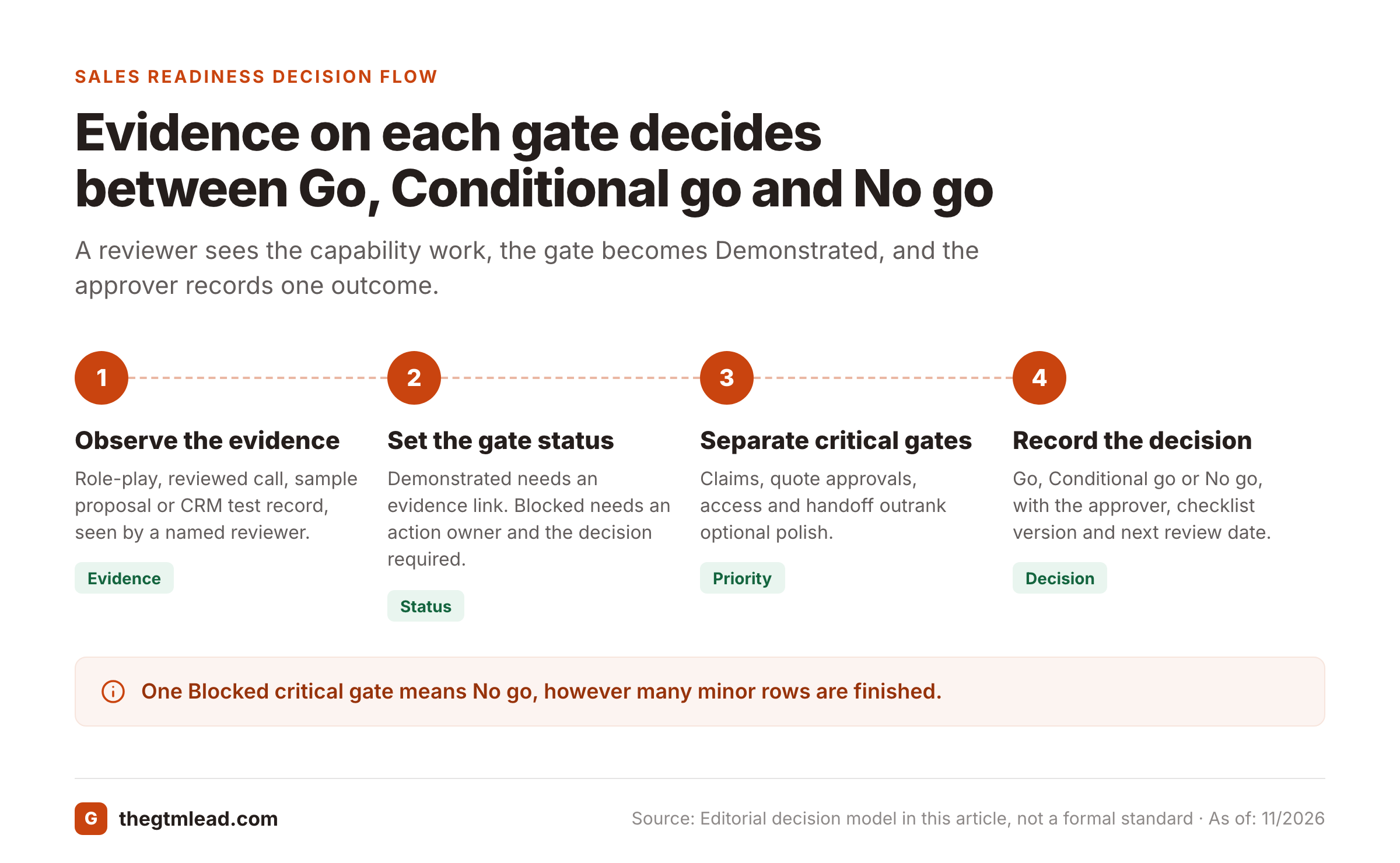
Score each capability as Not started, In progress, Demonstrated or Blocked. Require a specific evidence link for Demonstrated and a named action owner for Blocked. Separate critical gates from improvements that can happen after launch. For example, accurate product claims, quote approvals, CRM permissions and handoff procedures may be critical, while an optional presentation polish exercise may not.
| Status | Meaning | What's required |
|---|---|---|
| Not started | No work or evidence yet | Owner and due date |
| In progress | Work under way, evidence incomplete | Owner, due date, next step |
| Demonstrated | A reviewer saw the capability work | Evidence link, date, evaluator |
| Blocked | Cannot proceed without a decision or dependency | Named action owner and the decision needed |
Avoid calculating a single percentage that hides a severe failure. A team with many completed minor tasks but one unresolved compliance issue shouldn't be labeled ready. Add a decision date and an approver, and reassess after substantial changes to the product, the commercial model, the market or the operating workflow. The scorecard's a decision aid, not a substitute for judgment.
If you're comparing platforms that track this kind of evidence, see best sales readiness software. A spreadsheet is enough to start. The software question only matters once manual tracking can't keep up.
What should the launch decision look like?
At the final review, list every unresolved item and classify its risk. A critical blocker should have a clear owner, a remediation plan and explicit decision authority. Document the outcome with its reasons and limitations.
| Outcome | When it applies | What to record |
|---|---|---|
| Go | Every critical gate is Demonstrated and every rep in scope has passed | Approver, checklist version, evidence location, next review date |
| Conditional go | Every critical gate is Demonstrated for the offers, segments or reps in scope, but other reps or non-critical items aren't ready | The restricted offers, segments or reps, who accepted the risk, and the date the conditions lapse |
| No go | Any critical gate is Blocked, Not started, In progress or lacks evidence | The blocking items, owners and the date of the next decision |
A conditional launch might restrict certain offers, customer segments or representatives until requirements are satisfied. Communicate those boundaries in writing, because verbal limits don't survive a busy quarter. Don't change a status simply because a launch date is approaching.
After launch, monitor early customer questions, lost-deal reasons, quoting errors and handoff problems. They show whether the readiness test missed something real, and they tell you which rows to add or tighten. Teams that build coaching around these signals can connect this checklist to sales coaching software or a sales enablement framework without rebuilding the gates.
Common mistakes to avoid
| Mistake | Why it hurts | What to do instead |
|---|---|---|
| Confusing content distribution with competence | A deck download doesn't prove a rep can answer a buyer | Require a demonstrated scenario |
| Treating readiness as a one-time event | Products and contracts change | Reassess after material changes |
| Relying on a total score | It masks critical failures | Track critical gates separately |
| Assigning tasks without owners or evidence | Nobody can unblock or verify them | One named owner and one evidence link per row |
| Using unverified competitor claims | A battlecard that sounds decisive can be wrong | Label unverified items and keep them internal |
| Overlooking CRM and handoffs | They're less visible than pitch practice | Test them with seeded records |
Keep the process light enough that managers will use it, but rigorous enough to protect customers. If it's a chore, it won't survive the second launch.
How do you adapt the checklist for different teams?
The checklist works for new rep onboarding and for an ongoing readiness review of an existing team. What changes is which rows get depth, and that's a judgment call for the owner. New hires may need deeper product and CRM exercises, while experienced reps preparing for a new launch may need more messaging and competitive practice. Enterprise sellers often need more detailed procurement and stakeholder mapping. Transactional teams may prioritize routing, qualification and response quality. Partner teams should verify who may represent which claims and how leads are registered.
| Team | Add or deepen | Lighter touch |
|---|---|---|
| New hires | Product knowledge, CRM lifecycle, discovery basics | Advanced competitive practice |
| Experienced reps, new launch | Messaging, claim register, objections | Basics the reps have already demonstrated |
| Enterprise sellers | Procurement routing, stakeholder mapping, security responses | Short-cycle routing rules |
| Transactional teams | Lead routing, qualification speed, response quality | Deep stakeholder mapping when one person decides |
| Partner teams | Claim authority, lead registration | Direct quoting steps when partners don't quote |
Critical gates such as claims, quote approvals and handoff never move to the lighter-touch column. Don't copy another organization's thresholds without examining your own deal cycle and risk profile. What's acceptable for a transactional team isn't for a regulated enterprise sale. Start with the common core, add role-specific gates and remove requirements that don't change the launch decision. Frontline managers know what's missing, so ask them. Ask frontline managers and customer-facing specialists where failures occur in practice, and use that feedback to refine the checklist. For longer-term capability building, the sales onboarding software guide covers tools for ramping new hires.
Where the GTM Lead fits
The GTM Lead is our own product, and it covers one narrow slice of readiness: it sends a release brief to your SDRs, AEs and CSMs and records three states, viewed, acknowledged and ready. An acknowledgement shows the message reached the rep. It doesn't replace the observed role-play in your checklist.
It isn't a sales enablement suite, learning management system or content library, and it doesn't track activity or run leaderboards. It's a narrow tool. Keep the main checklist in your tracker, and use the GTM Lead only for the messaging and claims gate when a product or pricing change must reach the field quickly.
Frequently asked questions
How long should sales readiness take?
How long sales readiness takes depends on product complexity, role, existing skills and risk. Plan backward from the launch date and reserve time for reassessment. The first run usually exposes gaps you'll have to fix and retest.
Who signs off on sales readiness?
Assign one accountable decision maker, usually the revenue enablement lead or a sales manager, with input from the functional owners. Product marketing, revenue operations, legal or finance and managers each sign off on their own gates.
Should every checklist task be mandatory?
No. Identify critical controls separately from optional improvements. Accurate claims, quote approvals, access and handoff are typical critical gates. Presentation polish usually isn't.
Can a team launch with open items?
Only when an authorized owner accepts the documented risk and the boundaries are clear in writing. That's a Conditional go, with restricted offers, segments or reps and a date when the conditions lapse.
What evidence proves a rep is ready?
Observed role-plays, approved assets, CRM test records, reviewed proposals and completed handoff examples. A document existing in a shared folder isn't evidence of readiness.
How often should the checklist be updated?
Review it after major changes to the product, pricing, market or workflow, and use real sales and customer feedback to find missing gates. It works when it improves decisions, not when it creates paperwork. That's the test.