A go-to-market plan template turns a launch strategy into a list of decisions, deliverables, owners, deadlines and evidence. Use the copy-ready tracker below to coordinate product marketing, sales, customer success and product teams. It covers the ideal customer profile, positioning, pricing, channels, launch assets, field readiness and post-launch measurement. Unlike a launch calendar alone, it also records what has to be true before anyone announces the release.
It's built for B2B SaaS teams introducing a product, entering a segment, changing packaging or launching a meaningful feature. It works in a spreadsheet, so you don't need a paid project management platform. Every date, company and number in the worked example is illustrative. None of it's an industry benchmark.
- Define the buyer, problem, alternative and proof before choosing channels.
- Name one accountable owner and one approver for every launch-critical deliverable.
- Keep launch gates separate from task completion: a published deck isn't proof that reps understand it.
- Set a baseline, target, source and review owner for each metric.
- Use a go/no-go decision log so unresolved risks can't disappear behind a tidy dashboard.
Go-to-market plan template: copy this launch tracker
Copy the tracker below into a blank spreadsheet or download the XLSX file. Each row represents one verifiable deliverable, not a department or an entire campaign. The Proof link column can contain a document, recording, dashboard, signed approval or another auditable artifact. The T- notation in the example means days before the planned public launch, not a prescribed industry timeline.
B2B go-to-market launch tracker
Each row is one verifiable deliverable with an owner, an approver, proof and a launch gate. The example rows are for HarborDesk, a fictional B2B SaaS product introducing a new support workflow. Replace the names and relative dates with your own launch.
| Workstream | Deliverable | ICP | Owner | Approver | Due date | Dependency | Proof link | Status | Launch gate | KPI | Next action |
|---|---|---|---|---|---|---|---|---|---|---|---|
| Research | ICP interview synthesis | Support ops leads | Product marketing | launch lead | T-35 | Interviews complete | Research summary | Approved | ICP confirmed | Qualified interview themes | Share disqualifiers |
| Positioning | Positioning and claim sheet | Support ops leads | Product marketing | Product lead | T-28 | ICP synthesis | Approved messaging doc | Approved | Messaging approved | Message comprehension | Lock claims |
| Packaging | Price and eligibility FAQ | Support ops leads | Product | Finance lead | T-24 | Offer decision | Draft FAQ | In review | Pricing signed off | FAQ accuracy | Resolve exceptions |
| Demand | Segment landing page | Support ops leads | Growth lead | Product marketing | T-16 | Approved claims | Staging page | In progress | Page QA passed | Qualified visits | Test forms |
| Sales | Rep talk track and objection guide | Buying committee | Enablement lead | Sales lead | T-10 | Messaging approved | Training deck | In progress | Field readiness proven | Correct readiness answers | Run short check |
| Success | Existing-customer change notice | Customer admins | CS lead | Product lead | T-7 | Support policy | Draft notice | Blocked | Support ready | Notice delivery | Confirm impact |
| Operations | Go/no-go decision | All launch audiences | launch lead | Executive sponsor | T-2 | All critical gates | Decision record | Not started | Launch decision logged | Open critical blockers | Convene owners |
| Measurement | Funnel baseline and dashboard | Support ops leads | RevOps lead | launch lead | T-7 | Tracking specification | Dashboard link | In progress | Reporting ready | Qualified pipeline | QA attribution |
- Not started
- In progress
- Blocked
- In review
- Approved
A template with only tasks and due dates works for project tracking, but it isn't enough for launch approval. The additional Approver, Launch gate and Proof link fields let the launch owner distinguish work that exists from work that's safe to ship.
How to use the columns
Workstream identifies the function or phase. Deliverable names an output that can be reviewed. ICP forces a segment decision, especially when a launch affects existing customers differently from new prospects. Owner is the person doing the work; Approver is the person authorized to accept it. A single person can fill both roles on a small team, but make that explicit.
Due date is the last internal completion date, not the public launch date. Dependency names an upstream decision or asset. Proof link points to the latest accepted artifact. Status should use a controlled vocabulary: Not started, In progress, Blocked, In review, Approved. Launch gate is the condition that must pass. KPI names the outcome or quality signal. Next action records a concrete step, owner handoff or decision request.
Don't mark a row Approved while evidence is still missing. A landing page may be live while its conversion event is broken. A training deck may be delivered while reps still repeat an obsolete claim. Those are different states, and you'll want the tracker to show the difference. If it doesn't, it's just a to-do list.
What belongs in a GTM plan, and what doesn't?
A GTM strategy answers who you serve, why they'd switch, what you sell, how you reach them and how the business wins. A GTM plan converts those choices into accountable work with dates, approvals and measurement. A launch checklist is a smaller readiness view extracted from the plan. Keep all three aligned, but don't confuse them.
The plan needs enough strategic context to stop the team from executing contradictory tactics. It doesn't need a fifty-page market study, every draft social post or a full product roadmap. You'll store those in linked working documents. The launch tracker should point to the accepted version and record the decision owner.
For example, if product marketing targets a midmarket operations director but paid campaigns target individual contributors, a plan that simply says "ads ready" will hide the mismatch, and nobody's going to catch it before launch. A useful row says "Campaign audience approved against ICP" and links the actual targeting criteria.
A one-page executive GTM brief
Fill this section before populating the tracker. Keep each answer short enough that you can review it in a leadership meeting.
| Decision | Fill-in prompt | Fictional HarborDesk example |
|---|---|---|
| Launch | What is changing and for whom? | New escalation workflow for support operations teams |
| ICP | Which organizations are in scope? | Multi-team SaaS support organizations with formal escalation ownership |
| Trigger | What problem makes this urgent? | Unowned escalations crossing support and engineering |
| Alternative | What do buyers use today? | Shared inboxes, spreadsheets and ad hoc chat channels |
| Positioning | Why choose this approach? | One visible escalation owner and handoff record |
| Proof | What can we demonstrate without overclaiming? | Product walkthrough showing assignment and history |
| Commercial model | What is approved to sell? | Offer and eligibility, once Finance signs off |
| Channels | Where will the first qualified conversations come from? | Existing-customer outreach and focused partner webinars |
| Goal | What outcome defines a useful launch? | Qualified conversations that reach a real workflow evaluation |
| Decision owner | Who can postpone launch? | Executive sponsor after Product, CS and GTM input |
A good brief also names exclusions. They're short to write and they save arguments later. HarborDesk might explicitly exclude regulated healthcare workflows until security and legal teams approve the claim set. Exclusions keep marketing copy, sales qualification and support expectations consistent, so they're worth a row of their own.
Build the plan in six practical stages
The plan moves through six stages: confirm the buyer, approve positioning and commercial boundaries, select channels and handoffs, produce assets and test the buyer journey, prove field and customer readiness, then launch, review and adapt. Each stage ends in a gate from the tracker.
Stage 1: qualify the segment before building the campaign
An ICP isn't just "companies with 50 to 500 employees." Start with the workflow and the buying trigger. Identify who loses time or money when the problem occurs, which existing system is involved, who can approve the purchase, who can veto it for security or procurement reasons and what proof would change the buyer's mind.
Write a must-have, a nice-to-have and an exclude rule. For HarborDesk, a must-have could be cross-team support escalations (it's the problem the product solves); a nice-to-have could be a dedicated support operations manager; an exclusion could be a single-person support team with no handoffs. The criteria should let an SDR reject a superficially attractive but poor-fit account. If they can't, they aren't criteria yet.
Use an interview evidence table with columns for quote, role, workflow, current workaround and confidence. Separate a repeated observed problem from a single enthusiastic opinion. One loud customer isn't a segment. If the product solves several problems, choose the one the launch will lead with. A broad message usually produces vague qualification.
Stage 2: make claims and exclusions usable by the field
Write one sentence for each element (it's harder than it sounds): target buyer, painful trigger, product category, main benefit, mechanism and proof. Then create a short claim sheet with three columns: Approved claim, Evidence and Don't say. An approved claim might be "shows the named escalation owner" if the product demonstration proves it. "Eliminates missed escalations" is a different, stronger claim and shouldn't be used without appropriate evidence.
You should also decide what happens when pricing, security review or feature availability changes after the brief is approved. Assign one person to update the canonical message and another to confirm it's reached sales and customer success. An outdated battlecard is definitely a launch risk even when the latest website is correct. Reps often work from their own notes, not the website.
Stage 3: design channels around a measurable handoff
A channel plan should include the audience, message, asset, call to action, conversion event, follow-up owner and measurement source. A webinar without a follow-up rule is an event, not a complete acquisition motion, and it won't produce pipeline on its own. A paid campaign without a qualified conversion definition may optimize toward the wrong leads, and you won't see it in the click numbers.
| Channel | Buyer moment | Primary offer | Handoff | Quality check |
|---|---|---|---|---|
| Existing customer outreach | Workflow expansion | Product walkthrough | CSM to account owner | Eligible accounts only |
| Partner webinar | Evaluating operational change | Demonstration and Q&A | Partner lead to SDR | Consent and qualification captured |
| Targeted outbound | Trigger identified in account | Problem-specific discovery | SDR to AE | Trigger documented |
| Search landing page | Actively researching solution | Relevant demo | Form to assigned owner | Form and routing tested |
Choose a limited initial mix that the team can run well. Record the decision, and note why you deferred the alternatives, in the Next action column or your decision log. If no one owns lead routing or feedback, the channel isn't launch-ready.
Stage 4: check the entire buyer journey, not just assets
Walk through the launch as a prospect would, and note what doesn't work. Click the actual campaign link, read the offer, submit the form, inspect the CRM record and confirm that a named person receives the lead. Verify that the rep's first response uses approved positioning. Then test an existing customer path and a support escalation path. If you can't complete them yourself, a buyer might not either.
Record screenshots or links as proof. They're what you'll point to when someone asks whether the form really worked. If a form silently drops a required field, the page can look polished while the handoff fails, and nobody notices until leads go missing. If a pricing FAQ conflicts with the contract, the team shouldn't compensate with improvised explanations. A launch gate should clearly reflect the buyer's experience, not the completion of a content production ticket.
Stage 5: measure readiness rather than distribution
"Training sent" and "training understood" aren't interchangeable. Ask a rep to explain the product change, identify a buyer who shouldn't receive the offer and respond to one likely objection. For a pricing or policy change, ask what the rep mustn't promise. Keep the questions short and specific to the launch. They shouldn't take more than a minute.
The launch owner should distinguish Viewed, Acknowledged and Ready. Viewed means a brief was opened. Acknowledged means the recipient confirmed the approved message and caveats. Ready means the recipient demonstrated understanding against a defined check. None of these measures proves future selling performance, but they're more useful for launch coordination than an unqualified "trained" checkbox.
Set a readiness rule before you collect results. For example, a team might require all customer-facing owners for a sensitive pricing change to complete a check, with named coverage for absences. That's a proposed internal policy, not a universal standard. Document exceptions and who approved them.
Stage 6: close the decision loop after launch
A launch isn't finished when the announcement goes out. During the first review, ask which segment engaged, which objections repeated, which handoffs failed and whether activation followed the initial interest. Keep a change log: hypothesis, observed signal, action, owner and next review date.
If qualified pipeline rises but onboarding stalls, the next action might belong to Product or CS rather than demand generation. If lead volume rises while fit declines, revisit targeting. The plan should make those ownership changes visible, so you aren't labeling the launch either a success or failure on one headline number.
Use a launch gate checklist before announcing anything
- ICP confirmed: buyer, trigger, disqualifiers and evidence accepted.
- Messaging approved: claims, caveats and proof reviewed.
- Pricing signed off: offer, eligibility and exception handling documented.
- Page QA passed: links, forms, routing and measurement tested.
- Field readiness proven: customer-facing teams completed the agreed check.
- Support ready: documentation, escalation owner and customer impact reviewed.
- Reporting ready: baseline, definitions and dashboard owner named.
- Launch decision logged: unresolved blockers, exceptions and approver recorded.
Keep the decision meeting short, but make it real. It's the one meeting where a "no" has to be possible. Read the open critical blockers aloud; they're the agenda. A red gate can mean a delay, a limited launch to a smaller audience or a formally accepted exception. Don't silently convert a blocker to "done" because the public date is close. If a limited launch is approved, specify which segments, regions, messages and channels are excluded, so nobody's guessing.
A useful decision record contains the date, release version, decision, approver, accepted exceptions, owner of each follow-up and a link to the evidence. A record like that answers the question when a customer later asks what you promised at launch.
A working launch timeline with owners and dependencies
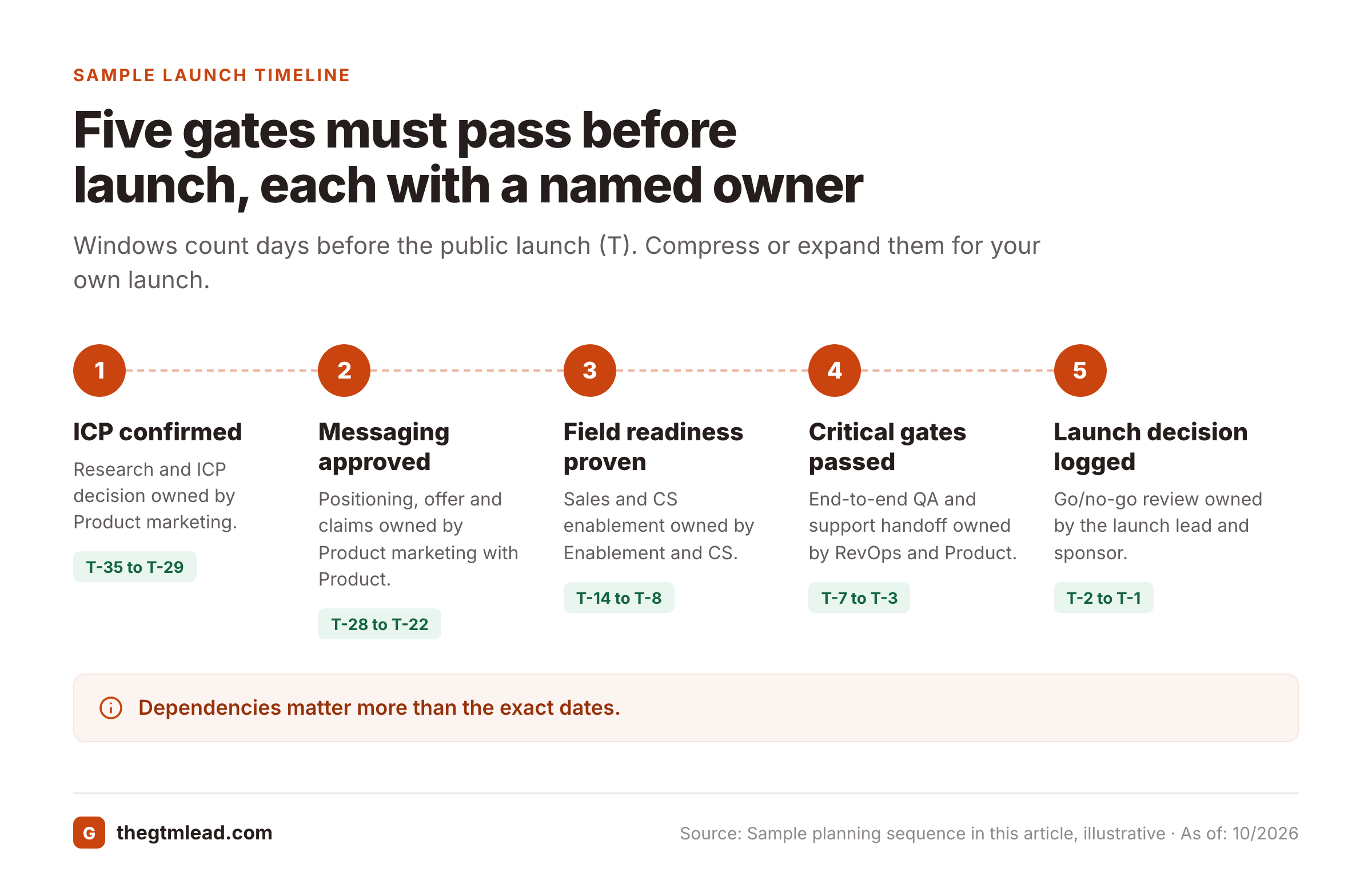
The timeline below is a sample planning sequence, not a claim that every company needs this much lead time. Compress it for a small feature and expand it for a new product or regulated market. Work backward from the external announcement and protect the gates that depend on other teams.
| Window | Work that must be complete | Primary owner | Exit condition |
|---|---|---|---|
| T-35 to T-29 | Research and ICP decision | Product marketing | ICP confirmed |
| T-28 to T-22 | Positioning, offer and claims | Product marketing with Product | Messaging approved |
| T-21 to T-15 | Channel plan, assets and routing | Growth and RevOps | Buyer path testable |
| T-14 to T-8 | Sales and CS enablement | Enablement and CS | Field readiness proven |
| T-7 to T-3 | End-to-end QA and support handoff | RevOps and Product | Critical gates passed |
| T-2 to T-1 | Go/no-go review | launch lead and sponsor | Launch decision logged |
| T to T+7 | Publish, triage, first signal review | Channel owners | Exceptions owned |
| T+8 to T+30 | Pipeline, activation and feedback review | RevOps and Product | Adjustments assigned |
Dependencies matter more than the exact dates. The demo script depends on approved positioning. Field training depends on the final offer and caveats. Paid traffic depends on a working landing page and lead routing. If the pricing decision slips, don't treat training completion as independent of it.
For launches with several teams, use a shared tracker and a weekly decision review before the final launch window. Move to shorter check-ins only when deadlines or blockers justify them; if nothing's at risk, don't add meetings. The cadence is your own operating choice. It isn't a universal benchmark, and there's no need to copy ours.
Measure the plan with a compact KPI scorecard
A GTM scorecard needs a metric, definition, data source, owner and the decision it informs. Add a baseline, target and review cadence for each metric before launch; they depend on your own numbers, so the table below leaves them out. Without those fields, two departments can report different versions of the same result. Keep outcome metrics separate from activity and quality checks.
| Metric | Definition | Data source | Owner | Decision it informs |
|---|---|---|---|---|
| Qualified conversations | Meetings that satisfy documented ICP and trigger criteria | CRM | Sales ops | Is targeting producing fit? |
| Qualified pipeline | Opportunity value accepted under a consistent qualification rule | CRM | RevOps | Is interest becoming real evaluation? |
| Lead-to-meeting rate | Qualified meetings divided by eligible inbound leads | CRM and form logs | Demand gen | Is routing and follow-up working? |
| Activation rate | New accounts completing a defined first-value action divided by eligible new accounts | Product analytics | Product | Can buyers realize the promise? |
| Readiness completion | Required recipients passing the agreed launch check divided by required recipients | Enablement record | Product marketing | Is the field prepared? |
| Support exceptions | Unresolved launch-related cases needing owner action | Support queue | CS lead | Is customer impact under control? |
Example: calculate the funnel without inventing benchmarks
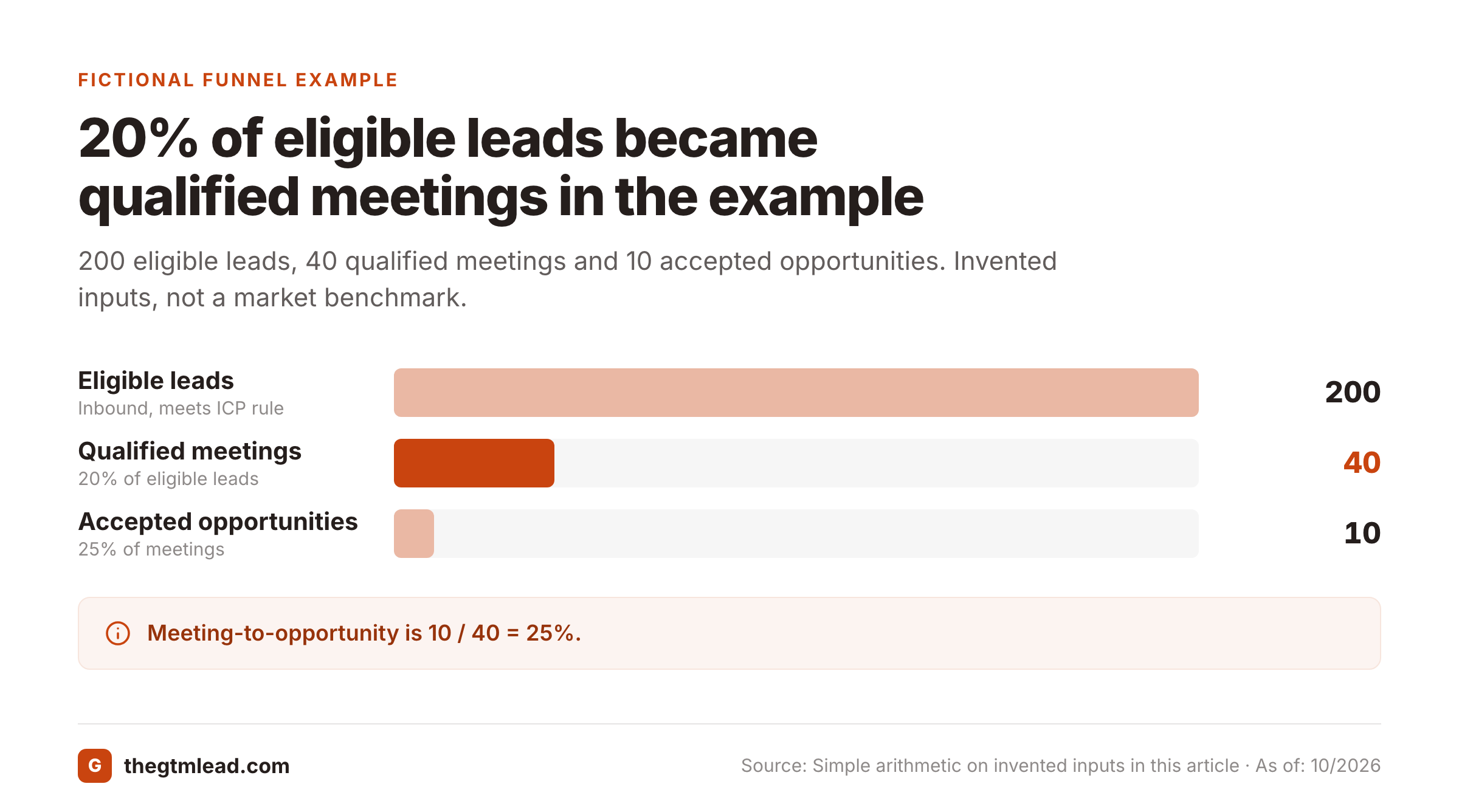
Say a fictional campaign produces 200 eligible leads, 40 qualified meetings and 10 accepted opportunities. The lead-to-meeting rate is 40 / 200 = 20%. The meeting-to-opportunity rate is 10 / 40 = 25%. Those numbers are simple arithmetic on invented inputs. They aren't observed market performance.
If the same fictional launch produces 30 new accounts and 18 complete the agreed first-value action, activation is 18 / 30 = 60%. Write down the eligibility rule and the action before launch. Otherwise a later change to the denominator or activation event can make performance appear to improve without any customer behavior changing.
Don't sum pipeline from different currencies without conversion assumptions. Don't compare a channel's raw leads with another channel's qualified opportunities. And don't attribute a closed deal entirely to a launch touch merely because the CRM recorded it as the latest campaign.
Example GTM plan for a B2B SaaS launch
Imagine HarborDesk is releasing an escalation workflow for support teams. Product marketing interviews existing users and finds that the strongest trigger is uncertainty over who owns a handoff between support and engineering. The GTM plan prioritizes organizations where that handoff is frequent and consequential. It explicitly excludes small teams with a single owner and no escalation process, because there's nothing to hand off.
The positioning is narrow: "Make the next escalation owner visible to everyone involved." The proof is a controlled product walkthrough. The team doesn't claim the feature eliminates escalations or guarantees response times. The offer isn't announced until Product and Finance approve availability and commercial terms.
For distribution, the team starts with existing-customer conversations and a partner webinar. The customer success lead identifies eligible accounts and confirms whether any customer communication is needed. The growth lead builds the registration page and verifies that registrations enter the correct CRM queue. Sales enablement provides a talk track that includes when not to pitch the feature.
Before public launch, an AE answers the readiness question: "A prospect asks whether every escalation will be resolved within one hour. What can you promise?" The accepted answer must stick to the documented product behavior and avoid unsupported service-level claims. The launch lead records the results and any exceptions, and they're part of the decision log. If the support policy is still unclear, the launch sponsor can limit the announcement or postpone it. That's a normal outcome, not a failure.
After launch, RevOps reports qualified conversations and pipeline while Product reports activation and CS reports recurring objections. If the message attracts interest but users can't complete the first escalation, the team investigates the workflow instead of buying more traffic. A plan like that coordinates learning as well as work.
How to adapt the template to your launch motion
New product: Expand market research, pricing, legal review, partner enablement and customer support readiness. A first-time offer needs more proof and a more explicit commercial decision than a minor feature update.
New segment: Preserve the core product work but revisit the ICP, language, channels and buyer committee. An enterprise buyer may require security and procurement evidence that a self-serve audience wouldn't ask for. Don't assume the same sales motion fits both.
Feature release: Shorten the market research workstream and put more emphasis on eligibility, existing-customer impact, messaging accuracy and field readiness. A feature that changes workflows can need more CS coordination than paid demand generation.
Pricing or policy change: Treat the effective date, customer cohorts, contractual exceptions and do-not-say claims as critical gates. The plan should identify who can answer customer questions and how updated language reaches every customer-facing team.
Partner launch: Add joint approvals, co-marketing assets, referral routing, data-sharing boundaries and a named owner on each side. A partner announcement without a defined handoff often creates leads that neither organization's ready to serve.
Keep field readiness visible without turning the plan into an LMS
The GTM Lead is a narrow release enablement tool for product marketing teams. It lets a product marketer write a brief with approved messaging and do-not-say caveats, share secure links with SDRs, AEs and CSMs, collect acknowledgements and a short readiness check, and see who is ready. Its role in this plan is the Field readiness proven gate. You copy the secure links and send them yourself. It doesn't replace the GTM tracker, publish release notes, manage the launch calendar, send email on your behalf or function as a CRM or training library.
If your team already uses a spreadsheet or project board, that separation can be useful: keep strategic choices, campaign tasks and KPI ownership in the plan, then link a specific readiness record as evidence for the launch decision. If the field isn't ready, the owner can follow up before the message reaches customers.
Common GTM planning mistakes and how to fix them
The plan is a content calendar. A calendar can show when an email goes out, but it can't show why the buyer should care, whether the offer's approved or who follows up. Add buyer, dependency, approver and proof fields.
Everyone owns the launch. Shared participation is good; shared accountability without a named decision maker isn't, because nobody's able to say no. Assign one owner per deliverable and one executive sponsor for the final go/no-go call.
Assets are marked ready before the message is approved. The team might finish a deck and a landing page using different product claims. Put positioning and commercial approval upstream and require a version reference. It's a small habit that prevents a lot of rework.
Training completion means attendance. Attendance proves a session happened, nothing more. Ask a short scenario question to check whether customer-facing staff understand approved claims and exceptions.
The team measures volume instead of fit. Large signup or lead counts can hide weak qualification. Define an eligible buyer and track conversion to a meaningful next action.
Post-launch work has no owner. A launch retrospective that produces no change request is a meeting, not a feedback loop. Don't hold it if nobody's going to act. Record the action, owner and review date in the same tracker.
Frequently asked questions
What should a go-to-market plan template include?
Include the ICP and buyer trigger, positioning, offer, channels, accountable owners, approval gates, deadlines, dependencies, proof links, KPI definitions and post-launch review actions. The tracker above gives each deliverable a single row, so you'll see gaps quickly.
What is the difference between a GTM plan and a GTM strategy?
A GTM strategy sets the audience, differentiation, commercial approach and route to market. A GTM plan assigns work, dates, owners, approval evidence and measurement to execute that strategy. A launch checklist is a subset of the plan's readiness gates.
Can I use this template in Google Sheets or Excel?
Yes. Paste the tracker into cell A1 of a blank sheet, or download the XLSX file, and replace the illustrative inputs with your own. Use a shared document link in the Proof link column and stick to the five status values, because free-text statuses can't be filtered.
Who should own a B2B SaaS go-to-market plan?
Assign a single launch lead to maintain the integrated plan. Product marketing typically owns positioning, Product owns product truth, RevOps owns measurement, and Sales and CS own their readiness. The executive sponsor makes the final go/no-go call, so that person doesn't also need to maintain the tracker.
How far ahead should we build the GTM plan?
Work backward from the launch and the longest real dependency, such as product approval, pricing, security review or sales enablement. The sample timeline is illustrative. It isn't a standard duration for every launch.
How do we know whether the launch is ready?
You're ready when you can show approved positioning and pricing, end-to-end buyer journey tests, field understanding, support ownership, measurement definitions and a documented decision on remaining risks. Completed tasks alone don't establish readiness.
A GTM plan should be easy to change without losing accountability. Keep the decisions short, the tracker current and the evidence close to each launch gate. For a deeper treatment of segmentation, positioning and channel choice, see our go-to-market strategy template.