The best sales forecasting software is the one that matches how your team builds the forecast: reps submit a call and managers roll it up, a model scores the deals, or finance owns the plan. This guide compares nine tools by that process: who submits what, how the number rolls up, what the AI part is based on, and which package you need before any of it is switched on.
Two things changed the market since 2025. Clari merged with Salesloft, and on September 2, 2026 Salesloft became the company and platform brand while the product kept the name Clari Forecast. BoostUp renamed itself Terret in September 2025. Only Salesforce, HubSpot and Forecastio publish prices. The other six sell by quote, so we show where forecasting starts in each price list instead of guessing at numbers.
- tools compared
- 9
- publish a price (Salesforce, HubSpot, Forecastio)
- 3
- name or ownership changes since September 2025
- 2
- G2 reviews behind eight of the ratings
- 56,000
Best Sales Forecasting Software: Our Picks by Job
Our picks match each tool to the forecasting job it handles best, from a CRM-native weekly call to a finance-owned plan. The tool cards further down explain each pick and who should skip it.
 Best if your pipeline already lives in SalesforceSalesforce Sales CloudCollaborative Forecasts roll opportunities up by category, and a manager's adjustment overrides a rep's while the gross rollup stays visible underneath.
 Best for HubSpot teams starting outHubSpot Sales HubThe forecast tool starts at Professional: reps submit an amount and a note per month or quarter, and a History tab keeps submissions for a year.
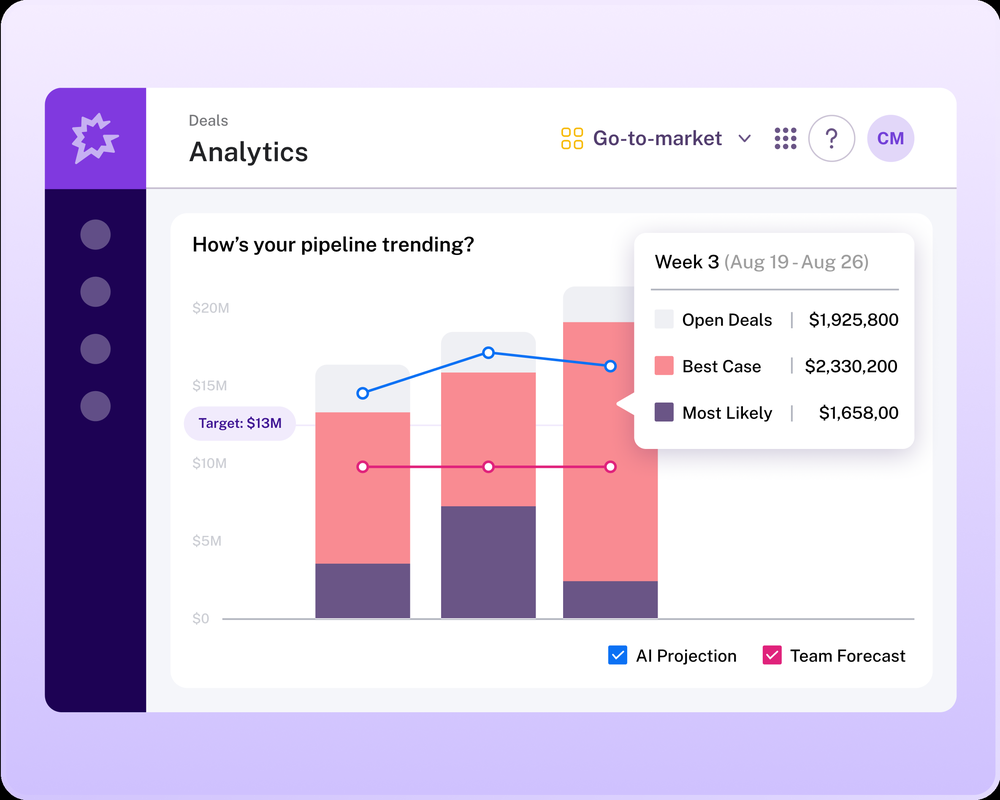
 Best for the weekly leadership callClari ForecastQuota, commit, best case and pipeline views with week-over-week comparison and a Forecast AI projection beside the plan.
 Best for a saved snapshot of every callOutreachEach submission is stored as a snapshot with notes and can be exported to CSV.
 Best when call recordings are your evidenceGong ForecastForecast categories map to a CRM field, and the AI predictions draw on conversation and activity data.
 Best for scored deals and custom hierarchiesAvisoA Winscore on every deal, with explanations, and hierarchies that can differ from the CRM's.
 Best when finance owns the planAnaplanForecast submissions roll into a planning model that also holds quota, capacity and financial plans.
Sales Forecasting Software Compared
| Tool | Type | How the forecast gets built | Price (USD) | G2 rating |
|---|---|---|---|---|
| Salesforce Sales Cloud | CRM forecasting | Reps and managers adjust Best Case and Commit; the manager's number rolls up over the rep's | Pro Suite $100, Core $195, Advanced $395, Max $550 per user per month, billed annually; Revenue Intelligence add-on from $220 | 4.4 (25,300) |
| HubSpot Sales Hub | CRM with sales content | Reps submit an amount and note per month or quarter; the team number falls back to the sum of rep submissions | Free; Starter from $7, Professional from $90, Enterprise from $150 per seat per month; forecasting starts at Professional | 4.4 (13,617) |
| Clari Forecast | Forecast management | Quota, commit, best case and pipeline fields with a Forecast AI projection beside the plan | Quote only | 4.6 (5,609) |
| Outreach | Sales execution platform | Rep call per category, manager rollup or override, each submission saved as a snapshot | Quote only; forecasting is listed only in the top Amplify Pro tier | 4.3 (3,574) |
 Forecastio | HubSpot forecasting app | Reads HubSpot deals, rolls submissions up and logs every change in an audit trail | $249 per month for 2 seats, billed annually; $49 per extra seat. Forecasting & Revenue Intelligence $369 per month | 4.5 (24) |
| Gong Forecast | Revenue intelligence | Forecast categories mapped to a CRM field, with AI predictions from conversation and activity signals | Quote only (per-user license plus a platform fee) | 4.7 (6,521) |
| Aviso | AI forecasting | Rolls up through the CRM or its own hierarchy, with a Winscore on every deal | Quote only | 4.3 (959) |
 Terret Forecast | AI revenue platform | Booked, commit, best case and pipeline rollup with the machine forecast beside each rep's commit | Quote only; free 48-hour proof of concept offered | No reviews yet |
| Anaplan | Connected planning | Forecast submissions roll up into a planning model shared with finance | Quote only | 4.6 (461) |
 The GTM Lead Our product | Release enablement acknowledgements | Shows which SDRs, AEs and CSMs are ready to explain a product change | Access code | No reviews yet |
Prices and packages checked on vendor pages on October 18, 2026. G2 blocks automated access, so ratings are the figures G2 showed in search results on the same day. For Clari, Gong, Anaplan and Outreach the rating covers the whole platform, not forecasting alone. Terret has no current G2 data we could read.
What Sales Forecasting Software Does
Sales forecasting software predicts how much revenue a team will close in a period by combining the pipeline in your CRM with the calls your reps and managers make and, in many tools, a model's own projection. It sits between two other systems: the CRM, which stores the deals but doesn't tell leadership which ones to count, and a planning tool, which builds the financial plan.
Tools fall into three groups. CRM-native forecasting, such as Salesforce and HubSpot, runs inside the system where reps already update deals. Dedicated forecast management, such as Clari, Outreach and Forecastio, adds submission workflows, history and model projections on top of the CRM. Connected planning, such as Anaplan, ties the sales forecast to quota, capacity and finance. The forecast in all three is only as good as the stages, amounts and close dates reps keep current. The stage history behind that forecast also feeds win rate and conversion reports, which we cover in our guide to sales analytics software.
How the forecast gets built
Three methods show up in the tools we read, and most products combine them.
- Stage-weighted pipeline. HubSpot's default forecast comes from deal stages, based on each deal's likelihood to close.
- Rep and manager calls by category. Salesforce's standard forecast categories are Pipeline, Best Case, Commit, Omitted and Closed. In Gong, categories roll up cumulatively: Commit includes closed-won deals, Most Likely adds to Commit, and Best Case adds to Most Likely. In Outreach, each rep submits a call per category and the manager can submit the rollup or enter a different number.
- Model projections. HubSpot's AI projection, still in beta, uses only closed-won deals from the past three months and returns a lower, most likely and upper range. Clari says Forecast AI is trained on your own history and predicts outcomes from deal size, stage and velocity. Outreach shows its projection as a second opinion next to the human call.
That's how predictive analytics gets used in practice: as a number beside the human call rather than a replacement for it. The section on testing a tool below shows how to check whether the model beats your reps on your own data.
When a spreadsheet is enough
Excel can forecast a time series without any extra software. The FORECAST.LINEAR function predicts a future value from existing values by linear regression, and Forecast Sheet on the Data tab builds a forecast worksheet with a chart from a date series. Microsoft's documentation lists predicting future sales as a use.
That works for a steady monthly revenue history, but it stops working when you need rollups by rep and manager, forecast categories, or a record of who changed which deal's category and when. At that point the CRM's forecast tool or a dedicated product earns its cost.
How a Weekly Forecast Call Runs in Each Tool
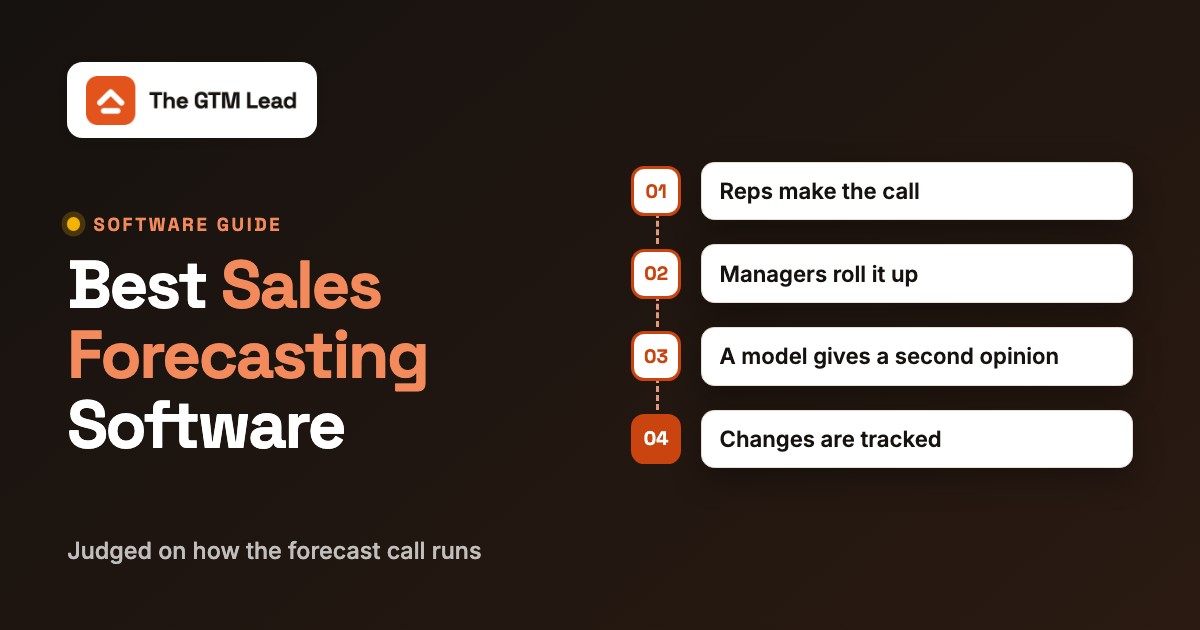
A forecast call has four moving parts: the rep's call, the manager's rollup, a model's second opinion and a record of what changed. The block below shows which tools document each part. Where a vendor's pages don't describe a step, the tool is left off that step.
- Step 1Reps make the call
- HubSpot Sales Hub
- Outreach
- Salesforce Sales Cloud
- Forecastio
Breaks when a call with no note leaves the manager guessing - Step 2Managers roll it up
- Salesforce Sales Cloud
- Outreach
- Gong Forecast
- Aviso
Breaks when the rollup differs from the sum of rep calls and nobody records why - Step 3A model gives a second opinion
- Clari Forecast
- Gong Forecast
- Aviso
- Terret Forecast
- HubSpot Sales Hub
Breaks when the model and the reps disagree and nobody checks who was right - Step 4Changes are tracked
- Outreach
- Forecastio
- HubSpot Sales Hub
- Clari Forecast
Breaks when a deal slips a quarter and the number moves without an explanation - Before the callSee who is ready
- The GTM Lead
Shows which SDRs, AEs and CSMs have read a pricing or packaging change
Clari, Aviso, Terret and Anaplan describe rollups and projections on their product pages, but the pages we read don't document the rep submission step or manager overrides. Ask for that flow in a demo with your own hierarchy, because it'll decide how long a weekly call takes.
What Changed in 2025 and 2026: Ownership and Naming
Several products in this list changed hands, names or domains recently, and older reviews often use the old names. Check the name on your quote against this table before you read a three-year-old review.
| Product | What changed | What it means for a buyer |
|---|---|---|
| Clari and Salesloft | The two companies merged. Salesloft announced on September 2, 2026 that it is now the company and platform brand. | Clari Forecast keeps its name. Salesloft's merger FAQ says contracts, pricing and renewal dates aren't affected. |
| BoostUp | Renamed Terret in September 2025. boostup.ai now redirects to terret.ai. | Ask for Terret Forecast by name. Terret describes itself as a move from a forecasting tool to a full AI system. |
| Outreach | Still independent. Its site moved from outreach.io to outreach.ai in 2026. | Older help links and reviews point to the old domain. The forecasting product appears under its former name, Commit, in some URLs. |
| Salesforce Sales Cloud | Some roundups list it as Agentforce Sales. | Salesforce's pricing page, read on October 18, 2026, uses Sales Cloud. |
| InsightSquared | Acquired by Mediafly, which closed by January 2022. Sold as Mediafly Intelligence360. | Mediafly's own site no longer shows a forecasting module, so we didn't rank it. Ask before buying it for forecasting. |
How to Choose Sales Forecasting Software
Start with who submits the call, not with the model. If reps and managers already submit a number every week, you'll need rollups and history. If they don't, a model won't fix that, and a CRM-native tool is the cheaper way to build the habit. The vendor pages we read don't state an implementation time, so ask for it in writing. Then check seven things in every demo, which the list below spells out.
- Categories and rollup math. Gong rolls categories up cumulatively, but Salesforce can roll up per category or cumulatively. Make sure the math matches how your leadership reads the number, because that's where calls go wrong.
- History. HubSpot keeps past submissions up to a year back, Outreach stores a snapshot with notes at each submission, and Forecastio logs slipped deals and category changes in an audit trail. Salesforce's help pages we read don't document snapshots.
- What the model reads. HubSpot's AI projection reads only recent closed-won deals. Gong lists 300+ signals as a claim but doesn't name them. Ask each vendor which fields and activity feed the projection, and what they'd do with a deal that has no activity.
- CRM fit. Forecastio works with HubSpot only. Outreach's help docs reference Salesforce. Terret lists Salesforce and HubSpot.
- The package gate. Forecasting often sits in a higher tier, not the entry plan. See the package table below.
- Who administers it. In Outreach an admin builds each forecast and must publish after every change. In Anaplan the customer or a partner builds much of the workflow.
- Scenarios. Outreach's Scenario Planner, Salesforce's Commit Calculator, Forecastio and Anaplan model what-ifs. HubSpot's and Clari's pages we read don't mention them, though, so ask.
- Export the last four closed quarters of opportunities with stage, amount and close-date history
- Write down the forecast each quarter would have shown four weeks before quarter-end, using your own process
- Ask the vendor to run its model on the same history and freeze the horizon
- Compare rep calls, manager adjustments and model output separately
- Run one live weekly call in the tool and time how long the rollup takes
- Change a close date and a category and check that the change history shows who did it
- Ask who owns field mapping and how long the vendor says it takes
CRM-Native Forecasting: Salesforce and HubSpot
These two forecast inside the CRM where reps already update deals. That removes a sync, but the rollup only reflects what reps enter, so stale stages and close dates flow straight into the number. Our guide to deal management software covers the tools that flag those stale deals before the forecast call.
Salesforce Sales Cloud
Best if your pipeline already lives in Salesforce
Salesforce forecasts live in the CRM your reps already update, so there's no second system to keep in sync.
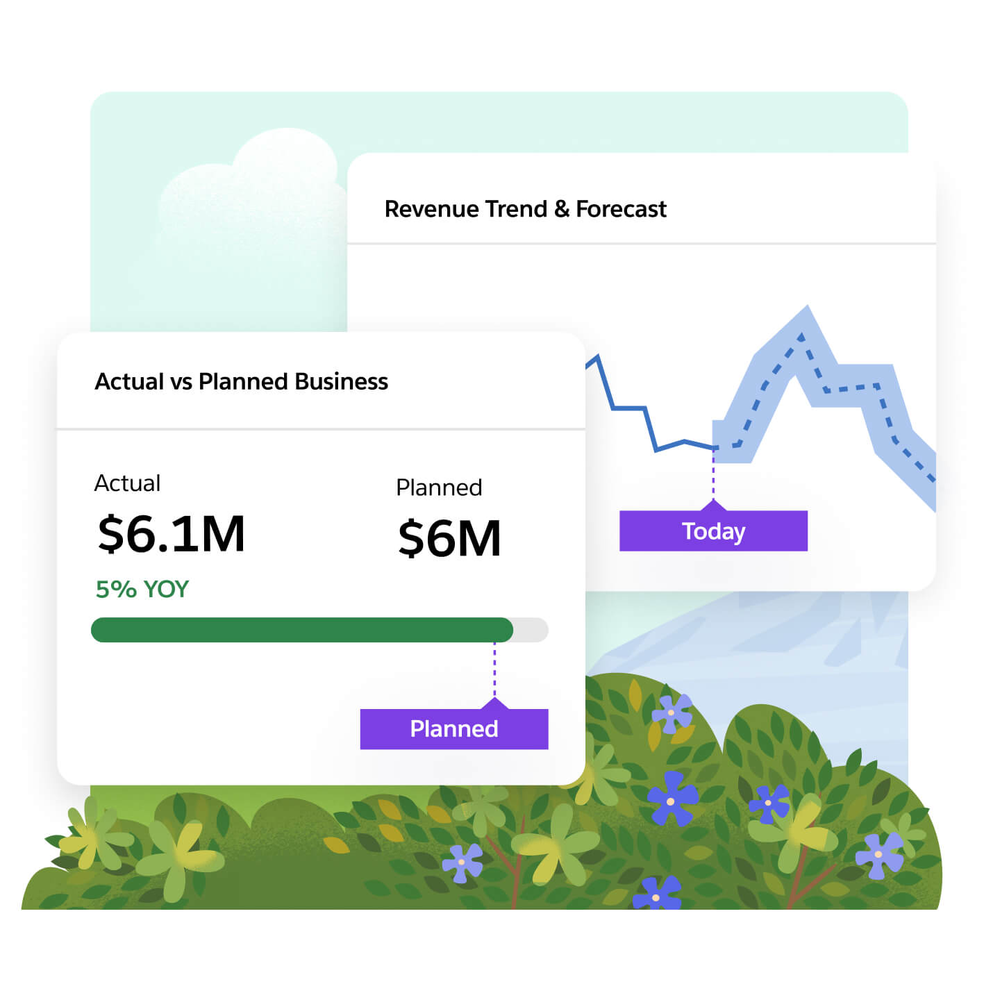
In Collaborative Forecasts an admin defines the forecast type and the hierarchy, and opportunities roll up by category: Pipeline, Best Case, Commit, Omitted and Closed. Reps, if admins allow it, and managers adjust Best Case and Commit. A manager's adjustment overrides a subordinate's on the same forecast, while the gross rollup stays unchanged underneath, so you can see both numbers. An org can run up to four active forecast types.
One trap from Salesforce's own help: when an opportunity changes category, the adjusted summaries don't update, so someone has to revisit the adjustments by hand.
The edition decides how far you get. Salesforce's Sales Cloud guide places basic forecasting in Professional, advanced forecasting and pipeline inspection in Core, predictive AI in Advanced, and Revenue Intelligence and Sales Planning in Max. Revenue Intelligence is also sold as an add-on, and it's what adds Forecast Insights, which compares the current forecast with a comparable earlier period, and a Commit Calculator for what-if scenarios.
- your pipeline already lives in Salesforce and you want the forecast in the same org, with no second system to sync
- you want a published per-user price and an edition ladder you can budget against
- you expect a deal-level AI score on a lower edition: the Sales Cloud guide places predictive AI in Advanced and Revenue Intelligence in Max or a $220 add-on
- your reps rarely keep opportunity stages and close dates current: the rollup only reflects what is entered
- Users like
- Core CRM breadth
- Users dislike
- Cost and admin effort
- Source: G2, 25,300 reviews
How it works in practice
Salesforce's help pages we read don't document forecast snapshots. If you need a saved history of each call, confirm how your edition handles it. The Starter Suite at $25 per user doesn't list forecasting.
- Starting price
- Pro Suite $100, Core $195, Advanced $395, Max $550 per user per month, billed annually; Revenue Intelligence add-on from $220
- Forecast categories
- Pipeline, Best Case, Commit, Omitted, Closed
- Adjustments
- Manager adjustment overrides a subordinate's
- Forecast types
- Up to four active
HubSpot Sales Hub
Best for HubSpot teams that want the forecast in the CRM
HubSpot's forecast tool is the shortest path to a weekly forecast if your deals already live in HubSpot.
Forecasting needs Sales Hub or Service Hub Professional or Enterprise, an assigned seat and forecast permissions. By default the forecast comes from deal stages, based on each deal's likelihood to close, and forecast categories let reps adjust a deal without losing its stage.
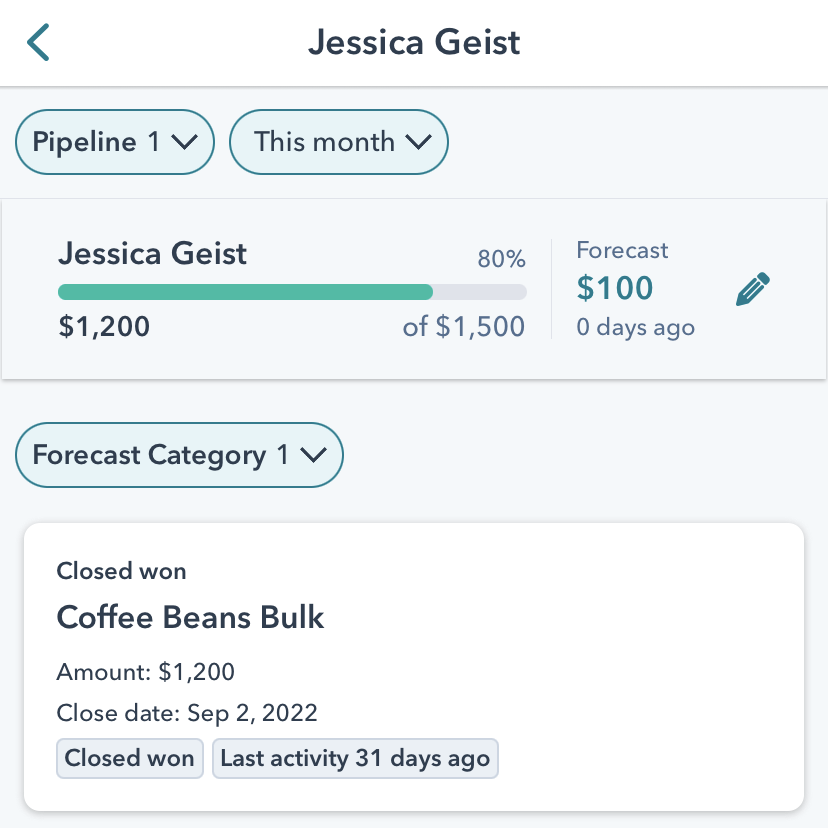
Reps submit a custom forecast for a month or quarter with an amount and a note, and managers can submit on a rep's behalf by adding deals. The team number is the team submission or, if there's none, the sum of the rep submissions. A History tab keeps past submissions up to a year back.
The AI projection is a beta. It uses only closed-won deals from the past three months, returns a lower, most likely and upper range, and refreshes on days 1, 7, 14, 21 and 28 of each month. It isn't a deal-level model.
- your deals already live in HubSpot and you want one forecast tool with no second system to sync
- you want a published per-seat price and managers who can submit on a rep's behalf
- you're on Free or Starter: forecasting starts at Professional, which also carries a $1,500 one-time onboarding fee
- you want a deal-level AI score, scenarios or snapshot comparisons: the AI projection is a beta that looks only at the past three months of closed-won deals
- Users like
- Interface and automation
- Users dislike
- Cost grows with seats and add-ons
- Source: G2, 13,617 reviews
How it works in practice
Free and Starter plans list no forecasting. HubSpot's own roundup of forecasting software ranks HubSpot first, so read it as a vendor page. Apps such as Forecastio read HubSpot deal data if you need scenarios and a change log.
- Starting price
- Free; Starter from $7, Professional from $90, Enterprise from $150 per seat per month; forecasting starts at Professional
- Forecast tool
- Professional and Enterprise
- Rep submissions
- Amount and note per month or quarter
- History
- Past submissions up to one year
- Across team hierarchies
- Enterprise
- Onboarding fee
- $1,500 (Professional), $3,500 (Enterprise), one time
Dedicated Forecast Management: Clari, Outreach and Forecastio
These three add a submission workflow, history or a model on top of your CRM. They differ in how much of that workflow the vendor documents publicly.
Clari Forecast
Best for the weekly leadership forecast call
Clari Forecast is built around the leadership view: plan, commit and gap to go for each team in one place.
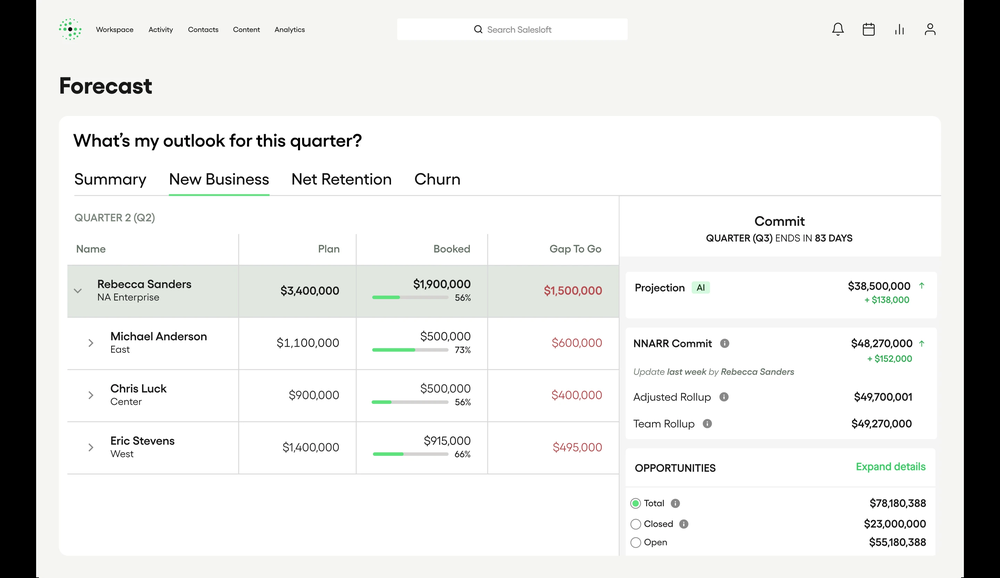
Clari Forecast organizes the forecast around quota, commit, commit coverage, best case and pipeline fields, which you can filter by bookings, renewals, region, segment or account size. Rep-level views show plan, booked amount and gap to go, and the team view adds a commit trend. Forecast AI is trained on your own history and predicts outcomes from deal size, stage and velocity, shown next to the plan. Week-over-week and quarter-comparison views show how the call has moved.
Salesloft's forecast page doesn't describe the submission step, manager adjustments or snapshots, and Clari's help center now redirects to Salesloft's community, so we couldn't read it. Ask for the exact submission and override flow in a demo, because the page shows the output but not how the number is submitted. Salesloft's merger FAQ says existing integrations, including Salesforce, HubSpot and Gong, aren't affected.
- leadership runs a weekly forecast call and wants plan, commit, best case and gap to go in one view
- you want an AI projection trained on your own history shown next to the human call
- you need a published price: Salesloft shows none on its forecast page
- you can't spare a RevOps owner: third-party reviewers flag cost and a learning curve for mid-market teams
- Users like
- Salesforce integration and forecasting ease
- Users dislike
- Customization limits
- Source: G2, 5,609 reviews
How it works in practice
The G2 rating covers the Clari platform, not Forecast alone. Reviewers praise the Salesforce integration and forecasting ease. The recurring complaint is customization limits, and third-party reviewers flag cost and a learning curve for mid-market teams.
- Starting price
- Quote only
- Forecast fields
- Quota, commit, commit coverage, best case, pipeline
- AI
- Forecast AI from deal size, stage, velocity
- Brand
- Salesloft is the company brand since 2 Sep 2026
Outreach
Best for a saved snapshot of every forecast call
Outreach keeps a snapshot of each forecast submission, which makes the weekly call auditable.
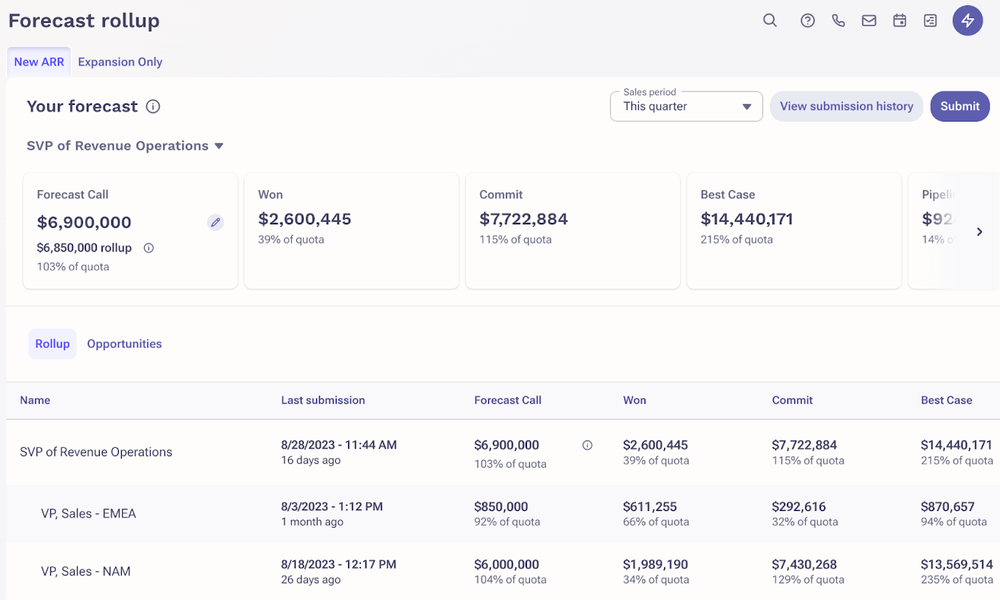
In Outreach's help docs, an admin builds one or more forecasts under Administration, Tools, Forecasting, and must click Publish after every change. Each rep submits a call per category, with Commit, Best Case and Pipeline as examples, plus comments. The calls roll up to the manager's team, and the manager can submit the rollup as their own call or enter a different number. Managers above see that submission.
Each row in the submission history is a snapshot of all metrics at the time of submission, with notes, and you can export it to CSV. Changes to entries and pipeline filters show over the last seven days. The AI Forecast Projection acts as a second opinion built from won business, remaining pipeline, intraquarter deals and pulled-in deals, and Scenario Planner models changes such as pipeline volume or win rates.
- your reps already run sequences in Outreach and you want the forecast call in the same system as deal execution
- you need saved snapshots of each submission and a CSV export for the weekly review
- you're not on the top tier: the pricing page lists forecasting only in Amplify Pro
- your CRM isn't Salesforce: the help docs we read only reference Salesforce
- Users dislike
- Bugs, sync problems and a hard-to-navigate UI (Capterra reviewers)
- Source: G2, 3,574 reviews
How it works in practice
G2 shows 4.3 for the Outreach platform. In G2 comparison snippets its sales forecasting feature score is 7.8 from 38 reviews, against 9.1 for Aviso and 7.9 for Gong. Capterra reviewers mention bugs, sync problems and a hard-to-navigate interface. The help docs we read reference only Salesforce.
- Starting price
- Quote only; forecasting is listed only in the top Amplify Pro tier
- Plan with forecasting
- Amplify Pro
- Submission history
- Snapshot per submission, CSV export
- Brand
- outreach.io now redirects to outreach.ai
Forecastio
Best for HubSpot teams that outgrow the built-in tool
Forecastio adds scenarios and a change log to HubSpot deals at a published price.
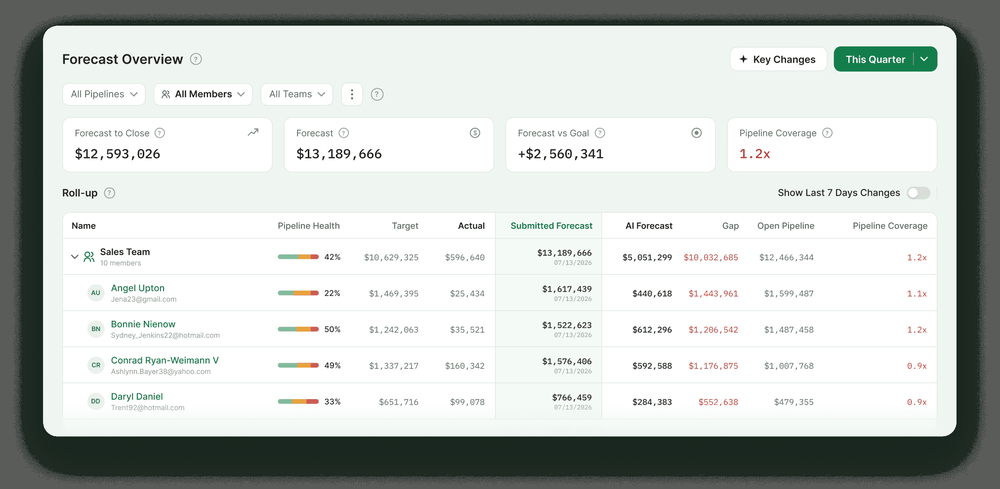
Forecastio syncs HubSpot deals, owners and properties. Reps and managers submit forecasts and roll them up across the org, a team or a pipeline, and the model (time series, weighted pipeline and machine learning) shows its own number beside the manual categories. Every change that moves the forecast, such as a slipped deal, an amount change or a category update, goes into an audit trail with who, when and the impact. The $249 plan includes what-if scenarios and accuracy tracking.
Both plans include a one-month free pilot. The higher plan adds pipeline and deal intelligence, with deal review and win/loss agents. The pages we read don't describe the rep submission screen.
- HubSpot is your CRM and its built-in forecast tool lacks scenarios and a change log
- you want a published price and a one-month free pilot
- your CRM isn't HubSpot: it connects to HubSpot only
- you want a large review base: both of its HubSpot Marketplace listings show zero reviews
- Users like
- Interface and reporting
- Users dislike
- Custom pricing (one reviewer)
- Source: G2, 24 reviews
How it works in practice
Forecastio has two HubSpot Marketplace listings, and both show zero reviews with 10+ and 30+ installs. An older listing shows a $119 per month Basic plan dated August 2025, and we couldn't confirm it's still sold. Its G2 profile has 24 reviews and has been inactive for over a year. Forecastio's pricing page says each plan includes 2 seats, while an older post on its own blog says one admin seat, so confirm the seat count in your quote.
- Starting price
- $249 per month for 2 seats, billed annually; $49 per extra seat. Forecasting & Revenue Intelligence $369 per month
- CRM
- HubSpot only
- Audit trail
- Slipped deals, amount and category changes
- Pilot
- One month free
Conversation-Led and AI-First Forecasting: Gong, Aviso and Terret
Gong, Aviso and Terret lead with a model or with conversation data. Their vendors publish accuracy claims, but we don't repeat them, because none comes with a method you can check. The testing section below shows how to check them yourself. If you're buying Gong mainly to coach reps from their calls, our guide to sales coaching software compares it with Chorus, Avoma and AI role-play tools.
Gong Forecast
Best when call recordings are your evidence
Gong Forecast puts the forecast next to the conversations behind each deal, if your team already records calls in Gong.
Gong sells two forecasting tiers. Forecast Essentials covers deal boards, the AI Deal Reviewer, win/loss insights and deal drivers. Gong Forecast adds forecast submission, the AI Deal Predictor, Forecast Analytics and the AI Revenue Predictor.
In Gong's help docs an admin maps the forecast categories (Commit, Most Likely, Best Case) to a CRM forecast field, and for Salesforce Gong recommends a custom forecast field over the standard Forecast Category. Rollups are cumulative, so a deal that moves between buckets shows up as a positive or negative change. A business-total board combines several forecasting motions into one view and needs the manage-forecast-settings permission and the Forecast package.
Gong says the AI Deal Predictor uses 300+ signals and is 20% more precise than algorithms based on CRM data alone. The signals aren't listed, so treat it as a claim until your own backtest.
- your team already records calls in Gong and wants the forecast reviewed next to the conversations behind each deal
- you run several forecasting motions and want one business-total board
- you don't use Gong for conversation intelligence: Forecast is a paid tier on top, with a platform fee
- you need deep planning or hierarchy modeling: third-party analyses rate Clari stronger for classic forecasting
- Users like
- Ease of use and integrations (whole platform)
- Source: G2, 6,521 reviews
How it works in practice
The G2 rating of 4.7 covers the Gong platform, and we found no forecasting-specific G2 data. An Airframe analysis of Gong Forecast says Clari is often seen as stronger in classic forecasting, with Gong's forecast acting as a layer on its conversation data.
- Starting price
- Quote only (per-user license plus a platform fee)
- Tiers
- Forecast Essentials, Forecast
- Category rollup
- Cumulative (aggregate)
- AI claim
- 300+ signals (vendor claim)
Aviso
Best for scored deals and custom hierarchies
Aviso scores every deal and shows why, which suits managers who'd rather have a reason behind each move into or out of commit.
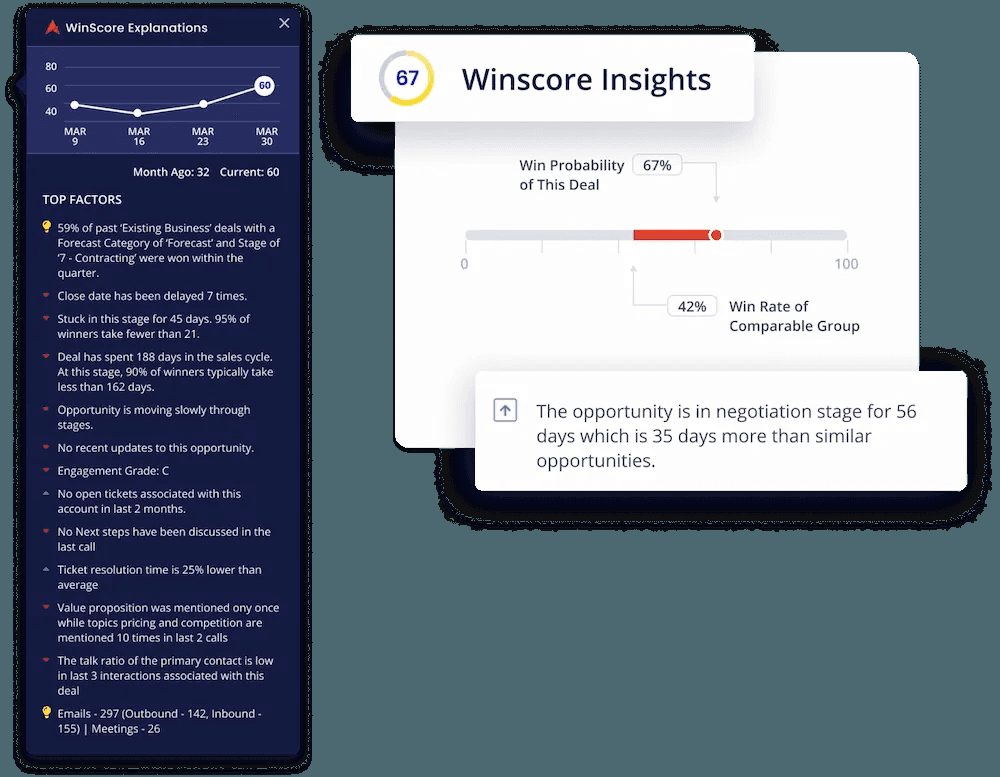
Aviso rolls forecasts up across every rep, category and team, showing best case and most likely against the number. It can mirror the CRM's hierarchy or keep its own, and it scores each deal with a Winscore built from CRM data, engagement, conversations and historical trends, with an explanation of the score. Managers can move a deal into or out of commit in one click based on that score. Consumption forecasting turns usage data into ARR and MRR forecasts, and there's a mobile app for deal reviews.
Salesforce sync is bidirectional, and Aviso says it supports other CRMs. Its pricing page asks for a custom proposal. A comparison page on Aviso's own site claims a flat per-seat price, but the pricing page shows none, so treat it as quote only. We found no Aviso help center and no description of snapshots or scenarios.
- forecast accuracy is the main reason you're buying and you want a model that explains each deal score
- you need hierarchies that differ from the CRM's, or forecasts for usage-based revenue
- you want a quick, self-serve rollout: reviewers cite a steep learning curve and slow page loads
- you need public pricing: the pricing page asks for a custom proposal
- Users like
- AI prediction for quarterly forecasts
- Users dislike
- Steep learning curve and slow page loads
- Source: G2, 959 reviews
How it works in practice
G2 reviewers credit the AI prediction for quarterly forecasts. The recurring complaints are a steep learning curve, slow page loads and data problems with the Salesforce integration.
- Starting price
- Quote only
- Deal score
- Winscore with explanations
- Hierarchy
- CRM-mirrored or its own
- Usage revenue
- Consumption forecasting
Terret Forecast
Best for seeing where the model and your reps disagree
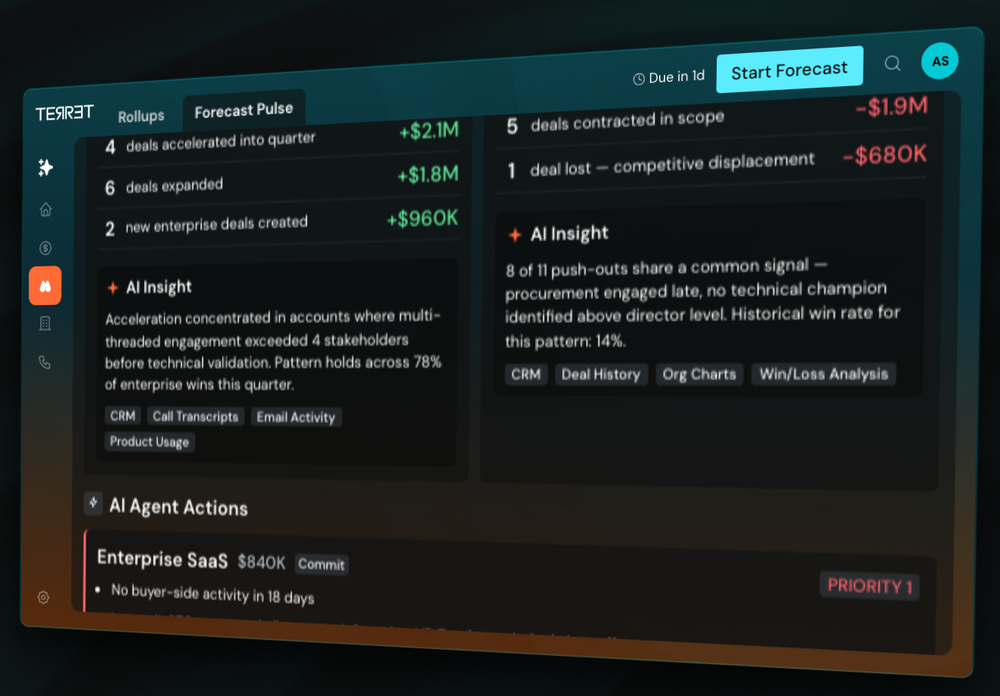
Terret, the new name of BoostUp, shows the machine forecast next to each rep's live commit.
Terret Forecast shows a rollup of Booked, Commit, Best case and Pipeline buckets with deal counts. The machine forecast considers deal characteristics, rep performance, customer behavior and market conditions, including signals from calls, email, champion activity and stage velocity. It appears beside each rep's live commit, so a manager sees where the model and the rep disagree. An AI-written narrative explains why the forecast changed and which deals drove the movement.
Terret says forecasts refresh automatically as data changes, which is the opposite of what's in a static snapshot. That keeps the number current, but if you need a saved record of each weekly call, ask how it's kept, because the forecast page doesn't describe submissions, overrides, snapshots or scenarios. The example numbers on the page are demo data. Terret lists Salesforce and HubSpot, Gong and Chorus, Gmail and Outlook, and Outreach and Apollo among its integrations.
- you want to see where the model and your reps disagree before the forecast call
- you want a written explanation of which deals moved the number each week
- you need documented submission, override and snapshot steps: its forecast page doesn't describe them
- you want an established review base: Capterra shows 23 reviews under the old BoostUp name and we couldn't read current G2 data
How it works in practice
Capterra shows 4.3 from 23 reviews under the old BoostUp name. We couldn't read current G2 data. Terret now describes itself as a full-stack AI system rather than a forecasting tool, so check which forecasting features your contract includes.
- Starting price
- Quote only; free 48-hour proof of concept offered
- Former name
- BoostUp
- Rebrand date
- September 10, 2025
- CRMs
- Salesforce, HubSpot
Connected Planning: Anaplan
Anaplan is the one tool here that's a planning platform first rather than a forecasting add-on. It's the one to look at when the forecast has to feed quota, capacity and the financial plan.
Anaplan
Best when finance owns the plan
Anaplan fits when sales and finance must work from the same model.
Anaplan's Sales Forecasting datasheet describes rolling up forecast submissions, tailored to each go-to-market team and revenue model, into one view. Anaplan Forecaster adds an AI time-series forecast, and scenario planning models what-ifs from a single deal change to a market shift. Deal reviews run off a live pipeline view that tracks momentum and risk. The forecast connects to territory, quota, capacity and incentive compensation, and to finance and supply chain plans.
The datasheet doesn't describe forecast categories, a rep submission screen or snapshots, and much of the workflow is configured by the customer or a partner. It lists CRM connectors, APIs and ETL tools for data. Anaplan publishes no price. Third-party estimates range from tens of thousands to over a million dollars a year, which is too wide to be useful.
- finance and sales must work from one planning model, including territory, quota and capacity
- you want to model best and worst case scenarios on the same data finance uses
- you want a forecast call running in weeks: G2 reviewers cite a steep learning curve and expert help
- you have nobody to own the model: much of the workflow is configured by the customer or a partner
- Users like
- Flexibility for custom models
- Users dislike
- Steep learning curve
- Source: G2, 461 reviews
How it works in practice
The G2 rating of 4.6 from 461 reviews covers the whole Anaplan platform. Reviewers praise flexibility for custom models and complain about a steep learning curve that needs expert help.
- Starting price
- Quote only
- Scope
- Whole planning platform, not a CRM add-on
- Scenarios
- What-if, best and worst case
- AI
- Anaplan Forecaster time-series forecast
Which Package Unlocks Forecasting, and What Does It Cost?
Only Salesforce, HubSpot and Forecastio publish prices, but forecasting rarely starts at the cheapest tier. The table shows where it starts in each price list, based on the vendor pages we read.
| Tool | Where forecasting starts (plan or tier) | Price status |
|---|---|---|
| Salesforce | Pro Suite lists forecasting; advanced forecasting from Core; predictive AI from Advanced | Published, per user per month |
| HubSpot | Sales Hub Professional | Published, per seat per month |
| Gong | The Forecast tier; Forecast Essentials is the lighter tier | Quote only, plus a platform fee |
| Outreach | Amplify Pro, the top tier | Quote only |
| Forecastio | The $249 per month plan | Published, per month plus seats |
| Clari | Not stated on Salesloft's forecast page | Quote only |
| Aviso | Not stated on the pricing page | Quote only |
| Terret | Not stated | Quote only; free 48-hour proof of concept |
| Anaplan | Sales Forecasting application | Quote only |
Is there free sales forecasting software?
None of the nine tools lists a free plan that includes forecasting on the pages we read. HubSpot's Free and Starter plans don't include it, and Salesforce's Starter Suite doesn't list it. The free routes are a spreadsheet with FORECAST.LINEAR or a trial, not a permanent plan: Forecastio includes a one-month free pilot, and Terret offers a free 48-hour proof of concept.
How to Test a Forecast Tool Before You Buy
Vendor accuracy claims don't tell you how a model performs on your sales cycle, so test on your own closed quarters instead. Microsoft's guide to Forecast Sheet gives the idea in one line: start the forecast before the last historical point, then compare the forecast with the actual data.
- Define the outcome. Pick one measure, such as new bookings in US dollars, and decide how to treat renewals.
- Freeze the horizon. Compare forecasts made at the same point, for example four weeks before quarter-end, using only what was known then.
- Use several closed periods. Include an ordinary quarter and an unusual one.
- Keep the sources apart. Record rep calls, manager adjustments and model output as separate forecasts.
- Record error and bias. Absolute percentage error is the absolute difference between forecast and actual, divided by the actual. The signed error shows whether you miss high or low.
The table uses made-up numbers to show the arithmetic. They aren't vendor data.
| Quarter | Sales forecast four weeks out (USD) | Actual bookings (USD) | Signed error (USD, %) | Absolute percentage error (%) |
|---|---|---|---|---|
| Q1 | $3.8M | $4.0M | -$0.2M (-5.0%) | 5.0% |
| Q2 | $4.6M | $4.0M | +$0.6M (+15.0%) | 15.0% |
| Q3 | $4.3M | $4.5M | -$0.2M (-4.4%) | 4.4% |
The mean absolute percentage error across the three quarters is 8.1%, and the signed errors average +1.9%. The average hides the real finding: one quarter missed by 15%, and a tool that would have flagged it earlier is worth more than one that's slightly closer on average. If you track a single large deal, keep it out of the average and look at it separately.
Where The GTM Lead Fits
A forecast also depends on what reps tell buyers. After a pricing or packaging change, the step nobody tracks is which SDRs, AEs and CSMs have read the new terms. The GTM Lead covers that one step. It doesn't forecast anything.
FAQ
Which tool is used for forecasting?
The right tool depends on the job. Excel's FORECAST.LINEAR function predicts a future value from a history of numbers by linear regression. Salesforce and HubSpot forecast inside the CRM. Clari, Outreach, Gong, Aviso, Terret and Forecastio add submission workflows, history or model projections on top of the CRM, while Anaplan connects the forecast to finance planning.
How do I find a sales forecast in Excel?
Select a date series and its values, go to the Data tab, and choose Forecast Sheet in the Forecast group. Excel builds a worksheet with the historical and predicted values and a chart. For a single predicted value, use FORECAST.LINEAR with the x value, the known y values and the known x values.
How do I forecast sales for a startup?
With few closed deals there's too little history for a model, so start with a stage-weighted pipeline or a weekly rep call by category (Commit, Best Case, Pipeline) in your CRM. Record each week's call so you can compare it with the actual result later. If you run HubSpot, you'll find the forecast tool starts at Professional, and Forecastio starts at $249 per month.
How can predictive analytics be used for sales forecasting?
Most tools show a model's projection next to the human call, as a second opinion. HubSpot's beta uses recent closed-won deals, Clari's Forecast AI uses deal size, stage and velocity, and Outreach's projection uses won business and remaining pipeline. Test any model by comparing its forecasts with actual results over several closed quarters.
Is there free sales forecasting software?
No tool in this comparison offers a permanent free plan with forecast submissions and rollups, on the pages we read. The free routes are Excel or Google Sheets formulas for a simple series, a one-month Forecastio pilot for HubSpot teams, and a 48-hour Terret proof of concept.
Which sales forecasting software works with HubSpot?
HubSpot has its own forecast tool from Professional. Forecastio works with HubSpot only. Terret lists HubSpot among its CRM integrations, and Salesloft's merger FAQ says Clari's HubSpot integration isn't affected. Outreach's help docs we read reference only Salesforce.