Product marketing software is not one product category. It is the set of tools a product marketing team uses to learn what customers say, watch competitors, announce launches and equip sellers. Product marketing software can mean several different jobs, so the first decision is which job you are buying for.
This guide covers seven tools, each chosen because it does one product marketing job well enough that the vendor documents it. We read each vendor's pricing, feature and help pages between October 19 and November 4, 2026, plus one review source per tool. We left out email and campaign automation on purpose. If you need that, a marketing automation roundup is the better read. For deeper dives into single jobs, see our guides to competitive intelligence software, product launch software and product roadmap software.
- tools read on vendor sites, one per job or close to it
- 7
- have a free plan (Dovetail, Pendo up to 500 monthly active users)
- 2 of 7
- publish a USD price for a paid plan (Similarweb, LaunchNotes)
- 2 of 7
- sell by quote only, with no free plan (Klue, Crayon, Highspot)
- 3 of 7
What Is Product Marketing Software?
Product marketing software is any tool that supports the work between a product and its market: customer research, positioning, competitive analysis, launches and sales enablement. No vendor sells the whole set. A product marketer usually runs a small stack, and the useful question is which job each tool takes off the team's plate.
| Job | Question it answers | Tool type | Example in this guide |
|---|---|---|---|
| Customer research | What do customers actually say? | Voice-of-customer analysis | Dovetail |
| Competitive tracking | What did rivals change? | Battlecard and change tracking | Klue, Crayon |
| Market size and traffic | Is a rival's audience growing? | Web traffic intelligence | Similarweb |
| Launch communication | How do customers learn what shipped? | Release announcements and in-app guides | LaunchNotes, Pendo |
| Seller readiness | Do sellers have the launch content? | Sales content and plays | Highspot |
Marketing automation sits outside this table. It sends and measures campaigns, while the tools above feed those campaigns with evidence and ship the product story. Our guide to market intelligence software covers the research side in more depth.
How We Judged Product Marketing Software
Four checks decided what made the list, and the same four decide what you should ask a vendor.
- One documented job: The vendor's own pages must describe the job, such as battlecards or in-app announcements, not just list "marketing" as an audience.
- Where the output lands: Check where a finding ends up for sellers, customers or the product team: Salesforce, Slack, a changelog page or a shared document.
- Who needs a seat: Product marketing rarely works alone. Check whether sales, product and design can read the output without paying for an editor seat.
- Price before a call: Check what the pricing page shows without a demo. Only two of the seven publish a USD price for a paid plan.
Our Picks by Product Marketing Job
Each pick is the tool with the clearest vendor-documented answer to one job. A job appears only where we read the page that supports it.
 Best for customer languageDovetailPulls calls, reviews and tickets into one place, with a free plan limited to one project.
 Best for battlecards inside SalesforceKlueA curator reviews an AI-filtered feed and sellers see the card on the deal or in Slack.
 Best for scored competitor changesCrayonEach change gets an importance score, and cards sit in open Salesforce opportunities.
 Best for rival traffic trendsSimilarwebTraffic, channel mix and audience for competitor sites from $125 per month billed annually.
 Best for announcing what shippedLaunchNotesOne announcement published to a changelog page, email and Slack, from $799 per month.
 Best for in-app announcementsPendoLightboxes, tooltips and banners aimed at user segments, with a free plan up to 500 monthly active users.
 Best for launch plays in the CRMHighspot by SeismicA launch packaged as a Sales Play that opens inside Salesforce or Dynamics.
Product Marketing Software Compared
The table lists the seven tools in the order a product marketer meets the jobs: learn, watch, announce, equip. The price column shows what each vendor publishes in USD and says "Quote" where it doesn't.
| Tool | Job | Where the output lands | Price status (USD) | G2 rating |
|---|---|---|---|---|
| Dovetail | Customer research and voice-of-customer analysis | Customer quotes, themes and AI Docs shared with brand, content and demand gen teams | Free; Enterprise by quote | 4.5 (168) |
| Klue | Battlecard platform | Battlecards in Salesforce, Slack and Teams, with win-loss in the same product | Quote (demo-gated) | 4.7 (441) |
| Crayon | Battlecard platform | Battlecards embedded in open Salesforce opportunities, Slack and Teams | Quote (demo-gated) | 4.6 (385) |
| Similarweb | Web and traffic intelligence | Weekly email alerts and exports for analysts | From $125 per month, annual | 4.4 (1,175) |
| LaunchNotes | Release communication | Product marketing drafts and publishes the announcement; subscribers get it by page, email and Slack. | From $799 per month, annual | 4.9 (33) |
| Pendo | In-app guides and product analytics | Announce the launched feature inside the product to the right segment and measure adoption. | Free to 500 MAUs; paid by quote | 4.4 (1,822) |
| Highspot by Seismic | Enablement platform | Sales Plays pushed into Salesforce and Dynamics, with knowledge checks | Quote (Good, Better, Best) | 4.7 (1,206) |
Prices and plans checked on vendor pages between October 19 and November 4, 2026. G2 ratings are the listing figures from those dates.
Learn What Customers Say: Dovetail
Positioning starts with the words buyers use. Dovetail is the only tool here built for that step, and its pages describe it for marketing teams directly.
Dovetail
Best for customer language
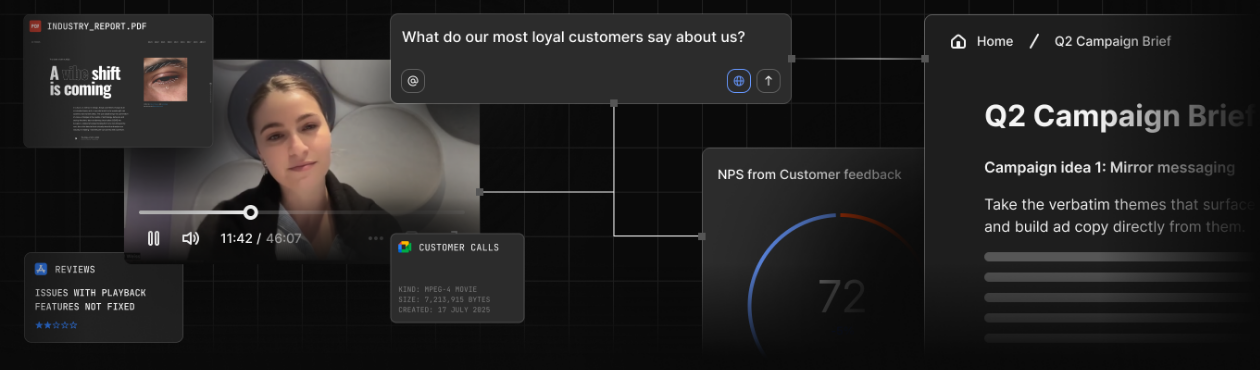
Dovetail collects calls, reviews, tickets and surveys in one place so a marketer can see the phrases customers use for their own problems.
Dovetail's marketing page describes four jobs: finding the language customers use, tracking brand and competitor sentiment, validating messaging before a campaign ships and sharing audience intelligence through AI Docs. Its listed integrations for marketing include G2, Gong, Salesforce, HubSpot Service Hub, Intercom, Slack, Claude and ChatGPT, so a G2 review export or a Gong call can land next to interview notes.
The pricing page shows two tiers. Free is $0 with no card, one channel, one project, and Chat and AI summaries inside that project. Enterprise is custom and adds unlimited projects, channels and Docs, dashboards (labeled beta), redaction and access control.
- you need real customer phrases from calls, reviews and tickets before you write messaging
- you want marketers to query customer evidence without a research brief
- you want a tool that tests messaging with panels of strangers: Dovetail analyzes your own first-party data
- you need more than one project or channel but won't buy Enterprise: the free plan caps both at one
- Users like
- Research repository and analysis of interviews
- Users dislike
- Missing features and limitations on some modules
- Source: G2, 168 reviews
How it works in practice
Dovetail's own FAQ says it analyzes first-party evidence from interviews, sales calls, tickets and surveys, which is different from social listening of public posts. G2 shows about 4.5 from 168 reviews on a comparison page. One G2 comparison lists missing features and limitations as the top cons. Because the free plan allows a single project, a team that wants separate projects per product line should price Enterprise early.
- Starting price
- Free ($0, one channel, one project); Enterprise by quote
- Free plan
- One channel, one project, Chat and AI summaries inside that project
- Enterprise
- Unlimited projects, channels, Docs, dashboards (beta), redaction
- Marketing integrations
- G2, Gong, Salesforce, HubSpot Service Hub, Intercom, Slack, Claude, ChatGPT
Watch Competitors: Klue, Crayon and Similarweb
Competitive work is the job with the most dedicated software. The three tools differ in what they watch: Klue and Crayon track what competitors say and change, while Similarweb tracks how many people visit.
Klue
Best for battlecards inside Salesforce
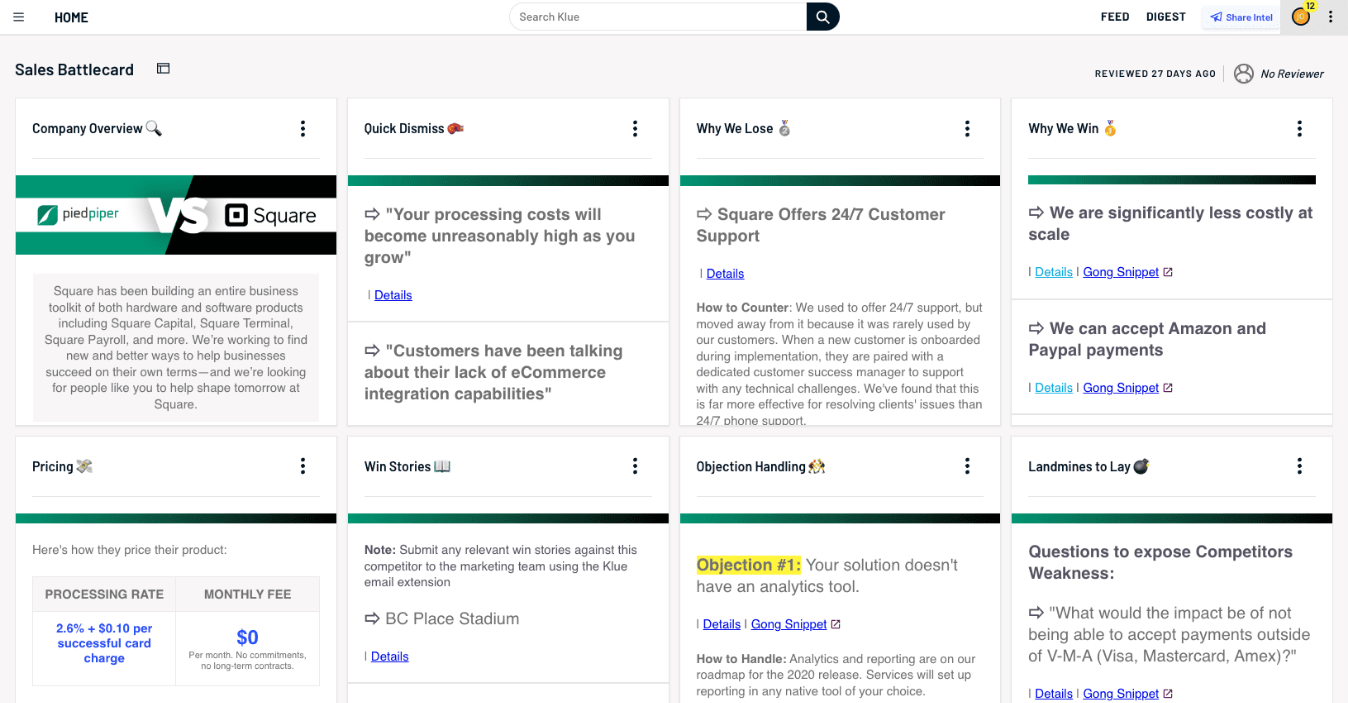
Klue suits a product marketing team that owns the competitive program and wants battlecards where sellers already work.
Klue gathers public signals such as website changes, reviews and press, plus field intel from Slack, Teams, email and call tools. On its product page it says AI filters out roughly 87% of what it collects, and a curator turns the rest into battlecards. Sellers open them in a Salesforce panel, through a Slack command or in Teams. A win-loss suite sits in the same product.
- a product marketing team owns the competitive program and wants battlecards inside the CRM and chat tools sellers already use
- you want win-loss interviews and competitive intel in one product
- you have no one to review the AI-filtered feed: Klue's own model puts a human curator in the loop
- you only want page-change alerts and don't need battlecards or win-loss
- Users like
- Responsive, knowledgeable support
- Users dislike
- Integrations (Salesforce especially) take some legwork to set up
- Source: G2, 441 reviews
How it works in practice
Klue's rating of 4.7 comes from about 441 G2 reviews, with support praised and Salesforce setup named as legwork. Its pricing page offers only a demo request. The curator role is the cost the price page hides: the model assumes a person reviews the feed.
- Starting price
- Quote only (demo-gated)
- Collects
- Public web, reviews, social, plus field intel from Slack, Teams, email and Gong
- Delivery
- Salesforce panel, Slack, Teams, digests
- Win-loss
- Interviews and AI-written stories
Crayon
Best for scored competitor changes
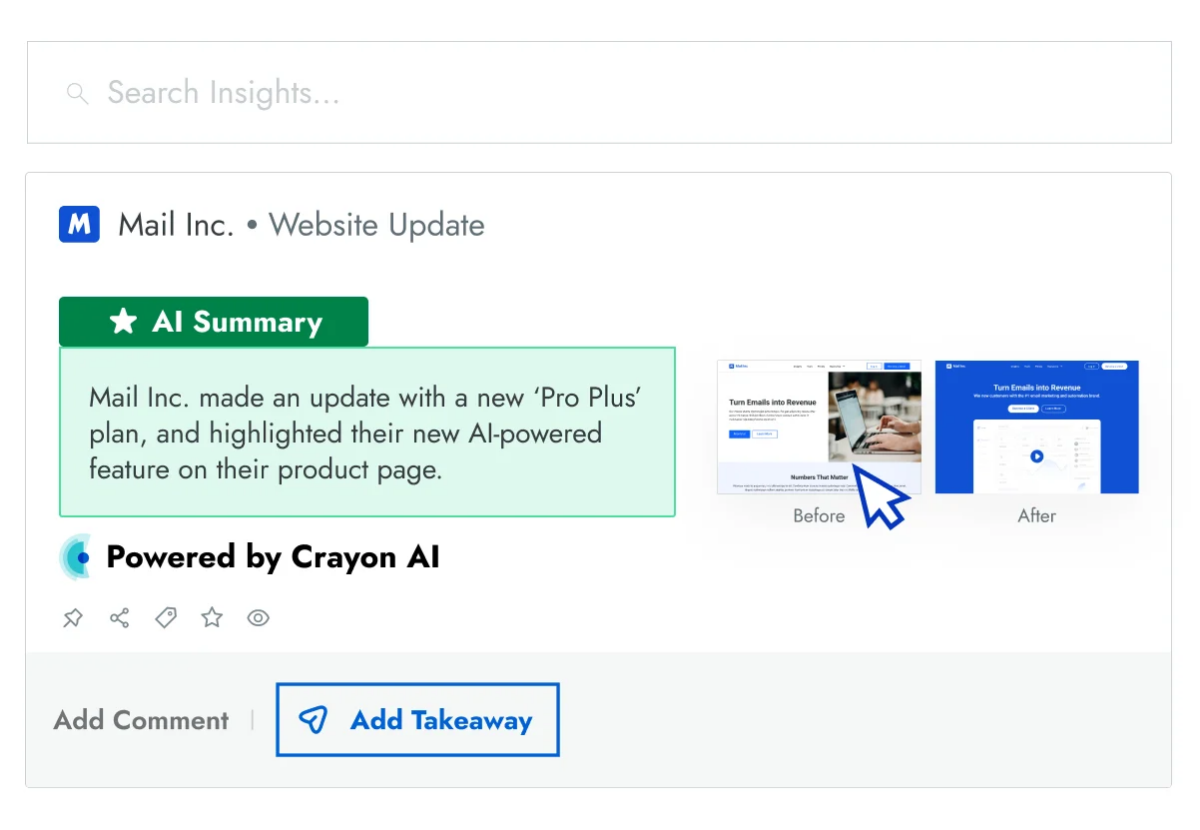
Crayon scores each competitor change for importance, so the curator starts with the biggest ones.
Crayon tracks before-and-after changes to competitor pages and also captures pricing, news and reviews. AI importance scoring sorts changes, and a daily email summarizes the previous day. Curators add takeaways to battlecards that appear inside open Salesforce opportunities and in Slack, Teams, Highspot and Seismic. It also reports who uses battlecards and how that relates to competitive deal results.
- you run a dedicated competitive program and want every change scored and reviewed before it reaches sellers
- you want to see who actually opens battlecards and how that relates to closed deals
- your CRM isn't on its integration list: the one complaint in G2 summaries is CRM compatibility
- you're a small team without a CI owner to review the feed
- Users like
- Centralized competitive intel and battlecards for sales
- Users dislike
- CRM integration and compatibility
- Source: G2, 385 reviews
How it works in practice
Crayon's 4.6 comes from about 385 G2 reviews, and CRM compatibility is the complaint in G2's summaries. Pricing is demo-gated. Choose it over Klue if seeing and ranking page changes matters more than a built-in win-loss program.
- Starting price
- Quote only (demo-gated)
- Collects
- Competitor pages, news, reviews, call recordings, Slack
- AI
- Importance scoring, news summaries, Sparks, Answers
- Delivery
- Salesforce, Slack, Teams, Highspot, Seismic, Showpad, MCP and APIs
Similarweb
Best for rival traffic trends
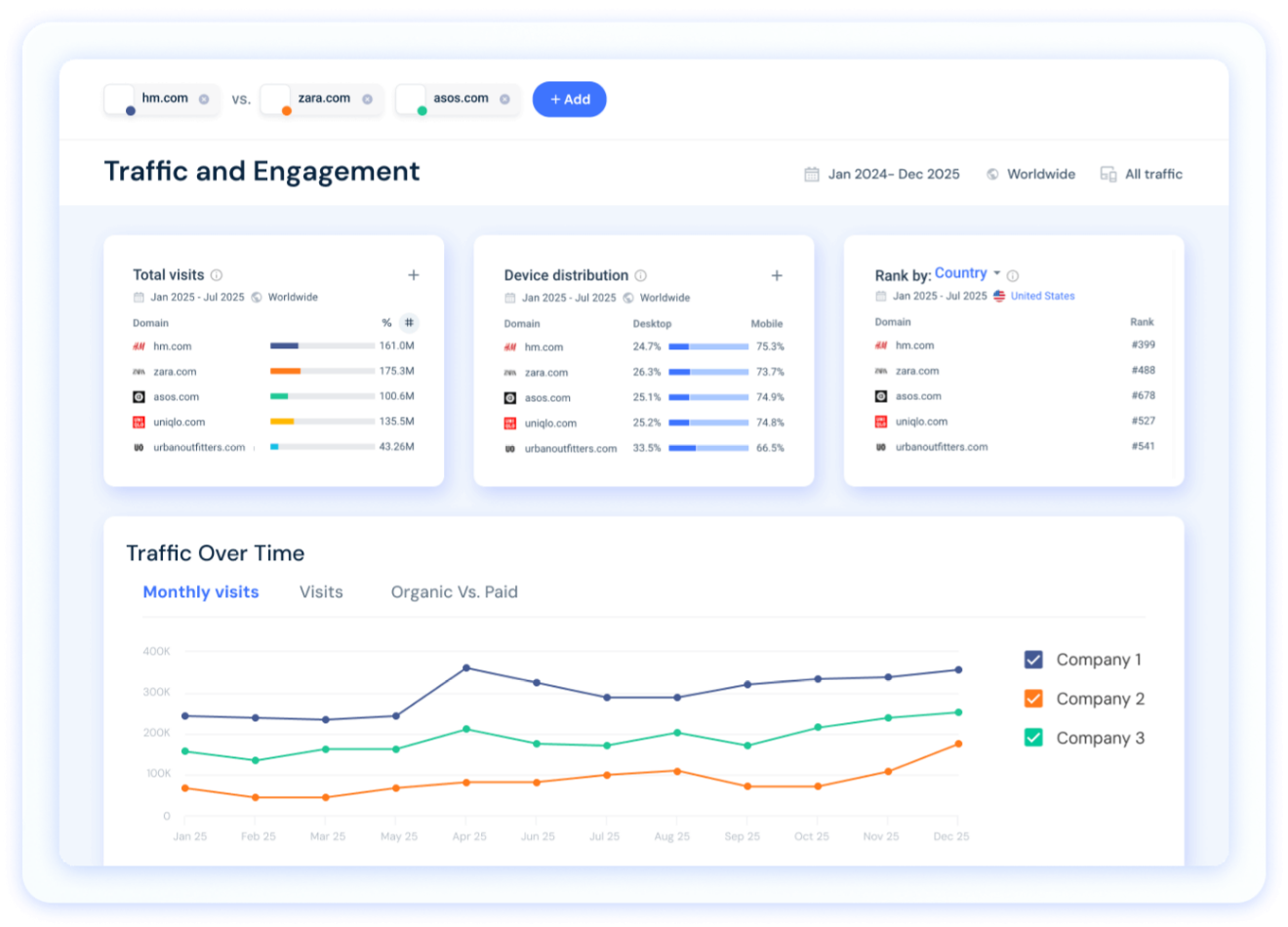
Similarweb shows how many people visit a competitor and where they come from, not what the competitor changed.
Self-service plans cover one user. Competitive Intelligence costs $125 per month billed annually or $199 monthly, with website performance, traffic and engagement, demographics and marketing channels. A $333 plan adds SEO intelligence and AI search tracking, and a $542 plan adds ad intelligence. Business and Enterprise plans are by quote.
- you need to know whether a competitor's traffic, channels or audience are shifting, before building a story around it
- you want a one-user entry plan at $125 per month billed annually, or $199 month to month
- you need to know what a competitor changed on their pricing or product pages: it measures traffic, not page content
- you need battlecards, win-loss or Slack delivery: we found none in the sources
- Users like
- Traffic and competitor analysis
- Users dislike
- Price, and data accuracy for smaller sites
- Source: G2, 1,175 reviews
How it works in practice
Similarweb's 4.4 comes from about 1,175 G2 reviews, and price and accuracy on smaller sites are common complaints. There is no battlecard builder or Slack delivery in the published vendor pages, so a product marketer turns the numbers into something sellers can use.
- Starting price
- From $125 per month billed annually ($199 monthly); business plans by quote
- Entry plan
- 1 user, 3 months of history
- Business
- Up to 37 months, 100+ countries, APIs
- CRM
- Salesforce and HubSpot via Integrations Hub
Klue or Crayon is the usual comparative question. Klue puts a human curator and a win-loss suite at the center, so it suits a team that wants interviews and battlecards in one product. Crayon starts from scored page changes and reports who uses battlecards, so it suits a team that wants a ranked feed of competitor moves and proof of use. Both sell by quote, and both show battlecards inside Salesforce. Similarweb answers a different question, whether a competitor's audience is growing, and does not replace either.
Announce and Equip: LaunchNotes, Pendo and Highspot
Once a feature ships, three audiences need to hear about it: customers, users inside the product and sellers. Each tool below takes one of those audiences. Whether customers then adopt the feature is measured with product analytics software.
LaunchNotes
Best for announcing what shipped
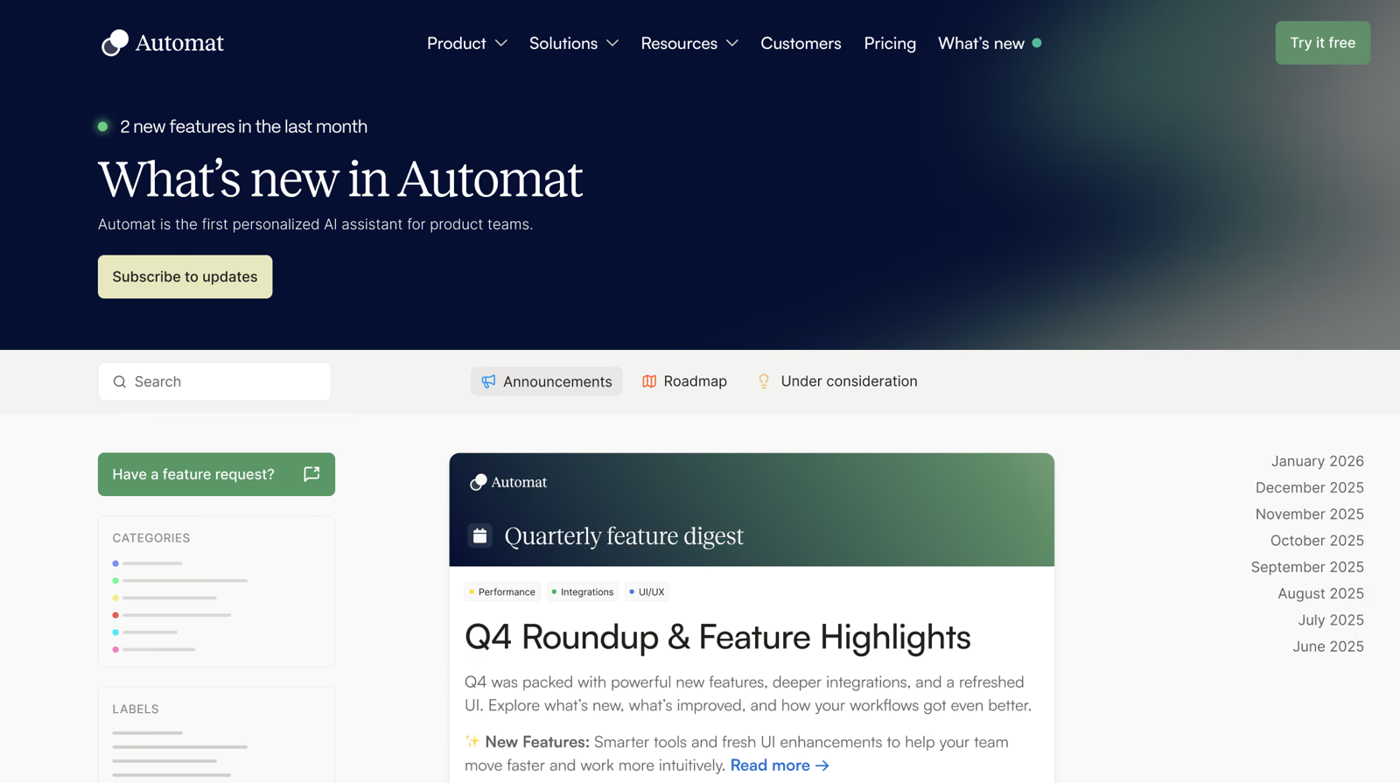
LaunchNotes turns shipped work into announcements, a public changelog and a roadmap published once to a page, email and Slack.
A product marketer starts a draft, adds a title, content and categories, or has the AI writer draft it from Jira tickets. A publishing card turns page, email and Slack on or off per announcement, and email and Slack need at least one category or cohort. You preview, send a test email to up to five addresses, then publish or schedule. It covers communication only: we found no launch checklists or task owners.
- Your main job is telling customers and internal teams what shipped across page, email and Slack
- You want a public changelog plus roadmap with ship notifications at a flat entry price
- Your engineering work lives in Jira and you want updates drafted from tickets
- You need Salesforce or HubSpot sync (not on its integrations page)
- You need launch checklists, task owners and cross-team launch tiers (not found)
- You need advanced segmentation, multiple pages or white-labeling without custom Premium pricing
- Users like
- Keeps customers and internal teams informed
- Users dislike
- Wants more integration options
- Source: G2, 33 reviews
How it works in practice
Growth costs $799 per month billed annually ($999 billed monthly) with one page, two users and 5,000 emails a month. There is no free plan and the 14-day trial follows a demo. G2 shows 4.9 from 33 reviews, and the main complaint is wanting more integrations. We found no Salesforce or HubSpot integration.
- Starting price
- Growth $799/month billed annually ($999 monthly); Premium custom; no free plan; 14-day trial after demo
- Channels
- Page, email, Slack
- Entry plan
- Growth: 1 page, 2 users, 5,000 emails a month
- Advanced segmentation
- Premium only
- Free plan
- None, 14-day trial after a demo
Pendo
Best for in-app announcements
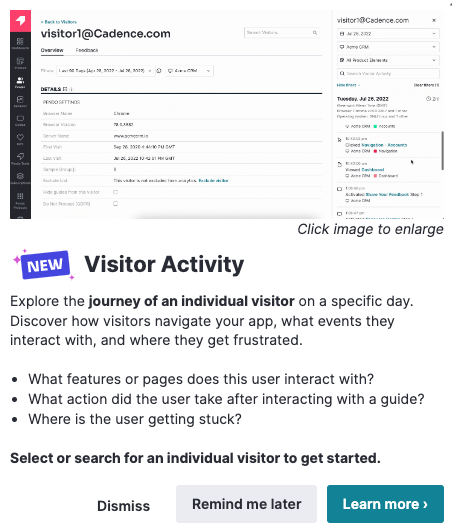
Pendo shows feature announcements inside the product and tracks adoption of the feature afterward.
Someone with Guide Creator rights builds a lightbox, tooltip or banner from blocks such as text, buttons, images and polls, picks a segment, stages it and hands it to a Publisher. Pendo's own guidance matches format to launch: a lightbox for a major announcement, a tooltip for a smaller release and a banner for something time-sensitive. Usage of the feature can be checked in the same product.
- You need targeted in-app announcements for feature launches
- You want to measure feature adoption in the same tool
- You want to try a free plan (500 MAU cap) before talking to sales
- You need a launch plan with owners, milestones and dependencies
- You need public list pricing, since paid plans are quote only
- You need A/B tests, guide logic or full Resource Center announcements, which require Guides Pro
- Users like
- Ease of use and analytics insights that help teams build in-app guides
- Users dislike
- Missing features and limitations; complex setup, especially multi-condition announcements
- Source: G2, 1,822 reviews
How it works in practice
The free plan covers up to 500 monthly active users. Base, Core and Ultimate are quote only. A/B experiments, guide logic and the full Resource Center announcements module need Guides Pro. G2 rates Pendo 4.4 from 1,822 reviews, praising ease of use and naming a complex setup as a downside. Pendo doesn't plan the launch project.
- Starting price
- Free up to 500 MAUs; Base, Core and Ultimate by quote only; 30-day trial via sales
- Free plan
- Up to 500 MAUs
- Paid plans
- Base, Core, Ultimate, quote only
- A/B tests and guide logic
- Guides Pro
- Trial
- 30 days via sales
Highspot by Seismic
Best for launch plays in the CRM
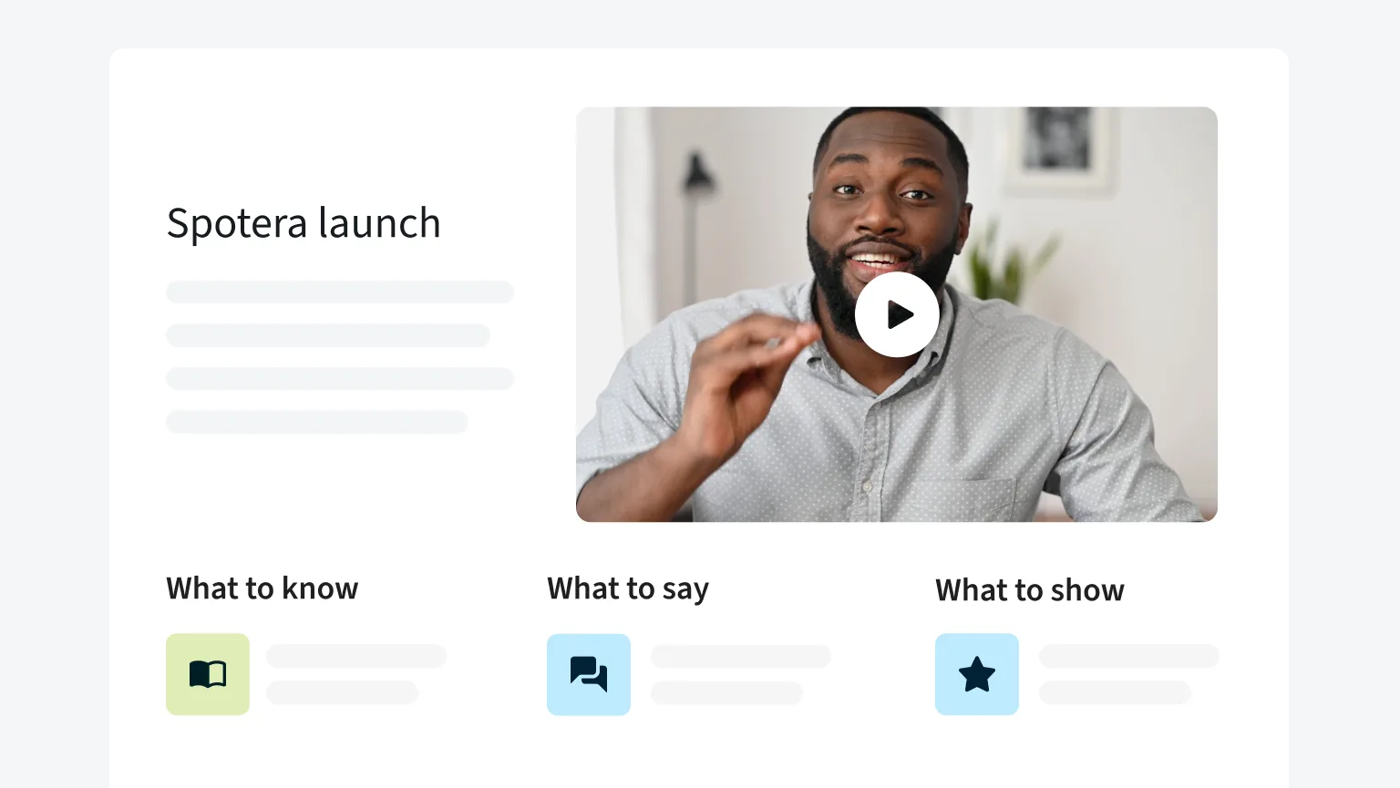
Highspot packages a launch as a Sales Play and shows it to sellers inside Salesforce or Microsoft Dynamics.
An enablement manager builds a play with three parts: what to know, what to say and what to show. Highspot surfaces it in the CRM so sellers don't search a library. Scorecards track use, and AI knowledge checks test whether sellers can explain the launch content. In a product marketing team the play is where positioning becomes something a seller can say.
- you want launches packaged as plays that show up on the right deals in Salesforce or Dynamics
- you want AI knowledge checks on launch content without buying the training tier
- you need courses, adaptive learning and automated nudging but plan to buy the entry package: those start at Better
- you want one vendor roadmap you can read before signing: Highspot and Seismic announced a merger in 2026 and the combined product plan is still taking shape
- Users like
- Ease of use
- Users dislike
- Learning curve and keeping content current
- Source: G2, 1,206 reviews
How it works in practice
Highspot is sold by quote in Good, Better and Best packages. Sales Plays are in the entry package, but courses, adaptive learning and nudging start at Better. The homepage now reads Highspot by Seismic. G2 rated it 4.7 from 1,206 reviews on October 17, 2026, with the learning curve and content upkeep as the work.
- Starting price
- Quote only (Good, Better, Best packages)
- Training and practice
- Better package and above
- Knowledge checks
- AI-generated checks on items in Good
How the Tools Fit One Launch
A launch passes through the same four stages whatever tools you own. The flow below shows where each tool in this guide takes over and what it hands to the next step. It is our own sequence, not a vendor template: none of the seven vendors publishes a launch workflow that spans the others.
- 1Learn
- Dovetail
Output Customer phrases and objections from calls, reviews and tickets - 2Position against rivals
- Klue
- Crayon
- Similarweb
Output Battlecards and a view of rival traffic - 3Announce
- LaunchNotes
- Pendo
Output A changelog entry, email, Slack post and in-app message - 4Equip sellers
- Highspot by Seismic
Output A play in the CRM with approved wording
Most teams do not need all four stages in software on day one. A common pattern is to start with the stage where the team loses the most time. If sellers keep hearing about competitors first, begin with Klue or Crayon. If customers learn about releases from support tickets, begin with LaunchNotes or Pendo.
Who Owns the Tools, and Do They Connect to Salesforce?
Product marketing rarely owns every tool alone, and sellers only benefit if the output reaches the CRM. The table shows who the vendor describes as the main operator and what the published vendor pages say about Salesforce. "Not stated" means the published vendor pages don't say; it doesn't prove the integration is missing.
| Tool | Who runs it, per the vendor pages | Salesforce connection |
|---|---|---|
| Dovetail | Marketing, product and research teams; marketers can query it without a research brief | Listed as an integration for marketing teams |
| Klue | A curator, usually product marketing | Battlecard panel on the deal |
| Crayon | A curator who adds takeaways | Battlecards inside open opportunities |
| Similarweb | One analyst per self-service seat | Not stated |
| LaunchNotes | Product marketing or product management | Not found on its integrations page |
| Pendo | A Guide Creator, with a Publisher approving | Not stated |
| Highspot | An enablement manager | Plays surface in Salesforce and Dynamics |
The pattern is simple. Tools that feed sellers (Klue, Crayon, Highspot) connect to the CRM, and tools that feed customers (LaunchNotes, Pendo) mostly do not. The customer-side in-app tools are compared in our guide to product adoption software. If you want a single owner for all seven, expect the product marketer to run research, competitor and announcement tools, and enablement to run Highspot.
How to Choose Product Marketing Software
Start from the stage that hurts, then check the plan that covers it.
- You want to try a tool before talking to salesDovetail (free, one project) or Pendo (free to 500 monthly active users)
- Sellers need competitor cards in SalesforceKlue or Crayon, both quote only
- You want to see whether a rival's traffic is growingSimilarweb, from $125 per month billed annually
- Customers should read what shipped in one placeLaunchNotes, from $799 per month billed annually
- Users should see the announcement inside the productPendo, with a free plan to test
- Launch content must open on the deal in the CRMHighspot, remembering courses start at Better
What Product Marketing Software Does Not Cover
Product marketing software produces evidence, announcements and content. None of the published vendor pages describe a way to confirm that the people who will talk about a change have read it and can explain it. A battlecard sits in Salesforce, a play sits in Highspot, and a seller can still quote last quarter's pricing on a call. When a launch also requires promotional video content, teams may work with providers offering ad creative services to produce the assets needed for campaigns.
The GTM Lead is a small tool for that one step. A product marketer writes a release brief with approved messaging and do-not-say lines, sends it to SDRs, AEs and CSMs, and sees who viewed it, who acknowledged it and who answered a quick readiness check. It is not a replacement for any tool above, and it does not run launches or hold a content library.
What is product marketing software?
Product marketing software is the set of tools a product marketing team uses to research customers, track competitors, announce launches and equip sellers. No single product covers every job, so teams combine tools such as Dovetail for research, Klue or Crayon for competitors, LaunchNotes or Pendo for announcements and Highspot for sales content.
Is marketing automation the same as product marketing software?
No. Marketing automation software sends and measures campaigns such as email and lead nurturing. Product marketing software feeds those campaigns with customer and competitor evidence and handles launch communication. Roundups for the two terms rank different tools.
Is there free product marketing software?
Two of the seven tools here have a free plan. Dovetail's Free plan is $0 with one channel and one project, and Pendo's free plan covers up to 500 monthly active users. The other five show quote-only prices or paid plans on the published vendor pages.
How much does product marketing software cost?
Published prices start at $125 per month billed annually for Similarweb's Competitive Intelligence plan and $799 per month billed annually for LaunchNotes Growth. Klue, Crayon and Highspot sell by quote, and Dovetail Enterprise and Pendo's paid plans are also quote only.
Which tool should a new product marketing team buy first?
Buy for the stage that costs the most time today. Sellers who hear about competitors from prospects first should look at Klue or Crayon, and customers who learn about releases from support tickets should look at LaunchNotes or Pendo. A free plan from Dovetail or Pendo is a low-risk first test.