A revenue enablement platform gives everyone who touches revenue, not only new-business sellers, the approved content, training, coaching and usage data they need, and ties that activity to results such as win rate and time to first deal. Most platforms sold under this label started as sales enablement tools, so the useful buying question isn't who has the longest feature list but which roles the vendor actually names, and which revenue numbers the platform can show.
This page answers that question for seven platforms. We read each vendor's own pages on October 31, 2026 and one review source per tool. The result is far less tidy than the marketing, though: all seven platforms sell by quote, six name marketing as a team they serve, and only two of the seven (Gong and Highspot) name customer success or account managers on the vendors' published pages. It's a companion to our guide to sales enablement software, which ranks the same category by how a product release reaches reps.
- platforms read on vendor sites
- 7
- sell by quote, with no USD list price
- 7 of 7
- name marketing as a team they serve
- 6 of 7
- name customer success or account managers
- 2 of 7
What Is a Revenue Enablement Platform?
A revenue enablement platform is software that equips every revenue-facing role with the content, training, coaching and analytics to do its job, and connects that work to revenue data. The Sales Enablement Collective describes revenue enablement as support for all revenue-focused teams at every stage of the customer journey, and Highspot's own guide names marketing, customer success and account management next to sellers.
In practice a platform has three layers, and a buyer should check each one.
- Content and plays sit in a governed library of approved decks, messaging and talk tracks that show up where people work.
- Learning and practice covers courses, tests, certifications and AI role play, so you can see who can say the new message.
- The revenue link is a set of reports that connect content use or training results to win rate, deal size or ramp time, usually by reading CRM data.
The third layer is what separates a revenue enablement platform from a content library with a new name, but it isn't automatic. It depends on the CRM connection and, at several vendors, on the package you buy.
Revenue Enablement vs Sales Enablement
Revenue enablement is the same discipline with a wider audience and a different scorecard. The Sales Enablement Collective splits the difference into three parts, and each one changes what you buy.
- Scope: Sales enablement serves sellers. Revenue enablement adds marketing, customer success, account management and partners, so the platform needs licenses and content for those roles.
- Org structure: Sales enablement usually reports into sales. Revenue enablement sits across teams, often next to revenue operations, so reporting needs to span departments.
- Metrics: Sales enablement tracks quota attainment and ramp. Revenue enablement also tracks renewal, expansion and partner-sourced revenue where the platform can see it. Running a channel program usually needs its own tooling, covered in our guide to partner relationship management software and, for the partner-facing login, partner portal software.
For a buyer, the practical test is a licensing question. Ask whether a CSM, a partner manager and a marketer get a seat, content and reports on the same terms as an AE, because they often don't. A pricing or packaging change reaches customers through all of them, not just through sellers.
What to Look For in a Revenue Enablement Platform
Six checks separate a platform that can carry revenue enablement from a sales tool with a broader name. We used them to read each vendor's pages.
- Role coverage: Check whether the vendor names marketing, customer success, account management and partners on its own site, and whether those roles get a seat and content on the same terms as sellers.
- CRM connection: Check which CRM the platform reads and writes, since the win-rate and ramp reports depend on it. All seven vendors name Salesforce, while HubSpot and Dynamics 365 are named by fewer.
- Revenue link: Check the exact report that connects content or training to win rate, deal size or ramp time, and ask which package includes it.
- Content governance: Check that approved messaging replaces old versions automatically, so a pricing change doesn't live on in last quarter's deck.
- Learning and practice: Check for tests, certifications and AI role play, and whether the pass score is yours to set.
- Price transparency: Check what the vendor publishes. All seven here sell by quote, so ask for package names and a written quote before the demo.
Our Picks by Revenue Job
Each pick is the platform with the clearest vendor-documented answer to one revenue job. A job is only listed when we read the page that supports it.
 Best for packaged enablement analyticsSeismicProgram Analytics, Engagement Analytics and self-service reporting are included in all three packages.
 Best for marketing, RevOps and partners on one platformHighspot by SeismicSeparate solution pages for marketing and revenue operations, plus a partner enablement product page.
 Best for linking course scores to win ratesShowpadCourses and Paths connect course completion and assessment scores to win rates.
 Best for a readiness score tied to CRM resultsMindtickleThe Readiness Index lines up skills with quota attainment, win rates and sales cycles.
 Best for channel and partner repsAllegoA channel sales enablement page, and a lower list price for channel and partner users.
 Best for customer success managers and ramp trackingGongInitiative Tracking links programs to win rates, deal size and ramp time, and the Enable page names CS managers.
 Best for answers inside Salesforce and GongSpekitIn-app guidance, with revenue attribution listed under the upper package.
Revenue Enablement Platforms Compared
The table lists the seven platforms by the job they start from. "Price" shows what the vendor publishes, which is nothing in USD for any of them, so the column names the packages instead.
| Tool | Starts from | How it ties to revenue data | Packages (USD price: quote only) | G2 rating |
|---|---|---|---|---|
| Seismic | Content and launch programs | Program, engagement and self-service analytics in every package | Essential, Advanced, Ultimate | 4.6 (1,802) |
| Highspot by Seismic | Content, plays and partner enablement | Scorecards for plays and content; marketing analytics page | Good, Better, Best | 4.7 (1,206) |
| Showpad | Content library and courses | Question-Based Analytics and course scores linked to win rates | Professional, Advanced, Expert | 4.6 (1,897) |
| Mindtickle | Readiness and training | Readiness Index aligned with CRM quota and win-rate data | Packages not stated | 4.7 (2,399) |
| Allego | Learning, content and conversation intelligence | Engagement, pipeline influence and win rates by asset | Four packages by capability | 4.6 (695) |
| Gong | Revenue intelligence with Gong Enable | Initiative Tracking links programs to win rate, deal size and ramp time | Enable Essentials, Enable | 4.7 (6,522) |
| Spekit | In-app enablement | AI Insights and Analytics; revenue attribution in the upper package | Just-in-Time Enablement, GTM Acceleration | 4.7 (282) |
Pricing and package names from each vendor's pricing or product-description page, read October 31, 2026. No vendor publishes a USD list price for these packages. Ratings are G2 listing figures from the same day.
Who Each Platform Serves Beyond Sellers
Revenue enablement is the vendors' phrase, so we checked whether their own pages back it up. The table shows which non-seller roles each vendor names on published pages. "Not stated" means the published vendor pages don't name the role. It doesn't prove the platform can't serve it.
| Platform | Marketing | Partners | Customer success |
|---|---|---|---|
| Seismic | Named, with a marketing solution page | Partner program section only | Not stated |
| Highspot | Named, with a marketing solution page | Named, with a partner enablement product page | Named in Highspot blog posts, no solution page |
| Showpad | Named, listed as a team | Channel selling listed as a team | Not stated |
| Mindtickle | Named, with a marketing solution page | Named, with a partner and channel page | Not stated |
| Allego | Named, with a marketing solution page | Named, with a channel page and lower list price | Not stated |
| Gong | Marketing leaders named as an audience for insights | Not stated | Enable page names CS managers; customer success page names account managers |
| Spekit | Named, with a solutions entry | Not stated | Not stated |
Two readings really matter. First, marketing is the easy case: six of seven vendors name it as a team they serve. Second, customer success is the gap. If CSMs and account managers carry renewal and expansion in your company, treat every "Not stated" as a demo question, and ask for a customer reference in that role.
Content-Led Platforms: Seismic, Highspot and Showpad
Seismic, Highspot and Showpad start from the governed content library and add training and analytics around it. If you're replacing Showpad, our guide to Showpad alternatives compares seven options. Seismic completed its merger with Highspot on August 18, 2026 (our guide to Seismic alternatives covers what that means for buyers), and Highspot's integrations page now reads "Highspot is part of Seismic" with a "Highspot by Seismic" footer. We list them separately because they remain two products with separate packages.
Seismic
Best for packaged enablement analytics
Seismic sells Enablement Cloud in three packages, and its program, engagement and self-service reporting is included in all of them.
Seismic's product-description page lists Program Analytics, Engagement Analytics and Self-Service Reporting in Essential, Advanced and Ultimate. Advanced Data Tools, which covers direct data access for BI and go-to-market reporting, starts at Advanced, and Programs and Meetings Intelligence is in Ultimate only. That makes Seismic one of the few vendors here where the package gate for the revenue link is written down.
The marketing page promises content insights that show what is used, what resonates and how content feeds pipeline. We found no page that names customer success or account managers, and no deal-influence feature on the revenue page, so those are demo questions. Integrations named on Seismic's page include Salesforce, Microsoft Dynamics 365, Gong, Slack and Outreach. HubSpot and Gainsight aren't named.
- marketing and enablement want one set of content analytics that's included at every package
- you run Salesforce or Dynamics and want content recommendations inside the CRM
- you want a published price or a light setup: pricing is quote only and G2 reviewers cite a steep learning curve
- customer success or account managers are the main audience: the published vendor pages don't name them
- Users like
- Document management and ease of use
- Users dislike
- Navigation and admin setup
- Source: G2, 1,802 reviews
- Starting price
- Quote only (Essential, Advanced, Ultimate)
- Packages
- Essential, Advanced, Ultimate (quote only)
- Revenue link
- Program Analytics and Engagement Analytics in all packages
- Named roles
- Marketing, revenue leaders, enablement, IT
- Integrations
- Salesforce, Dynamics 365, Gong, Slack, Outreach
Highspot by Seismic
Best for marketing, RevOps and partners on one platform
Highspot has solution pages for marketing and revenue operations and a separate product page for partner enablement.
The partner enablement page describes access by partner group, certification paths and engagement tracking, and a line about a unified view of partner impact. It names no feature and no package for that view. The marketing page ties campaign activity to pipeline, and the pipeline uplift figure it quotes is a vendor claim we didn't verify.
Customer success and account managers appear in Highspot's blog posts on revenue enablement and customer enablement, not on a solution page. For the revenue link inside the CRM, Highspot's pricing page lists scorecards for plays, content and initiatives. Integrations named are Salesforce, Dynamics 365, Slack and Salesloft. Highspot offers Good, Better and Best packages by quote.
- marketing, revenue operations and partner managers each need their own entry point
- you want play and content scorecards inside Salesforce or Dynamics 365
- you want a customer success workspace: Highspot has no solution page for it
- you want a published price: all three packages are quote only
- Users like
- Ease of use
- Users dislike
- Learning curve and keeping content current
- Source: G2, 1,206 reviews
- Starting price
- Quote only (Good, Better, Best packages)
- Packages
- Good, Better, Best (quote only)
- Revenue link
- Scorecards for plays, content and initiatives
- Named roles
- Marketing, revenue operations, partners; CS and AMs in blog posts
- Integrations
- Salesforce, Dynamics 365, Slack, Salesloft
Showpad
Best for linking course scores to win rates
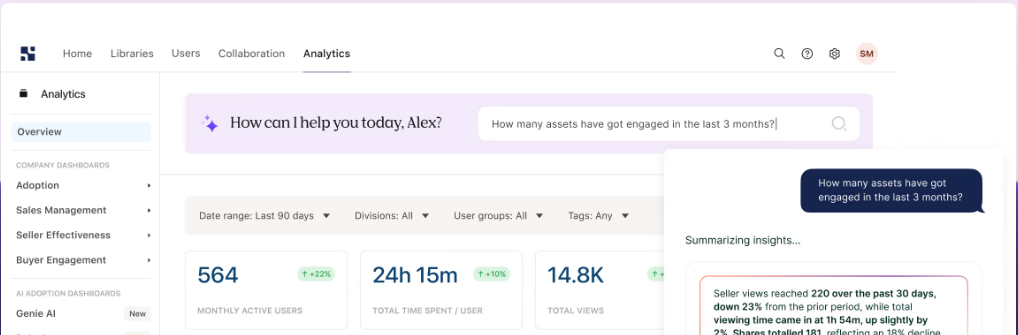
Showpad's Courses and Paths page promises to connect course completion and assessment scores directly to win rates, and its analytics page ties content to closed-won revenue through the CRM.
The vendor describes Question-Based Analytics as a way to relate readiness, content and coaching to win rates, deal size and cycle length. No published vendor page says which package includes it. Showpad lists marketing and channel selling as teams, and customer success and account managers aren't named.
Integrations named on its page are Salesloft, Outreach, Marketo, Microsoft Copilot, Salesforce Agentforce and Glean. HubSpot, Dynamics, Slack and Gong aren't named, so check your stack. Showpad sells Professional, Advanced and Expert packages by quote. Several Showpad pages, including its customer success and channel pages, are not available, so absence on this list is weaker evidence than for the other tools.
- you want a test score and a win rate on the same report
- marketing and channel teams share content with buyers and need to see what is used
- you need customer success use cases or named HubSpot and Gong integrations: neither is on the published vendor pages
- reporting depth matters most: G2 reviewers point to weak reporting and admin tools
- Users like
- Content search and sharing
- Users dislike
- Admin back end and reporting
- Source: G2, 1,897 reviews
- Starting price
- Quote only (Professional, Advanced, Expert)
- Packages
- Professional, Advanced, Expert (quote only)
- Revenue link
- Question-Based Analytics, course scores linked to win rates
- Named roles
- Marketing, channel selling
- Integrations
- Salesloft, Outreach, Marketo, Copilot, Agentforce, Glean
Readiness-Led Platforms: Mindtickle and Allego
Mindtickle and Allego start from training, practice and certification. They suit teams that need to prove people can deliver a message, then connect that proof to revenue.
Mindtickle
Best for a readiness score tied to CRM results
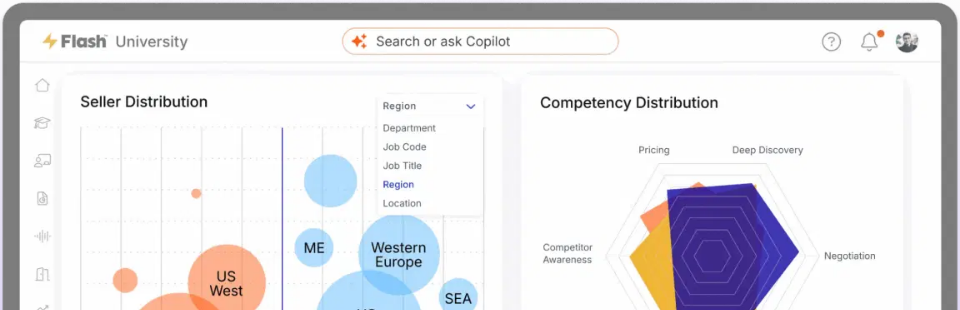
Mindtickle's Readiness Index lines up skills with CRM data on quota attainment, win rates, sales cycles and pipeline performance.
That's the clearest statement of the revenue link in this group, but the page doesn't say which plan includes it. Mindtickle adds a coaching view that analyzes the effect of coaching on deal progression, and content analytics that flag the assets that move deals.
Beyond sellers, Mindtickle has a marketing page, built around Digital Sales Rooms templates per persona, and a partner and channel page that tracks partner certifications and content use in the Readiness Index. Customer success and account managers aren't described as target roles. Salesforce is the integration named most clearly, with Slack, Gmail, Teams and Zoom. The published integrations page showed 20 of 65 connectors, so check HubSpot, Dynamics and Gainsight directly. Pricing depends on company size and requires a demo.
- partners and channel reps need certification on the same platform as your sellers
- you want one readiness score compared with quota and win rate
- you need a published price or a self-serve trial: pricing is by demo only
- customer success and account managers are the main audience: the vendor site doesn't describe them
- Users like
- Training content and coaching
- Users dislike
- Slow loading in the asset hub
- Source: G2, 2,399 reviews
- Starting price
- Quote only (no public price list)
- Packages
- Not stated (quote only)
- Revenue link
- Readiness Index, coaching impact, content analytics
- Named roles
- Marketing, partners and channel, revenue operations
- Integrations
- Salesforce, Slack, Gmail, Teams, Zoom
Allego
Best for channel and partner reps
Allego's pricing page says channel and partner users get a lower list price and that non-revenue roles are priced substantially lower.
Allego sells four packages by capability: Modern Learning with Conversation Intelligence, AI Role Play, Content Management, and Digital Rooms with Deal Navigator. Pricing is per user per month, billed annually upfront, and the page names a three-year term as typical.
The revenue link is on the content page, which says you can track engagement, pipeline influence and win rates by asset. Its channel page says it shows which content drives channel revenue, and the marketing page shows which launch assets reps use. Customer success and account managers aren't named as users. Allego lists more than 120 integrations, among them Salesforce, HubSpot, Microsoft Dynamics 365, Slack, Clari, Outreach and Salesloft. Gainsight and Gong aren't listed.
- channel and partner reps are a large share of seats and price matters
- you want learning, content and conversation intelligence sold as separate packages
- you want a short commitment: billing is annual upfront and a three-year term is typical
- customer success is the main audience: the vendor site doesn't name it
- Users like
- Ease of use and interactive courses
- Users dislike
- Interface and layout limits
- Source: G2, 695 reviews
- Starting price
- Quote only (per user per month, billed annually)
- Packages
- Four, by capability (quote only)
- Revenue link
- Engagement, pipeline influence and win rates by asset
- Named roles
- Marketing, channel and partner reps
- Integrations
- Salesforce, HubSpot, Dynamics 365, Slack, Clari, Outreach, Salesloft
Platforms Built Around Calls and In-App Answers: Gong and Spekit
Gong and Spekit reach the revenue team from the side: Gong from recorded customer conversations, Spekit from guidance inside the tools people already use.
Gong
Best for customer success managers and ramp tracking
Gong sells its enablement features as Gong Enable, and the Enable page says Initiative Tracking links changes in behavior to business results such as win rates, with deal size and ramp time also named.
Gong is the exception in the customer success column, although it gets there through calls rather than content. The Enable page names sales and CS managers, and Gong's customer success page speaks to account managers about risk, renewal and expansion. Partners aren't named.
What Enable includes depends on the plan: Gong's help center lists coaching features as available on Enable Essentials and Enable. AI Trainer builds practice sessions from real calls, scores them with the same scorecards used on live calls, and runs five to thirty minutes. We found no content management or in-call content cards on the Enable page, and Gong's own directory points to Highspot for content engagement. Gong prices licenses per user plus a platform fee by quote, and the Enable page states there is no free trial.
- customer success managers and account managers sit on recorded calls and need coaching on them
- you want training tied to ramp time and win rate from the same system that records calls
- you need a content library or in-call content cards: the Enable page lists none
- you want a published price or a trial: pricing is custom and the page states no free trial
- Users like
- Ease of use and support
- Users dislike
- Less tailored to small businesses
- Source: G2, 6,522 reviews

- Starting price
- Quote only (per-user license plus a platform fee); coaching access depends on the Enable Essentials or Enable plan
- Coaching inbox
- Shows last feedback per rep and open coaching requests
- Practice
- AI Trainer, Dry Run and Lessons (Gong Enable)
- Packages
- Enable Essentials, Enable (quote only)
- Revenue link
- Initiative Tracking
- Named roles
- Sales and CS managers, account managers, revenue and RevOps leaders
- Integrations
- Salesforce, HubSpot, Gainsight, Highspot (Gong Collective directory)
Spekit
Best for answers inside Salesforce and Gong
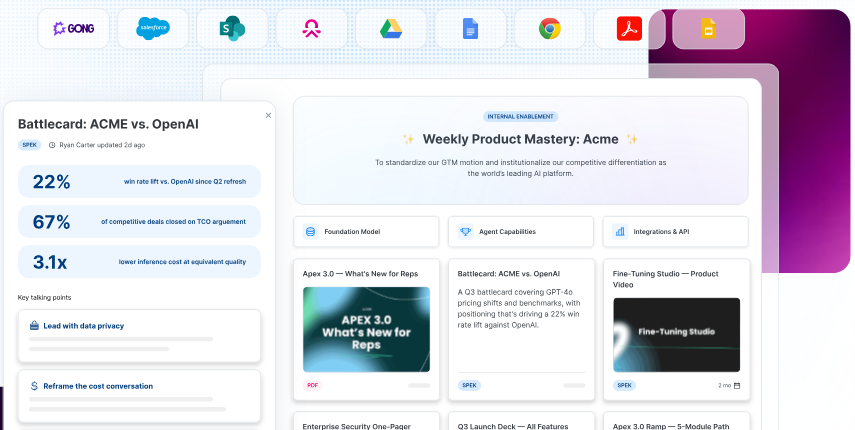
Spekit puts short guidance, learning paths and knowledge checks inside the tools people already use, and lists revenue attribution under its upper package.
Spekit's pricing page has two packages, Just-in-Time Enablement and GTM Acceleration. Our guide to Spekit alternatives covers what each contains. Revenue attribution, content ROI and AI Deal Rooms sit under GTM Acceleration, but the tier checkmarks are not readable in the page text, so confirm the gate with sales. The knowledge engine page lists AI Insights and Analytics, which it says connects content engagement and learning to revenue.
Spekit names marketing and revenue operations as solution roles. It doesn't name customer success, account managers or partners, and we found no customer success case study. Integrations named are Salesforce, Gong, Slack, Outlook, Gmail and LinkedIn through a Chrome extension; a separate page adds HubSpot and Salesloft for in-app guidance.
- your reps and CSMs live in Salesforce and you want guidance next to the record
- you want a lighter rollout than a full learning suite
- you need partners or customer success on the vendor's named list: neither is named
- you need revenue attribution at the lower package: it's listed under GTM Acceleration
- Users like
- Ease of use and answers inside other tools
- Users dislike
- Search and the browser extension pop-ups
- Source: G2, 282 reviews
- Starting price
- Quote only (custom packages)
- Packages
- Just-in-Time Enablement, GTM Acceleration (quote only)
- Revenue link
- AI Insights and Analytics; attribution in the upper package
- Named roles
- Marketing, RevOps, product marketing
- Integrations
- Salesforce, Gong, Slack, Outlook, Gmail, HubSpot, Salesloft
How to Measure Revenue Enablement
Measure revenue enablement by the outcomes it should move, and take each number from the system that holds it. The platform is rarely the source of record. Most of these tools read the CRM and report back. If you also want to see how much selling time goes into training and admin, time tracking tools can supply that number, while CRM close dates stay the source for time to first deal.
| Measure | What it tells you | Where the data lives |
|---|---|---|
| Time to first deal | Whether onboarding gets a new seller or CSM to a first result faster | CRM close dates plus course completion in the platform |
| Win rate by content or training | Whether people who used an asset or passed a test win more often | CRM opportunities linked to platform engagement |
| Content use | Which assets are shared and which are ignored | Platform engagement analytics |
| Renewal and expansion | Whether customer-facing teams hold and grow accounts | CRM or customer success tool, not usually the enablement platform |
Two cautions apply. A correlation between a course score and win rate isn't proof of cause, since stronger reps may simply take more courses, and that's easy to miss in a vendor dashboard. And the last row is the weakest across this list: most vendors here document a link to win rate and pipeline, not to renewal. Ask each vendor to show a renewal or expansion report before you count on one.
How to Choose a Revenue Enablement Platform
Start from the roles you need covered and the CRM data you can connect, rather than from the feature list. You'll shortlist faster that way.
- Customer success managers and account managers must be coveredGong or Highspot, the two vendors that name them; ask the others for a reference in that role
- Partners or channel reps carry a large share of revenueAllego, Highspot or Mindtickle, each with a partner or channel page
- Marketing must show which content moves dealsSeismic, Highspot, Allego or Mindtickle, each with a marketing page and content analytics
- You want training scores on the same report as win rateShowpad, Mindtickle or Gong
- Your teams work mostly inside SalesforceSpekit or Highspot for guidance and plays next to the record
- You need a public price to take to financeNone of the seven publishes one; ask each for a written quote by package
Rolling Out a Platform Across Revenue Teams
A revenue enablement rollout fails when only the sales team is onboarded. Stage it by role, and give each step an owner.
- Enablement leadList every role that will get a seat and the one number each is measured on Week 1
- RevOpsConnect the CRM and confirm which fields feed win rate and ramp reports Week 1 to 2
- Marketing leadMove approved decks and messaging into the library and retire old versions Week 2
- CS and partner leadsRun a pilot with one team each and check the reports show their work Week 2 to 3
- Enablement leadReview adoption by role and decide which roles to add next Week 4
What These Platforms Don't Confirm After a Release
Every platform above stores content, teaches it and reports on use, but none of the published vendor pages describe a per-release readiness view, meaning which people have read the approved messaging for one specific change and can explain it to a customer. That gap shows up on release day, when a pricing change reaches customers through sellers, CSMs and partners at once.
The GTM Lead is a small tool for that one job. A product marketer writes a release brief with approved messaging and do-not-say lines, sends it to SDRs, AEs and CSMs, and sees who viewed it, who acknowledged it and who answered the quick readiness check. It isn't a platform from this list and it doesn't replace any of them, yet it covers the one question they leave open.
What is a revenue enablement platform?
A revenue enablement platform is software that gives sellers, marketing, customer success, account managers and partners the content, training, coaching and analytics they need, and connects that work to revenue data such as win rate.
How is revenue enablement different from sales enablement?
Sales enablement serves sellers. Revenue enablement covers every revenue-facing role across the customer journey, usually reports across departments and adds renewal, expansion and partner revenue to the metrics.
How do you measure revenue enablement?
You measure revenue enablement by tracking time to first deal, win rate by content or training, content use, and renewal or expansion. Take each from the system that holds it, usually the CRM, and treat course scores and win rates as correlation, not proof.
Do revenue enablement platforms publish their prices?
None of the seven we read publishes a USD list price. All sell by quote, and Allego's pricing page adds that channel and partner users get a lower list price.
Which platform covers customer success?
Of the seven, Gong and Highspot are the only vendors that name customer success or account managers on published pages. Highspot does so in blog posts, not on a solution page.
Are Seismic and Highspot the same company?
Seismic and Highspot are one company now. Seismic completed its merger with Highspot on August 18, 2026. Highspot's integrations page now says it's part of Seismic, and the two products are still sold separately.